

Bengaluru
When you move into a flat in Bengaluru, there’s a common misconception: buying your unit means you and your society now own the land. But in reality, the builder often retains legal ownership, even decades after construction. That’s where deemed conveyance (or conveyance in general) becomes crucial to secure your society’s rights over land and common areas.
What Is Deemed Conveyance?
Deemed conveyance is a legal process through which ownership of the common areas and land of a housing society is transferred from the developer to the society or its members, even if a formal conveyance deed hasn’t been executed. Essentially, it’s a way to “deem” or recognize the society as the rightful owner of the shared property and land, ensuring residents have full control and legal rights. This is crucial because without this transfer, the developer technically retains ownership, which can create problems for society down the line, including redevelopment hurdles and limited control over common spaces.
Legal landscape in Karnataka
Unlike Maharashtra’s MOFA, Karnataka’s laws, like the Karnataka Apartment Ownership Act (KAOA) 1972 and RERA, don’t explicitly provide a ready-made “deemed conveyance” path. Under RERA Section 17, developers must transfer undivided interests in common areas to allottees or the RWA, but actual legal ownership transfer often gets delayed.
Surveys and reports show that builders often ignore or refuse conveyance, leaving ownership of land unclear and exposing societies to risks at redevelopment, obtaining municipal permits, or accessing credit.
Why is deemed conveyance critical?
Without it, your society:
- Can’t redevelop legally, as authorities demand ownership proof.
- Loses control of shared spaces like terraces, parking, and gardens.
- Risks are builders mortgaging the land or making third-party deals years later.
- May face legal trouble in upgrades, safety audits, or accessing FSI/TDR.
What can Bengaluru societies do?
- Form a co‑operative society
Registered under the Karnataka Co‑operative Societies Act, 1959. This legal entity is needed before pursuing conveyance. - Request a regular conveyance
Ask your builder to issue a legal conveyance deed. If they cooperate, the deed gets registered with the Sub-Registrar. - Explore deemed conveyance routes
Since there’s no automatic process, societies must:
- File a petition with Karnataka RERA, supporting the transfer of common area rights
- Or approach the Registrar of Co-operative Societies or file a civil suit demanding conveyance by interpreting existing laws
- Amass documentation
- Society registration, share certificates, sale/flat agreements
- Approved site plans, RERA/completion certificates
- Correspondence with the developer requesting conveyance
- Architect reports, property tax receipts, and title search documents
Your deemed conveyance checklist
- Register the Co‑operative Society (minimum 20 members)
- Collect foundational documents like sale agreements, share certificates, and layout plans
- Formally request the builder for conveyance
- If ignored, file a petition via RERA, Registrar, or civil court
- Present detailed evidence: builder correspondence, approvals, title reports
- Once approved, register the conveyance deed and update land records
- Ensure Khata/e-Khata reflects your society as the legal owner
Practical tips & legal updates
- Bengaluru residents, including groups like BAF, have petitioned the Karnataka government to establish formal deemed conveyance provisions under KAOA, but so far, no official policy change has occurred.
- Since May 2025, Bengaluru’s governance has shifted from BBMP to the Greater Bengaluru Authority (GBA). New civic rules may streamline property records and clarifications around conveyance.
- Keep an eye on RWA workshops or newsletters, many advocate for collective legal action and simplified conveyance guidance.
In Bengaluru, deemed conveyance isn’t a checkbox, it’s a vital process that protects your society’s legal standing and physical space. Without it:
- Societies remain vulnerable to builder control
- Redevelopment and civic compliance stall
- Shared assets stay at risk
Form your society, gather documents, push for conveyance either via builder or legal route, and ensure your property name reflects ownership under Khata and land records. This is how you claim your rights and your future.
Renting out your home is a common way to earn a steady second income. But if you’re a flat owner in a cooperative housing society, there’s one charge you shouldn’t overlook non-occupancy charges.
This is a fee that applies when your flat is not occupied by you or your immediate family, and instead is rented out to tenants. While it’s not a very large charge, it’s important to understand when it’s applicable, how it’s calculated, and what to do if you’re being overcharged.
What are non-occupancy charges?
Non-occupancy charges are levied by housing societies when a flat owner rents out their property to a person who is not a close family member. This fee is collected in addition to your usual monthly maintenance charges.
The purpose of this charge is to ensure that members who are earning rental income from their property also contribute a little extra to the upkeep of common services used by the tenant, such as security, lifts, water, and other shared facilities.
When are non-occupancy charges applicable?
These charges are applicable only if your flat is rented out to someone who is not your immediate family.
You will not be charged non-occupancy fees if:
- You, the owner, are living in the flat.
- The flat is occupied by close family members, such as your parents, spouse, children, siblings, in-laws, or grandchildren.
- The flat is locked, vacant, or unoccupied.
The charge becomes applicable when the flat is used to earn a commercial benefit (i.e., rent) by giving it to non-family members.
In such cases, the society usually requires you to:
- Complete police verification of the tenant (mandatory in many cities).
- Inform them in writing about the tenancy.
- Submit a copy of the lease or leave-and-license agreement.
- Fill out any society-required tenant forms.
How is the non-occupancy charge calculated?
Earlier, societies used to charge a flat amount as a one-time non-occupancy fee. This led to disputes and overcharging in many cases. To address this, the Maharashtra government issued a circular under Section 79A of the Maharashtra Cooperative Societies Act, which clearly states that:
Non-occupancy charges cannot exceed 10% of the service charges paid by the member.
This rule has since been upheld by the Supreme Court and is now followed by most cooperative housing societies, especially in Maharashtra and major metro cities.
Let’s break this down with an example:
- Suppose your total maintenance bill is ₹3,000 per month.
- Out of this, ₹2,000 is considered “service charges” (expenses such as security staff, society staff salaries, electricity for common areas, housekeeping, etc.).
- You will be charged 10% of ₹2,000 = ₹200 as non-occupancy fees.
Important: Service charges do not include sinking fund, repair fund, property tax, or water charges.
What if you are overcharged?
This is unfortunately not uncommon. In many housing societies, members have raised complaints that the management committee has either:
- Charged non-occupancy fees even when the flat is used by a relative
- Charged more than 10% of service charges
- Not provided clarity on the breakup of the charges
In such cases, here’s what you can do:
- Write to the managing committee and request an explanation with supporting calculations.
- If you don’t receive a proper response, escalate the issue to the Registrar of Cooperative Societies in your area.
- You can also approach a Consumer Forum for redressal if the charges are unfair or violate the law.
It’s illegal for societies to charge more than what is permitted under the rules. And it is equally illegal to collect non-occupancy charges when the flat is used by a family member.
Is GST applicable on non-occupancy charges?
Yes. As per recent GST clarifications, if the total maintenance charges (including non-occupancy) exceed ₹7,500 per month per member, then 18% GST is applicable.
However, this GST is not paid by the owner to the government directly. The society is responsible for calculating and collecting the GST and remitting it to the government. Make sure your maintenance bill reflects this clearly, especially if you cross the ₹7,500 threshold.
Do tenants have to pay the charge?
By default, non-occupancy charges are the responsibility of the flat owner, not the tenant.
However, if you want your tenant to cover this cost, you can mention it clearly in the rental agreement. That way, you can legally recover it from them along with rent and other maintenance charges. But societies will only deal with the owner for collecting this charge.
Is this rule the same across India?
The 10% rule originates from the Maharashtra government circular and is strictly enforced in cities like Mumbai, Pune, and Nagpur.
In other states like Karnataka, Telangana, Delhi, and Tamil Nadu, most societies either follow similar rules by internal agreement or choose not to charge non-occupancy fees at all. But unless there is a clear by-law stating otherwise, housing societies cannot arbitrarily fix this charge.
In Bangalore, for example, many RWAs do not charge non-occupancy fees unless it has been included in the society’s registered bye-laws.
Why should committee members understand this?
If you’re part of your RWA’s managing committee, you’re expected to:
- Inform members about non-occupancy charges when they rent out their flat
- Collect it as part of the maintenance bill
- Explain how the amount is calculated
- Ensure the society stays within the legal limits
Many disputes between owners and societies arise due to lack of communication or incorrect billing. Being transparent and following the law helps keep things smooth for everyone.
What if the owner refuses to pay?
If a flat owner does not pay the non-occupancy fee when it is due, the society can:
- Issue a payment reminder notice
- Declare the member as a defaulter for society billing purposes
- Withhold the No Dues Certificate required for property sales or rentals
However, societies must still act within the legal limit and cannot use coercive tactics or harassment.
Non-occupancy charges are legal and necessary but they must be applied fairly, transparently, and within the limits defined by law.
If you’re a homeowner renting out your flat:
- Check your society’s by-laws
- Inform the committee and submit documents
- Verify your monthly bill for correctness
- Know your rights if you’re being charged unfairly
If you’re on the committee:
- Know the rules
- Educate members
- Stay accountable
Understanding non-occupancy charges helps everyone avoid unnecessary conflict and ensures smoother community living.
Fire safety isn’t just some rule to follow, it’s what can save lives when things go wrong. Especially here in Bengaluru, where everything’s so close and packed, a fire can start anywhere and spread fast.
Remember the fire in Whitefield back in 2018? A short circuit in a car parked in the basement led to a tragedy where a mother and her little kid lost their lives. The fire brigade came quickly, but sometimes even that isn’t enough.
That’s why Karnataka insists every society has proper fire extinguishers, smoke alarms, sprinklers, and that everyone keeps checking and practicing fire safety.
➡️ Check out the official Karnataka State Fire & Emergency Services fire safety guidelines, and make sure your building is correctly equipped.
Managing modern residential societies is no longer a job for volunteers alone, it’s complex, demanding, and requires professionals. Society managers are paid experts who handle the daily operations of housing societies, from paperwork and maintenance to finances, resident issues, and legal compliance.
Without a society manager, gated communities often face chaos like delayed maintenance, financial confusion, and overworked committee members. A good manager brings structure, ensures legal compliance, supervises staff, manages vendors, and keeps residents informed.
Introduction
We’ve been working in housing society management for years now, and let me tell you – things have changed a lot. Back in the day, a few volunteers could handle most society work. Not anymore. These residential complexes have gotten huge and complicated. Residents want everything done perfectly and fast. That’s why almost every decent-sized society needs a proper manager these days.
Who is a society manager?
Think of them as the person who runs your building day-to-day.
They’re not volunteers like your RWA committee folks – they’re paid professionals who’ve learned how to handle all this stuff.
Some societies hire their own dedicated manager. Others use companies that send managers to handle multiple buildings.
Why a society manager is crucial
Here’s what happens without proper management – we’ve seen it plenty of times. Complaints pile up. Maintenance takes forever. Vendors show up whenever they feel like it. Nobody knows what’s going on with the money. Your volunteer committee members get burned out trying to handle everything.
A good manager fixes all this. They know the housing laws, deal with municipal authorities, and let your committee focus on making decisions instead of chasing contractors around.
Key responsibilities of a society manager
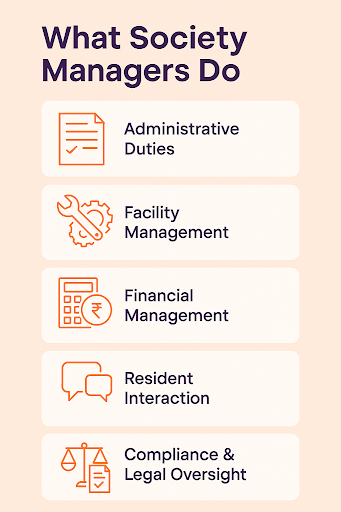
1. Daily operations & administration
Every meeting needs minutes. Every vendor needs a contract. Officials want notices. Someone has to track all this stuff and file it properly. During audits or legal issues, you’ll thank God someone kept proper records.
2. Facility maintenance
Cleaning staff need supervision. Gardens need maintenance. Something’s always breaking and needs fixing. Annual maintenance contracts need monitoring. When your elevator stops working or the generator fails, residents call the manager – not you.
3. Financial management
Budgets need planning. Maintenance fees need collecting. People who don’t pay need reminding (politely but firmly). Vendors need paying on time. Accountants need help during tax season. Without proper financial management, societies go broke fast.
4. Resident interaction
Residents complain about everything – noise, parking, maintenance, neighbors. New people move in and need orientation. Others move out and want deposits returned. Everyone wants updates on what’s happening. Managing all these personalities and expectations is honestly the hardest part.
5. Compliance & legal oversight
Fire safety inspections can’t be ignored. Structural audits are mandatory. Sewage treatment needs checking. Society registration must stay current. Labor laws apply to your staff. One missed compliance and you’re in serious trouble.
Tools and software society managers use

Most managers use apps now for communicating with residents. Visitor management systems track who comes and goes. Service requests get logged digitally instead of random phone calls.
Accounting software keeps financial records straight and generates reports automatically. Digital notice boards replace those paper notices that always fell down. Complaint tracking systems ensure nothing gets forgotten.
Put it all together and you get proper management systems instead of chaos.
Common challenges faced
- Residents expect different things. Some want immediate fixes, others complain about costs. During monsoons or festivals, everyone gets extra demanding.
- Collecting overdue payments without creating enemies requires serious diplomatic skills.
- Committee members often interfere or have unrealistic expectations.
- Vendors sometimes don’t show up or do shoddy work.
- Emergency situations – floods, power failures, medical emergencies happen at the worst possible times and need immediate handling.
Skills required to be an effective society manager
- Communication skills matter more than anything else. You’re constantly talking to residents, vendors, committee members, and officials. Poor communicators fail quickly in this job.
- Problem-solving under pressure separates good managers from mediocre ones. When three things break simultaneously during a festival weekend, panic doesn’t help – creative solutions do.
- Technology skills are becoming essential. You can’t avoid computers, smartphones, and management software anymore. Basic knowledge of housing laws and regulations prevents expensive mistakes.
Qualifications and hiring tips for RWAs
Most societies want college graduates, preferably with relevant diplomas in property management or business administration. Professional certifications help but aren’t always necessary.
Background verification is crucial – they’ll handle money and have building access. During interviews, give them real scenarios. How would they handle a major water leak? What if residents refuse to pay maintenance? How do they deal with difficult people?
Decide whether you want your own dedicated manager or prefer outsourcing to a management company. Your own manager gives personal attention but costs more. Management companies provide backup support and standard procedures.
FAQs
Is hiring a manager legally required?
No, but practically necessary for anything over 50-100 units. Volunteer committees simply can’t handle the workload effectively beyond that size.
Salaries range from ₹25,000 to ₹60,000 monthly, depending on location, society size, and experience. Mumbai and Delhi pay more than smaller cities.
Can residents become managers?
Yes, but they must quit any committee positions first. Otherwise, conflicts of interest become inevitable.
How do facility managers differ?
Facility managers focus mainly on building maintenance and infrastructure. Society managers handle broader responsibilities including finances, resident relations, and administration.
What if the manager doesn’t perform?
Submit written complaints to your managing committee. If problems persist, contact your state’s society registrar or housing authority.
Conclusion
Good society management makes everyone’s life easier. Residents get better service, committee members avoid daily headaches, and property values stay stable. The investment usually pays for itself through smoother operations and fewer conflicts.
Most importantly, professional management prevents small problems from becoming major crises. Prevention costs less than fixing disasters later.
Drainage problems often start with small puddles but can quickly escalate into basement floods, foundation damage, mold, and costly repairs. Common causes include poor grading, clogged gutters, failed French drains, and heavy clay soil. Fixing grading, upgrading gutter systems, installing proper French drains or sump pumps, and improving soil are proven solutions. Regular maintenance and professional help (when needed) are essential to prevent disasters and protect your home’s value.
Drainage issues start small. Maybe you notice a puddle that doesn’t dry up after rain. Then your basement smells musty. Before you know it, you’re dealing with foundation cracks and mold problems that cost serious money to fix.
Introduction
Last month, my neighbor’s basement flooded again. Third time this year. She keeps mopping up water and hoping it’ll stop, but the real problem is outside – water has nowhere to go. We’ve seen this story play out dozens of times in our neighborhood.
Drainage issues start small. Maybe you notice a puddle that doesn’t dry up after rain. Then your basement smells musty. Before you know it, you’re dealing with foundation cracks and mold problems that cost serious money to fix.
Why proper drainage matters in residential areas
Your home’s drainage system isn’t just about avoiding puddles. Good drainage keeps your property value up. Houses with water problems sell for less – buyers can smell trouble from a mile away. Plus, standing water breeds mosquitoes and creates perfect conditions for mold growth. Nobody wants their kids playing in a yard that turns into a swamp after every storm.
Then there’s the legal side. More cities are cracking down on stormwater runoff. Your drainage problems can become your neighbor’s drainage problems, and that leads to disputes nobody wants.
Top residential drainage system problems
1. Poor grading around the house
Walk around after a good rain and you’ll spot the trouble areas. Water sitting against your house foundation? That’s bad news waiting to happen. This happens usually because whoever did the original grading didn’t think it through, or the ground has settled over time.
2. Clogged or broken gutters and downspouts
Overflowing gutters are like having no gutters at all. Water cascades down your walls, stains the paint, and dumps right where you don’t want it. Most of the time it’s leaves and debris, but sometimes the gutters are just too small for heavy storms.
3. French drain failure
These underground drainage systems work great when they’re new. Five years later? Roots grow into the pipes, debris clogs everything up, and suddenly your “fixed” drainage problem is back worse than before.
4. Basement water seepage
That musty smell isn’t just unpleasant – it’s expensive. Water finds its way through foundation walls when the soil outside gets saturated. You’ll see white chalky deposits on your basement walls, rust on metal fixtures, and eventually actual puddles on your floor.
5. Soil saturation and yard flooding
Some properties just don’t drain naturally. Heavy clay soil holds onto water like a sponge. Low spots collect runoff from higher areas. Your grass dies, your landscaping suffers, and your yard becomes unusable for days after storms.
Warning signs of drainage issues
- Water stains on foundation walls tell a story. Even if they fade during dry weather, they’re warning signs of bigger problems coming. I always tell people to take pictures of these stains so they can track whether things are getting worse.
- Cracks in walls or floors that keep getting bigger usually mean your foundation is moving. Water damage causes this kind of structural shifting, and it doesn’t fix itself.
- Mold and mildew smells in basements are dead giveaways. Once you’ve got moisture problems, mold follows quickly. This stuff affects your family’s health and makes your house basically unsellable.
- Mosquitoes breeding around your property means you’ve got standing water somewhere. Even tiny amounts in hidden spots can support huge mosquito populations.
- Dead patches in your lawn despite regular watering and fertilizing usually indicate drainage problems underground. Waterlogged roots can’t get oxygen and die off.
Best solutions for common drainage problems
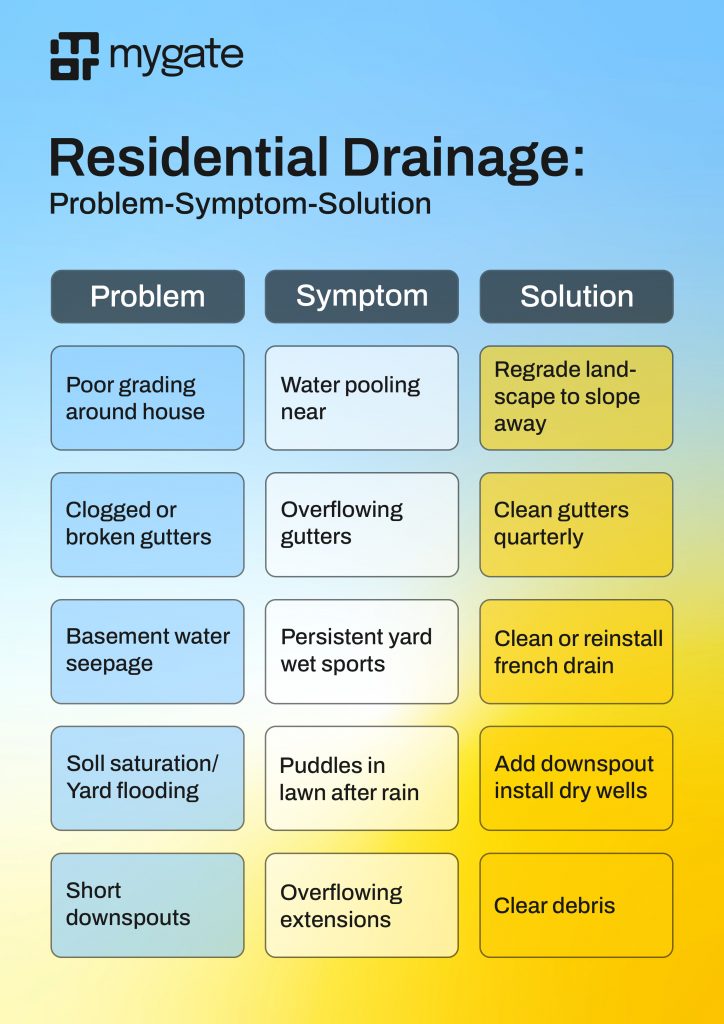
1. Fix your grading first
Your ground needs to slope away from your house – at least 6 inches over the first 10 feet. Sounds simple, but it requires bringing in the right kind of soil and shaping everything properly. Investing in proper grading now can prevent thousands in future repairs. Proper grading prevents way more expensive problems later. I’ve seen people spend hundreds on grading to avoid thousands in foundation repairs.
2. Upgrade your gutter system
Standard residential gutters often fail during today’s increasingly intense rainstorms. Go bigger if you’re replacing them. Add leaf guards to reduce maintenance headaches. Most importantly, make sure your downspouts dump water at least 6 feet from your foundation.It is always recommend getting your gutters professionally installed with the right slope toward downspouts. DIY gutter work often creates more problems than it solves.
3. French drain installation or repair
When installed correctly, French drains work for decades. The key is proper depth – usually 18-24 inches and using the right materials. Filter fabric prevents soil from clogging the system while still allowing water flow. Most failures come from cutting corners during installation. Proper pipe sizing, adequate gravel, and correct slope make all the difference.
4. Sump pump installation
If your basement floods regularly, you need a sump pump with battery backup. Power outages often happen during storms when you need pumps most. Get this professionally installed. Proper pit sizing and electrical work aren’t DIY projects. Regular maintenance includes testing the pump and keeping discharge pipes clear.
5. Soil aeration and dry wells
Clay-heavy soil causes drainage problems by holding onto water. Core aeration helps by creating channels for water and air movement. It’s not glamorous work, but it makes a real difference. Dry wells work in some situations, they collect stormwater and release it slowly into surrounding soil. These need adequate space away from your foundation and septic systems.
When to call a professional
- Some warning signs mean stop messing around and call experts immediately. Foundation shifts, new wall cracks, or doors and windows that suddenly don’t close properly indicate serious structural problems.
- Large areas of standing water that persist for days after storms usually require systematic solutions beyond DIY capabilities. I’ve watched homeowners throw money at temporary fixes while ignoring the real underlying issues.
- If you’ve tried multiple solutions and problems keep getting worse, professional assessment becomes essential. Experienced contractors spot root causes that aren’t obvious to homeowners.
Preventive maintenance tips
- Clean your gutters every three months, more often if you have lots of trees. This simple maintenance prevents most overflow problems.
- Check your grading annually, especially after heavy rain seasons or major landscaping work. Look for areas where soil has settled or erosion has changed drainage patterns.
- Make sure downspouts stay extended away from your house. These extensions get moved during lawn maintenance and forgotten.
- Rain barrels help reduce system burden during heavy storms while giving you water for dry periods. Native plants that tolerate wet conditions absorb excess water while looking good.
FAQs
How do I know if my drainage is bad?
Water pooling near your foundation, basement moisture, overflowing gutters, soggy yard areas, foundation cracks, and musty basement odors are clear warning signs.
Simple stuff like cleaning gutters, extending downspouts, and minor grading work are fine for DIY. Complex problems involving foundations, major regrading, or French drain installation need professional expertise.
When’s the best time to fix drainage problems?
Late spring and early summer provide ideal conditions for drainage work before heavy rainfall seasons. Emergency repairs should be addressed immediately regardless of timing.
Conclusion
Taking care of drainage problems before they become disasters saves enormous amounts of money and stress. Prevention costs way less than repairs after water damage occurs.
Regular attention and occasional updates keep drainage systems working as your landscaping matures and weather patterns change. When problems exceed your capabilities, getting professional help quickly prevents thousands in future repair costs.
Maintenance management of property is a key part of general property management since it helps to maintain the longevity and value of assets. The term “property maintenance management” refers to a vast array of activities, all directed to maintaining properties in the best possible condition. These consist of routine inspections, corrective action where necessary, repair work in emergency situations, seasonal repairs, and preventive maintenance. These initiatives ultimately function to maintain standards of safety and compliance, ensure high tenant satisfaction levels, and protect property value in the long run.
What particular goals do property managers anticipate having through maintenance?
One of the primary objectives is to prevent depreciation so that market value of the property over a period can be sustained or even enhanced. Also, properly maintained properties tend to have happier tenants, and that tends to result in longer tenancies and a lower rate of turnover. Most significant, perhaps, is the fact that it keeps houses safe for everyone who lives there, to codes and regulations that are put in place to protect residents and owners alike.
What sets property maintenance apart from overall property management?
Although property management entails a variety of duties such as leasing operations, rent payments, and interactions with tenants, property maintenance specifically focuses on the maintenance and repair functions of the property. Although related, many professions call for different techniques and expertise to be executed to be successful.
A number of important aspects of property maintenance management are blended to form a complete care plan. Regular inspection and assessment are the foundation of successful maintenance since they enable problems to be addressed before they turn into serious issues. In this way, minor problems are resolved before they become expensive repairs, thus saving time and money in the long run.
Preventive maintenance is another important component that entails planned activities such as the checkup of plumbing and HVAC systems to prevent unexpected breakdowns. Corrective maintenance fixes things when they arise, such as leaky faucets or roofs. Emergency maintenance procedures delay damage by responding to emergency repair situations in a timely manner, such as burst pipes. By preparing properties for varying weather conditions with work such as cleaning gutters and winterizing pipes, seasonal maintenance prevents season damage.
In order to expedite maintenance work, today’s property managers are increasingly depending on specialist software. Through expediting the processing of maintenance requests and monitoring issues so that nothing gets lost in between, these computer programs provide centralized management of maintenance requests. On top of that, these systems are ideally designed to monitor and schedule routine maintenance works, which enable users to remember what needs to be done when. Property managers can monitor the amounts of supplies, equipment, and tools to ensure they have everything in hand when the need arises with inventory and asset management systems.
Vendor management and coordination are much improved with centralized software while addressing service providers and contractors, cutting miscommunications and delays. Inventory and asset management technologies enable property managers to monitor the quantities of supplies, equipment, and tools to ensure all is at hand when needed.
There are a number of advantages to owners and property managers who utilize sound maintenance management. To begin with, routine maintenance prolongs the effective life of buildings and maintains them in superb condition, which maximizes their worth. As tenants are more likely to stay in well-managed places, properties with regular maintenance also have higher tenant satisfaction and retention rates. Therefore, there is less expensive turnover and downtime that saps profitability.
Have you ever thought about the cost of preventive maintenance?
By not allowing repairs to become so costly and straining your budget, addressing little problems before they can have time to get worse can save you loads of money. Other than maintaining properties in line with health and safety regulations, routine maintenance also protects tenants and prevents property managers from getting into hot water. Property management in general becomes more effective and productive if maintenance procedures flow like clockwork.
Property maintenance management has a number of issues, despite its obvious advantages. Maintaining a number of qualities at once can quickly become challenging, calling for careful planning and reliable methods. Managing crises and emergencies and making odd repairs is also an issue that can overtax resources and necessitate rapid, successful solutions. An added level of complication arises when property managers have to deal with multiple vendors and contractors to provide timely and quality service from complex third-party service providers.
Most property managers are constantly confronted with economic constraints and cost control, balancing between the need for maintenance and financial requirements. Staying abreast of innovations in technology also requires perpetual learning and adaptation, as introducing new technology to maintenance techniques can be problematic, the need to implement such to be competitive in today’s market is present.
Developing an overall maintenance plan tailored to each piece of property and detailing routine and preventive maintenance work is the first step in maintaining a property correctly. The best property management software that improves maintenance processes from task assignment to request management can be chosen and executed to establish a more efficient approach. Effective maintenance management entails assembling an experienced maintenance staff by recruiting qualified individuals and conducting ongoing training. Operations continue to be optimal in the long run if maintenance schedules are continuously reviewed and modified based on performance data and shifting needs.
Preserving property value, pleasing tenants, and optimizing overall operational performance all depend on successful property maintenance management. Emerging technology in property management software significantly enhances maintenance and makes organization and efficiency easier. As property managers aim to optimize maintenance and achieve maximum long-term performance, itis a smart strategic move to invest in efficient management solutions that will pay dividends through improved operation and property performance.
The right software does make a world of difference. It puts all your financial records in one spot, generates ready-to-audit reports with a few mouse clicks, cuts down on human error, and creates a clear trail of transactions. When the auditor raises an eyebrow about something, you can pull up the details instantly rather than diving into a mountain of papers.
At the end of the day, getting your audit closed properly remains one of the management committee’s most important jobs. When you understand what affects the timeline and take steps to make things go smoothly, you’ll avoid those audit nightmares we all dread.
Remember, timely audits show everyone you’re taking good care of the community’s money. They build trust with your neighbors and help keep your society financially healthy for years to come. With some planning and the right tools, audit time can actually become a chance to show off how well you’ve managed things rather than a stressful season everyone dreads.