

Mumbai
Mumbai may seem flush with water thanks to its monsoons, yet groundwater depletion and coastal saltwater intrusion are growing concerns. Since 2002 (expanded in 2019), the Brihanmumbai Municipal Corporation (BMC) has mandated rainwater harvesting (RWH) for most housing societies mainly to recharge groundwater, reduce flooding, and supplement flushing water. But too often, societies install systems just to get the Occupation Certificate (OC) and then ignore maintenance. That mistake can cost heavily financially, legally, and in sustainability.
Why rainwater harvesting matters in Mumbai
The city draws water from seven reservoirs, supplying residents about 90 L per person per day. That’s below the ideal 135 L pcpd, meaning cities rely on storage water for non-potable uses. When reservoirs run low, societies with functioning RWH systems can continue flushing toilets and washing cars without relying on tankers or expensive municipal supply cuts.
Moreover, percolation helps protect foundations from saline intrusion. Mumbai’s groundwater is steadily turning saltier as fresh layers disappear. Without RWH, buildings become more vulnerable.
BMC’s mandatory guidelines for Housing Societies
The Brihanmumbai Municipal Corporation (BMC) first made rainwater harvesting mandatory in 2002 for all new buildings with a plot area of over 1,000 m². The rule was introduced after successive monsoon floods and rising water shortages in Mumbai highlighted the need for sustainable water management. In 2019, under the Development Plan (DP-2034), the rule was tightened to cover all new constructions with a plot size of 300 m² or more, ensuring even mid-sized apartment complexes adopt rainwater harvesting.
This means no Occupation Certificate (OC) will be granted to a new housing society unless it installs a compliant, working rainwater harvesting system. Older buildings are not exempt if they undergo redevelopment or large-scale structural changes. BMC makes RWH implementation part of the approval process.
Key requirements under BMC’s rainwater harvesting rules
1. Certified RWH design
A society must get its RWH system designed and certified by a qualified engineer or consultant, preferably someone empanelled with BMC. The consultant will ensure that the design matches:
- The building’s roof area (for rooftop harvesting).
- Average annual rainfall in Mumbai (2,200–2,400 mm).
- Soil conditions (whether it is permeable enough for percolation or if a storage system is better).
The consultant’s sign-off is not just a formality; it’s a mandatory requirement for securing an OC. Without this approval, a building cannot legally be occupied.
2. Storage or recharge facilities
BMC doesn’t impose a one-size-fits-all rule. Societies have the flexibility to choose between:
- Storage Tanks: Water collected on the terrace is filtered and stored in dedicated tanks. This water is often used for flushing, gardening, and car washing, which together make up nearly 40% of a society’s daily water consumption.
- Recharge Wells or Pits: If the local geology supports it, the harvested water is diverted to recharge wells or percolation trenches that help replenish the groundwater table.
In coastal areas prone to saltwater intrusion, BMC often recommends deeper injection wells, which prevent saline layers from contaminating fresh groundwater.
3. Maintenance protocols
The biggest failure of rainwater harvesting in Mumbai has been poor maintenance. A clogged filter or neglected recharge pit makes the entire system redundant. To address this, BMC requires:
- Quarterly cleaning of filters, pipes, and rooftop gutters.
- Annual desilting of recharge pits or wells to prevent blockages.
- Regular inspections for mosquito breeding or algae formation.
BMC health inspectors frequently conduct monsoon preparedness checks, and a non-functioning RWH system can lead to fines or even notices to the society. Societies are also encouraged to keep a maintenance logbook signed off by the building’s facility manager or RWA secretary.
4. Penalties for non-compliance
To push RWAs to take RWH seriously, BMC imposes penalties of up to ₹1,000 per 100 m² of built-up area for societies that fail to:
- Install a system during construction.
- Maintain a functional system post-OC.
In some cases, Occupation Certificates can be revoked if a system is found to be permanently defunct. Redeveloped projects in Mumbai have already faced delays due to non-compliance with these guidelines.
5. Inspection & audit requirements
Once the system is installed, BMC can conduct random audits, particularly before the monsoon season. Societies are often required to submit an annual self-declaration that their RWH system is functional. For high-rise societies, BMC encourages RWAs to hire third-party RWH auditors who verify that the filtration and recharge systems meet standards.
Types of rainwater harvesting systems for societies
1. Rooftop collection & storage tanks
Rainwater from terraces is directed through a filtration system into large storage tanks. The filtered water is ideal for non-potable uses like flushing and gardening.
2. Groundwater recharge wells
Filtered water is allowed to seep back into the earth through dug wells or borewells (typically 1 metre in diameter and 6 metres deep). This approach improves the local water table and reduces dependency on borewell drilling.
3. Percolation trenches or pits
Narrow trenches (0.6 m wide, 1.5–2 m deep) filled with sand and gravel facilitate percolation. These are commonly combined with rooftop collection systems.
4. Injection wells
For coastal or saline-prone areas, pressure injection wells are used to push rainwater into deeper aquifers, preventing saltwater intrusion.
Installation & maintenance checklist
For RWAs, setting up an RWH system is only half the job. Ensuring its regular upkeep is equally important:
- Install before monsoon: RWH setups should be ready by June to avoid fines and delays in OC issuance.
- Use proper filtration: Systems must include first-flush diverters, insect-proof meshes, and at least two 100 mm pipes per 100 m² of roof area.
- Quarterly cleaning: Filters, rooftop gutters, and recharge pits should be cleaned before and during the monsoon to avoid blockages.
- Annual tank flushing: Tanks must be drained and cleaned at least once a year to prevent algae growth or mosquito breeding.
- Overflow management: Install proper overflow lines to prevent flooding or backflow during heavy rains.
Key government guidelines and resources
The BMC has issued comprehensive manuals detailing how societies should plan, install, and maintain rainwater harvesting systems. These guidelines outline technical specifications, including trench dimensions, storage capacities, filtration methods, and mandatory safety measures.
You can download the Water Conservation and Rainwater Harvesting booklet, available on BMC’s portal, which explains how RWAs can meet compliance while saving costs in the long term.
For Mumbai’s housing societies, rainwater harvesting is more than a regulation; it’s a civic responsibility. By investing in a well-planned system and regular maintenance, RWAs can not only avoid penalties but also future-proof their communities against water shortages.
If your society hasn’t yet upgraded or audited its RWH system, now’s the time to act. Download the BMC guidelines, arrange a society meeting, and invite an expert for a brief assessment. A little effort now will ensure cleaner water, lower bills, and a healthier city.
Renting out your home is a common way to earn a steady second income. But if you’re a flat owner in a cooperative housing society, there’s one charge you shouldn’t overlook non-occupancy charges.
This is a fee that applies when your flat is not occupied by you or your immediate family, and instead is rented out to tenants. While it’s not a very large charge, it’s important to understand when it’s applicable, how it’s calculated, and what to do if you’re being overcharged.
What are non-occupancy charges?
Non-occupancy charges are levied by housing societies when a flat owner rents out their property to a person who is not a close family member. This fee is collected in addition to your usual monthly maintenance charges.
The purpose of this charge is to ensure that members who are earning rental income from their property also contribute a little extra to the upkeep of common services used by the tenant, such as security, lifts, water, and other shared facilities.
When are non-occupancy charges applicable?
These charges are applicable only if your flat is rented out to someone who is not your immediate family.
You will not be charged non-occupancy fees if:
- You, the owner, are living in the flat.
- The flat is occupied by close family members, such as your parents, spouse, children, siblings, in-laws, or grandchildren.
- The flat is locked, vacant, or unoccupied.
The charge becomes applicable when the flat is used to earn a commercial benefit (i.e., rent) by giving it to non-family members.
In such cases, the society usually requires you to:
- Complete police verification of the tenant (mandatory in many cities).
- Inform them in writing about the tenancy.
- Submit a copy of the lease or leave-and-license agreement.
- Fill out any society-required tenant forms.
How is the non-occupancy charge calculated?
Earlier, societies used to charge a flat amount as a one-time non-occupancy fee. This led to disputes and overcharging in many cases. To address this, the Maharashtra government issued a circular under Section 79A of the Maharashtra Cooperative Societies Act, which clearly states that:
Non-occupancy charges cannot exceed 10% of the service charges paid by the member.
This rule has since been upheld by the Supreme Court and is now followed by most cooperative housing societies, especially in Maharashtra and major metro cities.
Let’s break this down with an example:
- Suppose your total maintenance bill is ₹3,000 per month.
- Out of this, ₹2,000 is considered “service charges” (expenses such as security staff, society staff salaries, electricity for common areas, housekeeping, etc.).
- You will be charged 10% of ₹2,000 = ₹200 as non-occupancy fees.
Important: Service charges do not include sinking fund, repair fund, property tax, or water charges.
What if you are overcharged?
This is unfortunately not uncommon. In many housing societies, members have raised complaints that the management committee has either:
- Charged non-occupancy fees even when the flat is used by a relative
- Charged more than 10% of service charges
- Not provided clarity on the breakup of the charges
In such cases, here’s what you can do:
- Write to the managing committee and request an explanation with supporting calculations.
- If you don’t receive a proper response, escalate the issue to the Registrar of Cooperative Societies in your area.
- You can also approach a Consumer Forum for redressal if the charges are unfair or violate the law.
It’s illegal for societies to charge more than what is permitted under the rules. And it is equally illegal to collect non-occupancy charges when the flat is used by a family member.
Is GST applicable on non-occupancy charges?
Yes. As per recent GST clarifications, if the total maintenance charges (including non-occupancy) exceed ₹7,500 per month per member, then 18% GST is applicable.
However, this GST is not paid by the owner to the government directly. The society is responsible for calculating and collecting the GST and remitting it to the government. Make sure your maintenance bill reflects this clearly, especially if you cross the ₹7,500 threshold.
Do tenants have to pay the charge?
By default, non-occupancy charges are the responsibility of the flat owner, not the tenant.
However, if you want your tenant to cover this cost, you can mention it clearly in the rental agreement. That way, you can legally recover it from them along with rent and other maintenance charges. But societies will only deal with the owner for collecting this charge.
Is this rule the same across India?
The 10% rule originates from the Maharashtra government circular and is strictly enforced in cities like Mumbai, Pune, and Nagpur.
In other states like Karnataka, Telangana, Delhi, and Tamil Nadu, most societies either follow similar rules by internal agreement or choose not to charge non-occupancy fees at all. But unless there is a clear by-law stating otherwise, housing societies cannot arbitrarily fix this charge.
In Bangalore, for example, many RWAs do not charge non-occupancy fees unless it has been included in the society’s registered bye-laws.
Why should committee members understand this?
If you’re part of your RWA’s managing committee, you’re expected to:
- Inform members about non-occupancy charges when they rent out their flat
- Collect it as part of the maintenance bill
- Explain how the amount is calculated
- Ensure the society stays within the legal limits
Many disputes between owners and societies arise due to lack of communication or incorrect billing. Being transparent and following the law helps keep things smooth for everyone.
What if the owner refuses to pay?
If a flat owner does not pay the non-occupancy fee when it is due, the society can:
- Issue a payment reminder notice
- Declare the member as a defaulter for society billing purposes
- Withhold the No Dues Certificate required for property sales or rentals
However, societies must still act within the legal limit and cannot use coercive tactics or harassment.
Non-occupancy charges are legal and necessary but they must be applied fairly, transparently, and within the limits defined by law.
If you’re a homeowner renting out your flat:
- Check your society’s by-laws
- Inform the committee and submit documents
- Verify your monthly bill for correctness
- Know your rights if you’re being charged unfairly
If you’re on the committee:
- Know the rules
- Educate members
- Stay accountable
Understanding non-occupancy charges helps everyone avoid unnecessary conflict and ensures smoother community living.
From water issues to fire emergencies, this list has every number your society might need.
| Service | Contact Information |
|---|---|
| Brihanmumbai Municipal Corporation (BMC) | Phone: 022-22620525 Ext.2609 |
| Maharashtra State Electricity Distribution Company Limited (MSEDCL) | Toll-Free: 1800-212-3435 / 1800-233-3435 Missed Call No.: 022-50897100 |
| Municipal Corporation of Greater Mumbai Emergency Operation Centre (Disaster Management) | Phone: 1916 022-22694725 / 022-22694727 / 022-22704403 |
| Citizens Call Centre | Phone: 155300 |
| Mumbai Waste Management | 022 2740 1468 |
| Mumbai Water Supply and Sewerage Board (MWSSB) | Email: [email protected] |
| Department of Drinking Water | Phone: 022-22616702 |
| Service | Contact Information |
|---|---|
| City Dog Control Office | Phone: 9987798436 |
| Western Suburbs Office (Bandra) | Phone: 9076202208 |
| Western Suburbs Office (Malad) | Phone: 9076202207 |
| Eastern Suburbs Office | Phone: 022-25618001 |
| Cattle Nuisance Control (Cattle Pound Office) | Phone: 022-28820296 |
| Service | Contact Information |
|---|---|
| General Public Grievance Service | Phone: 1509 |
| Grievance Redressal Portal | Phone: 1800 120 8040 |
| Service | Contact Information |
|---|---|
| Mumbai Fire Department | Emergency Number: 101 Other Contacts: 022-23076111 / 022-23086181 / 022-23074923 / 022-23076112 / 13 |
| Mumbai Police | Emergency Number: 100 |
| Local Police Stations | South Mumbai (Colaba): 022-22020402 Western Suburbs (Andheri): 022-26121235 Eastern Suburbs (Mulund): 022-25617722 |
| Service | Contact Information |
|---|---|
| Maharashtra Pollution Control Board (MPCB) | Phone (Head Office): 022-24010437 / 022-24020781 Email: [email protected] / [email protected] |
| Service | Contact Information |
|---|---|
| Registrar of Societies | Phone: 022-22634001 |
| Service | Contact Information |
|---|---|
| National Senior Citizen Helpline | Phone: 14567 |
| Service | Contact Information |
|---|---|
| Ambulance | 108 |
| Women’s Helpline | 1091 |
| Child Helpline | 1098 |
| Anti-Terror Helpline | 1090 |
| Service | Contact Information |
|---|---|
| Ambulance Services | Phone: 108 / 1298 |
| Mumbai Red Cross | Phone: 022-22660468 |
| Mumbai Blood Bank | Phone: 022-24131447 / 022-24134542 |
| Service | Contact Information |
|---|---|
| Apollo Pharmacy (24/7) | Toll-Free: 1860-500-0101 |
| Netmeds (Medicine Delivery) | Toll-Free: 1800-103-0304 |
| 1MG (Medicine Delivery) | Website: www.1mg.com |
| Service | Contact Information |
|---|---|
| BMC Water Tanker Booking | Phone: 022-24392323 |
| Emergency Private Water Tanker Services | Contact: 9819079283 / 9820095521 |
| Incometax Offices | https://www.incometaxmumbai.gov.in/about-us /our-offices-in-mumbai-region/ |
| Traffic police helpline | 022-24940303 |
| Commissioner of Mumbai Railway Police | 022 2375 9251 |
| Mumbai Railway police (Emergency contact) | 1512/ 1800 22 1512 |
| Service | Contact Information |
|---|---|
| Blue Dart Express | 1860 233 1234 |
| Delhivery | 8069856101 |
| Porter | 080 4410 4410 |
Fire safety isn’t just a formality, it’s what stands between a close call and a tragedy. In a densely packed city like Mumbai, being prepared can save lives.
Early in the morning of March 24, 2025, a fire broke out at the Takshshila Co‑operative Housing Society in Vidyavihar. Flames ripped through five flats between the first and second floors of the 13‑storey building. A security guard lost his life, another was grievously injured, and 15–20 residents were rescued before things got worse.
That incident underscores why the BMC mandates gated communities to install and maintain fire safety essentials, fire extinguishers, smoke detectors, sprinklers, and regular upkeep.
So, is your society actually prepared, or just hoping nothing goes wrong?
➡️ Check out the official BMC fire safety guidelines, and make sure your building is correctly equipped.
Bylaws are key to keeping residential communities running smoothly.
Framed by the Brihanmumbai Municipal Corporation (BMC), these rules help maintain order, promote safe and sustainable living, and protect the city’s infrastructure.
From waste management and building upkeep to public safety and shared responsibilities, bylaws outline how every society should function. Following them ensures better governance, smoother day-to-day operations, and a better quality of life for all residents.
Managing modern residential societies is no longer a job for volunteers alone, it’s complex, demanding, and requires professionals. Society managers are paid experts who handle the daily operations of housing societies, from paperwork and maintenance to finances, resident issues, and legal compliance.
Without a society manager, gated communities often face chaos like delayed maintenance, financial confusion, and overworked committee members. A good manager brings structure, ensures legal compliance, supervises staff, manages vendors, and keeps residents informed.
Introduction
We’ve been working in housing society management for years now, and let me tell you – things have changed a lot. Back in the day, a few volunteers could handle most society work. Not anymore. These residential complexes have gotten huge and complicated. Residents want everything done perfectly and fast. That’s why almost every decent-sized society needs a proper manager these days.
Who is a society manager?
Think of them as the person who runs your building day-to-day.
They’re not volunteers like your RWA committee folks – they’re paid professionals who’ve learned how to handle all this stuff.
Some societies hire their own dedicated manager. Others use companies that send managers to handle multiple buildings.
Why a society manager is crucial
Here’s what happens without proper management – we’ve seen it plenty of times. Complaints pile up. Maintenance takes forever. Vendors show up whenever they feel like it. Nobody knows what’s going on with the money. Your volunteer committee members get burned out trying to handle everything.
A good manager fixes all this. They know the housing laws, deal with municipal authorities, and let your committee focus on making decisions instead of chasing contractors around.
Key responsibilities of a society manager
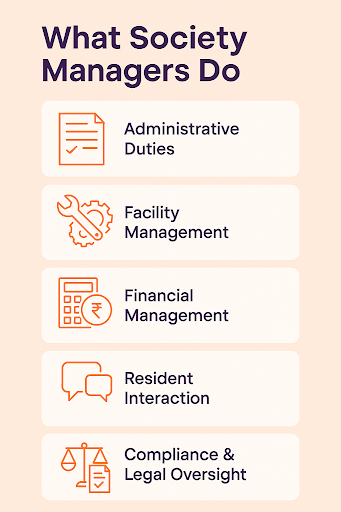
1. Daily operations & administration
Every meeting needs minutes. Every vendor needs a contract. Officials want notices. Someone has to track all this stuff and file it properly. During audits or legal issues, you’ll thank God someone kept proper records.
2. Facility maintenance
Cleaning staff need supervision. Gardens need maintenance. Something’s always breaking and needs fixing. Annual maintenance contracts need monitoring. When your elevator stops working or the generator fails, residents call the manager – not you.
3. Financial management
Budgets need planning. Maintenance fees need collecting. People who don’t pay need reminding (politely but firmly). Vendors need paying on time. Accountants need help during tax season. Without proper financial management, societies go broke fast.
4. Resident interaction
Residents complain about everything – noise, parking, maintenance, neighbors. New people move in and need orientation. Others move out and want deposits returned. Everyone wants updates on what’s happening. Managing all these personalities and expectations is honestly the hardest part.
5. Compliance & legal oversight
Fire safety inspections can’t be ignored. Structural audits are mandatory. Sewage treatment needs checking. Society registration must stay current. Labor laws apply to your staff. One missed compliance and you’re in serious trouble.
Tools and software society managers use

Most managers use apps now for communicating with residents. Visitor management systems track who comes and goes. Service requests get logged digitally instead of random phone calls.
Accounting software keeps financial records straight and generates reports automatically. Digital notice boards replace those paper notices that always fell down. Complaint tracking systems ensure nothing gets forgotten.
Put it all together and you get proper management systems instead of chaos.
Common challenges faced
- Residents expect different things. Some want immediate fixes, others complain about costs. During monsoons or festivals, everyone gets extra demanding.
- Collecting overdue payments without creating enemies requires serious diplomatic skills.
- Committee members often interfere or have unrealistic expectations.
- Vendors sometimes don’t show up or do shoddy work.
- Emergency situations – floods, power failures, medical emergencies happen at the worst possible times and need immediate handling.
Skills required to be an effective society manager
- Communication skills matter more than anything else. You’re constantly talking to residents, vendors, committee members, and officials. Poor communicators fail quickly in this job.
- Problem-solving under pressure separates good managers from mediocre ones. When three things break simultaneously during a festival weekend, panic doesn’t help – creative solutions do.
- Technology skills are becoming essential. You can’t avoid computers, smartphones, and management software anymore. Basic knowledge of housing laws and regulations prevents expensive mistakes.
Qualifications and hiring tips for RWAs
Most societies want college graduates, preferably with relevant diplomas in property management or business administration. Professional certifications help but aren’t always necessary.
Background verification is crucial – they’ll handle money and have building access. During interviews, give them real scenarios. How would they handle a major water leak? What if residents refuse to pay maintenance? How do they deal with difficult people?
Decide whether you want your own dedicated manager or prefer outsourcing to a management company. Your own manager gives personal attention but costs more. Management companies provide backup support and standard procedures.
FAQs
Is hiring a manager legally required?
No, but practically necessary for anything over 50-100 units. Volunteer committees simply can’t handle the workload effectively beyond that size.
Salaries range from ₹25,000 to ₹60,000 monthly, depending on location, society size, and experience. Mumbai and Delhi pay more than smaller cities.
Can residents become managers?
Yes, but they must quit any committee positions first. Otherwise, conflicts of interest become inevitable.
How do facility managers differ?
Facility managers focus mainly on building maintenance and infrastructure. Society managers handle broader responsibilities including finances, resident relations, and administration.
What if the manager doesn’t perform?
Submit written complaints to your managing committee. If problems persist, contact your state’s society registrar or housing authority.
Conclusion
Good society management makes everyone’s life easier. Residents get better service, committee members avoid daily headaches, and property values stay stable. The investment usually pays for itself through smoother operations and fewer conflicts.
Most importantly, professional management prevents small problems from becoming major crises. Prevention costs less than fixing disasters later.