

The pandemic is a scary prospect for us all. But it’s much worse when you can’t even afford essential medicines, as is the case with the majority of our population.
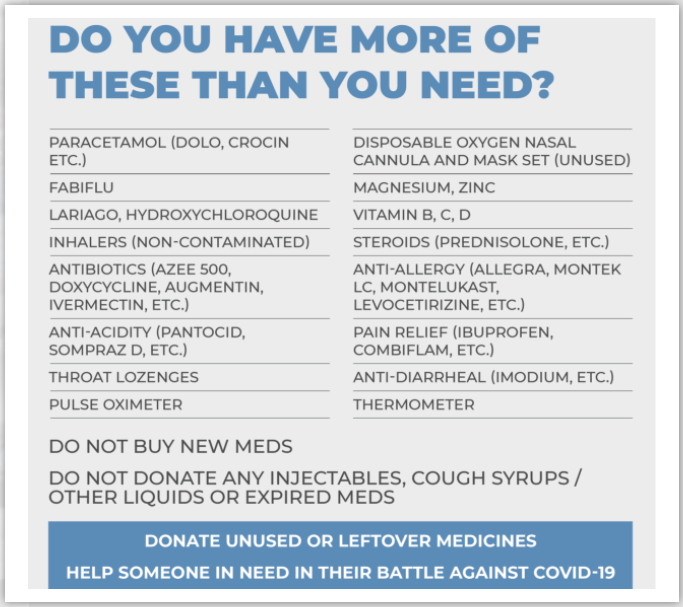
In the attempt to bridge this gap, MedsforMore is collecting unused, unexpired COVID-19 medicines (see list in image below) and making them available to the needy.
Should you wish to contribute to this initiative, do register with them as an ambassador — or simply make a donation.
About MedsforMore
MedsForMore (“MFM’) is a citizen level volunteering social initiative established only to facilitate collection of unused COVID-19 medicines only to be prescribed and distributed free of charge by its volunteering partners. MFM in no manner encourages anyone to purchase medicines and donate for its purposes. MFM is carrying out this activity without any financial consideration. MFM is in no manner intending to raise any funding, monetary donations through this website or any other means for the said purpose.
Society FocusAn Emergency Response Team may sound like an alien concept to implement in a housing society but its many versions are commonly known to us all. A neighborhood watch or a SWAT team, or in more recent times, an ERT of medical practitioners. These are the first-hand responders in times of trouble. Let’s explore further.
What is an Emergency Response Team?
Also known as an Incident Response Team, it’s a group of people who are appointed to solve crises, and respond to emergencies (in a calm and collected manner) with practical action plans. Such a team consists of members who are qualified and prepared to handle emergencies (volunteers or designated members).
Why is an ERT needed in a housing society?
A housing society faces emergencies quite frequently. Some examples are listed below:
- COVID-19 (or other medical) cases that can escalate quickly.
- Lack of essentials during continuous lockdowns or unavailability of specific medicines and daily needs.
- Incoming (forecasted or otherwise) natural calamities like flooding issues, storms, earthquakes, etc.
- Accidental fires or structural breakdown in the building.
- Failure of society assets like composting units, electric/smart meters, fire alarm systems, etc.
- Domestic or community conflict (in some cases, physical assault).
- Intruders, robbers, and vandals are causing damage to property and disturbing the privacy of residents.
- Mishandling of hazardous materials during maintenance and repair.
Any such incidents need to be handled with caution so as to prevent any physical, monetary, psychological, and emotional distress to the spirit of community living.
How to form an Emergency Response Team (ERT) in your housing society?
Step 1: Identify the categories of emergencies within the desired Incident Response Team and appoint points of contact for each.
Points of contact for:
- Medical/Covid-19 emergencies
- Domestic/internal conflicts
- Technical failure, equipment malfunction
- Natural calamities or accidents within the premises
- Elevators safety and malfunctioning with people trapped inside.
- Any other categories as per the needs of your housing society
Step 2: Select members based on needs and qualifications
Circulate a notice to form ERT among group chats and notice boards and announce that volunteers are welcome.
Usually, the responsible members who are willing to help will step forward. Alernatively, if you already know the members who would do a good job as a reliable point of contact, you can approach them directly after discussing it within the MC meeting. Use both approaches as you’d be able to appoint a secondary point of contact through willing volunteers as well.
What will be the responsibilities of the ERT?
After you’ve appointed the primary and secondary points of contact for each category, formulate their core responsibilities and the action plan needed for their roles.
Here’s a sample.
1. ERT points of contact in society for accidental fire and natural disasters should have:
- An action plan for evacuation
- Fire safety plan
- A drill practiced in advance
- A plan for securing vehicles and other property of the society.
- Train the security guard and maintenance staff in damage control.
2. Points of contact in society for internal conflicts, robbery, vandalism should:
- Be able to intervene immediately.
- Hear out all parties involved, devise a fair judgment, and impose it.
- Apprehend the perpetrators immediately and hand them over to the local authorities.
- Set up a neighborhood patrol if needed.
3. ERT points of contact in society for Medical/ Covid-related emergencies should be responsible for:
- Arranging for first aid and CPR, temporary solutions like bandaging wounds, PPE /isolation protocols.
- Providing a list of nearby health facilities and doctors on call.
- Distributing safety measures for children, elderly family members of the patient.
- Making medicines or supplements available.
4. Points of contact in society for equipment failure should:
- Maintain a list of all associated vendors and their contact information.
- Be trained in emergency lift rescue protocols (usually, the guard and facilities manager should be able to handle such scenarios).
- Solve minor technical glitches or get someone from within the society premises to help immediately.
Above are some examples. However, each point of contact can create their own action plans and acquire skill sets to implement them based on society’s requirements. A society can set aside funds for ERT activities or go ad hoc for funds if needed. Team members can be from the MC/RWA as well as regular members.
Common rules for ERT members
- Protect people first, the property later.
- Be available at all times to respond.
- Choose ERT members with specific skill sets (e.g. medical health professionals, engineers, people with necessary life experience who may be in managerial/leadership roles in their careers or experienced business owners.)
- They should be self-trained in their ERT roles with periodic retraining to maintenance staff and guards.
- Each ERT member should make their own checklist along with an action plan to stay on top when an emergency strikes.
- Firefighting/escape and drills and basic medical emergency, first aid skills should be taught mandatorily to all ERT members.
An Emergency Response Team should be able to act swiftly, think on their feet, and consider the good of the many above selfish motives.
– Over 75% of respondents’ ‘Trust Circle’ now includes people from the neighbourhood as well;
– 81% of respondents claim that they would be more likely to depend on their neighbours as compared to pre-Covid-19 times;
– Nearly 90%of respondents felt the need to create a ‘Trust Circle’ that is focused on real relationships to combat the stress and loneliness resulting from isolation in the pandemic
National, 8th July, 2021: The manner in which communities are formed and sustained have been dramatically altered by major advances in communication technology, and the advent of social media. For close to two decades, they have helped people overcome great distances by offering a digital proximity, via likes, shares, comments or chats. Simultaneously, though, they have frequently been cited as a reason for a deterioration in neighbourhood relations, as the easy availability of information and ability to connect with friends and relatives online have left fewer opportunities and reasons to form relationships locally.
The events of the pandemic, however — the scrambling for essential items in the early part of lockdown and the organisation of local vaccination drives, to name two examples — have re-established the importance of proximity and, therefore, brought about strong changes in the neighbourhood. To understand the impact of the pandemic on people’s attitude towards their immediate surroundings, MyGate, India’s largest community application, commissioned a report, now titled ‘Trust Circle’.
The study witnessed participation from over 2,867 Indians of all ages across Tier-1 and Tier -2 cities, namely Ahmedabad, Bengaluru, Chandigarh, Chennai, Delhi, Hyderabad, Indore, Jaipur, Kochi, Kolkata, Mumbai, Pune. According to the report, while the degree or depth may differ, the emergence of neighbourhoods as a pillar of the ‘Trust Circle’ has become a national phenomenon, cutting across age groups, regions and nature of dwelling. Around 80% of respondents living in gated communities and 71% in the non-gated communities are in agreement with the statement, “My ‘Trust Circle’ has shifted to include people in my neighbourhood whom I am likely to interact with every day”.
Elaborating on the report’s findings, Mr. Vijay Arisetty, CEO & Co-founder, MyGate said, “It has been heartening to hear the many stories of neighbours coming closer together to tackle this unprecedented situation for over a year now. From this research, we can infer that these stories are not mere anomalies but the real expansion of our ‘Trust Circle’. The pandemic has re-infused the need to be-connected with one’s neighbours, with all demographics showing greater trust in members of the neighbourhood than before, be it the family next door, the local chemist or the apartment security guard.
“Through this endeavour we hope to understand the trust deficits that exist in communities and work to build bridges that can overcome these challenges.”
Illustrating the emergence of the neighbourhood as part of the ‘Trust Circle’, 81% of respondents said that they are more likely to depend on their neighbours in case they needed any urgent help as compared to pre-covid levels where their dependency was much higher on close friends and relatives. It is heartening to note that the trust and relationship built with neighbours was not just limited to the health crisis, but also reached new heights when it came to social engagement, and other regular interactions such as those related to electricity, water, maid, etc.
The emergence of Neighbourhood in the ‘Trust Circle’
Nearly 90% of all respondents agree that they needed to create a ‘Trust Circle’ that focused on real relationships to combat the stress and loneliness resulting from the isolation.
– Nearly 38% of the respondents are confident in leaving their keys with their neighbours while going out, indicating the emergence of neighbourhoods as a strong pillar that Indians trust.
– Though Gen Z (18 to 24 years of age) and millennials (25 to 34 years of age) do rely extensively on technology, it is the neighborhood that they often rely on in their daily life for any help or information. Even amongst Gen Z, the dependence on the neighbourhood (28%) for information or help on a daily basis is higher than the dependence on close relatives (22%) and friends (25%).
– 88% respondents mentioned that their relationship and dependence on neighbours, the local vendors and support staff (watchman, delivery boy, and maids) improved during the pandemic. Over 75% of respondents helped their support staff (security guard maid, plumber etc) with grocery, food or salary. Furthermore, nearly 73% of respondents engage with their maids beyond work, offering tea, coffee, food or even a salary of 3 months or more as loan if required.
– From a city perspective, the data suggests that ‘Trust Circle’ does not remain uniform across the different cities in our country. More than two thirds of respondents in Ahmedabad (68%) would leave their key with their neighbours compared to only 18% of the respondents in Kolkata. 39% of respondents in Hyderabad would trust their security guard compared to only 1% respondents in Kochi. 44% respondents in Kolkata would trust a friend close by compared to only 13% respondents in Ahmedabad.
Technology further enlarges the ‘Trust Circle’
WhatsApp video, FaceTime, Skype, Zoom and Google Meet added a new meaning to staying connected and combating pandemic-induced loneliness.
– Nearly 90% of all generations claim that technology has made it easier for them to address community issues in a seamless way, cutting down time and effort while bringing communities together.
– 44% of respondents would turn to technology to verify/validate the credibility of service providers such as an electrician, plumber, etc.
– 43% Gen Z claimed that even if they moved into a new neighbourhood, it would be technology that would make them feel most comfortable as compared to 40% Gen Z and 38% millennials
– Nearly the same proportion of the respondents over 45 yrs of age (28%) as millennials (27%) and Gen Z (27%) admit that after the Covid-19 pandemic, they would continue to use technology to stay connected with their ecosystem showcasing the acceptance of technology usage across generations.
Men, Women & trust circle
62% of men often rely on technology and their neighbourhood for any help or information they need (compared to 40% women), while 60% of women rely on their close friends and family (compared to 38% of men).
– Interestingly, contrary to the popular belief it is men who have formed a deeper bond with the neighbourhood than women. While only 25% of the women surveyed relied on the neighbourhood for any help or information, the men’s ratio was close to 35%.
– When looking for information and guidance regarding emergencies like Covid-19, 43% men would turn to close friends and family (compared to 39% women), while women (28%) would turn to internet based information like social media handles and reputed agencies like World Health Organisation (compared to 18% men)
– Close to 49% of the men who had participated in the survey mentioned that they are ‘highly likely’ to work with neighbours to set up a joint representation to authorities in matters like water supply, waste management, sewage disposal, etc.
– When it comes to relationship with house help, 30% of men claim they have minimal contact with their maid (compared to 20% women), in contrast, 38% of women always provide extra food for the maid and her family compared to only 30% men
The report establishes the fact that the pandemic has brought to the forefront the compassionate nature of human beings. Relationships amongst community members (gated and non-gated neighbourhoods) have strengthened significantly, with people realising or appreciating the value and importance of their support system, such as their domestic help, security guards, plumbers, electricians, and household personnel. For now, it is clear that these bonds have deepened, but as individuals and communities prepare for the resumption of normal life after the second wave, it will be interesting to see what shape this new dynamic takes.
About MyGate
Founded in 2016, MyGate is the largest community app in the country, simplifying urban living of over 4 million homes in 20,000+ housing societies. It was ranked #4 on YourStory’s list of India’s Most Disruptive Start-ups in December 2019 and one of India’s coolest start-ups by Business Today in 2019. MyGate was founded by Vijay Arisetty, an ex- IAF pilot (Shaurya Chakra awardee), Abhishek K, former VP at Goldman Sachs, and Shreyans Daga, former project head at Oracle and Digit. For more information, please see https://mygate.com/
Dengue, Malaria, and Chickengunia are infections caused by mosquito bites, which are widely and extensively found in almost all of India and are a major public health concern for the government and a risk that residents of gated communities face commonly. In 2020, 228 malaria, 1,072 dengue, and 111 chikungunya cases were reported in India. Even though there has been a drastic decline in the last few years, there is always a chance that there can be a random outbreak, especially from April through November in the North and all year round in the southern regions. The Indian subcontinent is globally at a high risk of Dengue and Malaria which are serious diseases and should not be taken lightly.
Common Symptoms of Dengue and Malaria
- General discomfort
- Headache
- Pain behind the eyes
- Rashes
- Fever
- Swollen glands
- Chills
- Backache, lower body pain
- Easy bruising, light nose or gum bleeding, pale, clammy Skin
What is Malaria Symptoms?
- Nausea
- Vomit
- Joint pain
- Abdominal pain and diarrhea
Note: Fever may or may not be accompanied by bouts of sweating.
What is the difference between Malaria and Dengue?
Dengue and Malaria are caused by two different breeds of mosquitoes.
What causes Malaria?
The transmission of a parasite called Plasmodium causes Malaria when a person is bitten by a female Anopheles mosquito while
What causes Dengue?
Dengue is caused when a person gets bitten by an already infected Aedes aegypti mosquito’s bite.
Tips for prevention of Community-wide spread of malaria and dengue
- Organize a volunteer team to spread awareness and education about the causes, symptoms, prevention, and cure of Malaria and Dengue at least once before each mosquito season (whenever it falls in your region).
- If there are any wastewater bodies in your society premises, such as stagnating water pools, residual grey water collected from apartments (that might be left untreated), filthy stormwater, should be either completely cleaned and dried out or be treated as per the society’s waste management rules.
- If your society has open composting pits or gardening mulch laying around, it may attract mosquitoes. Keep the composting drums closed and avoid putting meat, fish, poultry, and bones in them. Gardening mulch should be disposed of immediately or recycled in composting drums.
- Another measure is to remove weeds, shrubs, and dead leaves from the society’s landscaping and to regularly throw out the dry and wet waste post segregation and not let it accumulate in individual homes and collectively at society levels.
- Vector-borne diseases thrive in monsoons. Make sure you don’t let water pools gather in the parking lots, basement, streets and storm drains throughout the monsoon season.
- Advice residents, maintenance/domestic staff to use natural and organic insecticides in and around the house as well as plants. Organic antiseptic and antiviral plants such as lemongrass/lemon oil, eucalyptus oil, thyme oil, and Citronella, one of the most popular mosquito repellants and pyrethrum which is derived from the crushed flowers of a type of chrysanthemum species.
- In case of community-wide infection in nearby areas, you could spread professional chemical insecticide spray services to prevent infections from spreading in your own society, however, make sure you use certified chemicals and use them cautiously as the last resort.
- Malaria can be prevented by mosquito bite prevention and Chemoprophylaxis, however, Dengue can be prevented by bite prevention alone. Dengue fever, if severe, can cause internal bleeding and damage the organs in worse-case scenarios. Hence, it’s vital that the managing committee and the residents take necessary actions to spread awareness so that a couple of cases don’t turn into an outbreak.
How to Prevent Malaria and Dengue at home?
Ensure mosquitoes don’t breed and form a habitat – Your surroundings and living space should be kept pristine for mosquitoes to keep away. Vector-borne diseases are particularly intense in monsoon and if the surroundings are unclean/filthy, they find it easy pickings to breed. Make sure that there is no stagnant water inside or around the house. Keep your potted plants clean and dry. Keep food items, lids and containers covered as well as the trash cans and garbage bags. Clean overhead water tankers, clogged gutters, and clear out water pools and old tyres, cardboard, and other junk from homes and society premises.
Use mosquito repelling products – A good quality mosquito net is a great way to sleep safely at night since that’s when the mosquito attacks cannot be physically stopped. However, some people may feel claustrophobic sleeping under a net, in which case, it can be raised higher but make sure there are no holes and it’s tightly tucked in. Insect-killing products (sprays, creams, etc.) that contain an active ingredient called DEET are safe for use, however, they’re not safe to inhale. Mosquito coils are generally safe to use, however they should not be used in closed rooms. The residue left after the burn should be disposed of safely without touching the skin as it may cause an allergic reaction.
Keep yourself covered – An outbreak of mosquitoes is quite common during spring, summers, and monsoons throughout India. Wear light-colored full-sleeved cotton clothing to avoid mosquito bites. In case of a bite, wash the bitten part with baking soda and warm water. Avoid traveling to places in which there may be outbreaks of any of these diseases.
Don’t let them in Come evening, keep your windows and doors closed or you can install mosquito screens and check them periodically for holes and breakage. A well-screened house is your safest bet towards cutting the problem in half. You can purchase insect screens or door/window mesh online and install it yourself as well.
Isolation in case of infection – These are highly infectious diseases and spread rapidly from one person to another. If anyone in your family or among the neighbors has contracted either Dengue or Malaria, you must prevent further infection by following the isolation, personal protection equipment, and distancing protocols (same as a Covid positive person).
WHO Awareness regarding Dengue and Malaria
The WHO (World Health Organization) has published an ‘ABCD’ to spread awareness regarding Dengue and Malaria. It goes like this:
Awareness: Find out if you’re at the risk of Malaria (or Dengue) within your neighborhood and educate the residents about the risks of not taking preventive measures.
Bite prevention: Make sure you take all the aforementioned preventive measures to prevent mosquito bites. Additionally, you can insecticide-treat your bed, furniture, and home surroundings.
Chemoprophylaxis means that you take antimalarial medication to prevent any infections.
Diagnosis means that as soon as you notice symptoms, you seek prompt diagnosis and treatment to cure the infection at the right time.
Technically, a Homeowners Association, according to Investopedia, homeowner’s association (HOA) is an organization in a subdivision, planned community, or condominium building that makes and enforces rules for the properties and its residents. Those who purchase property within an HOA’s jurisdiction automatically become members”. In the Indian context, it’s like an Apartment Owners Association that is formed and operated by volunteers of a residential complex.
Features of an HOA/AOA
AOA/HOA is a team of seven members, required to form an Apartment Owners Association.
It is an arbitrator for disputes and has the right to collect the maintenance and other dues.
The Apartment Ownership Act 1989 as well as state pertinent AOA Acts apply.
It includes a general body, associate member, and a management committee that includes a president, vice president, secretary, and treasurer.
What are the documents required for an AOA?
- Society name and address
- A signed and stamped proposal letter by the executive committee/MC/RWA addressed to the Registrar of Societies requesting registration
- Associations memorandum
- Proceedings (MOM) of the first general body meeting
- A standard fee which may vary according to districts and states
Pros of Homeowners Associations
1. Maintenance and management
Having an official body of officers in charge of running simple and complex affairs is necessary for a gated community for a good and comfortable standard of living. This includes landscaping, security, financial administration, maintenance collection, repair and restoration, and other maintenance activities. HOA/AOA or a Resident Welfare Association are also responsible for the apartment complex/housing society’s bye-laws which have to be registered through the Cooperative Societies Act or the registration rules of the city /state government.
2. Arbitration and dispute resolution
Any apartment complex needs to create an HOA/AOA/RWA sooner rather than later as it’s important to resolve conflicts, complaints, and oversights in a lawful manner. If there are problems or disputes arising between neighbors, the HOA Committee has the right to intervene and mediate to arrive at a mutually agreeable resolution.
3. Access to amenities and common spaces
Members of HOA are responsible for appointing caretakers and managers for the clubhouse, gym pool, and other facilities as well as a service staff/waste management vendor, paying common utility bills, maintenance of financial records, statements, and legal documents, builder handover documents for the society and information of the members, government departments, and manage water supply issues, appoint reliable security services or fulfill any other administrative need of the residents.
4. For security and privacy
HOA members are the point of contact for overall safety concerns that the residents have. Apart from individual security measures, an apartment complex must have responsible security guards who should be trained in fire safety protocols and basic equipment handling such as LPG/Electrical meters, etc.
5. Legal and operational needs
In matters of grievances against the builder or legal disputes arising due to construction or ownership issues, an AOA can be the reliable source to figure out lawful solutions by approaching the right authorities, National Consumer Disputes Redressal Commission (NCDRC), or any other local authority concerning with the nature of the disputes. Also, AOA is required to keep immaculate records including banking account management for the apartment and property taxes, applicable GST, etc. Coordinating with different outside service vendors like waste management, electrical boards, composting vendors, etc., is also a task that befalls the HOA.
Cons of an HOA/AOA
1. A standard fee
Every apartment owner has to pay a predetermined monthly fee to the homeowners association as it’s necessary to have finances in order to maintain and run the complex efficiently. The monthly maintenance fee depends on the sq feet rate (based on the size of the flat), flat rate (for all apartments), or hybrid rates (a combination of both charged for the type of service). The more the amenities and services under possession, the more the fees.
2. Abiding by the rules
An HOA is responsible for forming all rules and regulations regarding monthly payments, code of conduct, waste disposal, and other society-specific rules. These bye-laws are formed in accordance with the government laws (central and state), and contain Do’s and Don’ts with respect to community etiquette and regulations that need to be followed.
3. Liable to pay fines
The HOA has the right to charge penalties to the apartment owners if they default on payments, ignore rules repeatedly and create any kind of nuisance or conduct unlawful activities within the complex premises. In cases of extreme non-compliance, the HOA can even take legal action against the members.
Although listed as cons, the aforementioned rules are necessary to keep the apartment complex safe, secure, and disciplined so that community living becomes delightful.
In summary, an HOA is a necessary official body for any society, with its pros far outweighing the cons. However, the HOA members should be picked wisely and have the necessary expertise and wherewithal to operate the society.

Maintaining a home is a daily job that befalls everyone, however, common house maintenance is not just limited to vacuuming and mopping. There are several minor cleaning tasks that we may forget and major home maintenance duties that we may ignore due to lack of time.
The main pitfall would be not having a maintenance checklist of repair and replacement tasks so it’s always advisable to not make mental notes but have a proper list of items to check, inspect and replace.
Let’s take a look at house maintenance pitfalls:
Not having a toolkit
It’s only natural you’ll need to repair and restore little things here and there. You must have a basic toolbox which should include different sized hammers, nails, screwdrivers (Phillips, spotted, square drive assortments) drill (for bigger DIY projects), tape measure, scissors, power glue, utility knife, woodworking tools like saws, adjustable squares, clamps, etc. for advanced users. You can assemble it on your own or simply order a kit online.
Not checking infrequently used faucets for leaks
Sometimes we overlook this seemingly minor detail but leaky faucets cause wastage of water and can leave marks on the tiles which lead to more expenses in repairs. Other plumbing defects include slow drain flow over time, faulty water heaters due to operating roughly, rattling pipes due to imbalanced water pressure.
Avoiding clogged gutters
If you don’t clear out the regular and storm drain pipes, overflowing water/filthy mulch could lead to erosion of the foundation, and waterlogging could lead to flooding in basements, parking lots, and society pathways. You can hire professional services for cleaning the gutters twice a year at least.
Appliance maintenance not done
Refrigerators, ACs, fans, air filters, and other appliances in your kitchen and home should be serviced regularly including the refrigerator coils and exhaust fans/chimneys, or else they will break down and lead to replacement expenses.
Leaky roofs and ill-maintained overhead tanks
Old pipes, water damage to the foundation of the roof, damaged shingles, and incorrect flashing can cause the roof to leak in different places. Faulty roofing material or storm, wind damage can also cause leaky roofs. These should be examined especially before monsoons. Overhead tanks should be cleaned regularly so that they don’t collect rust, dead bugs, dirt, and algae. Make sure there are no broken tiles or snags in the drain pipes.
Faulty electrical wiring
Signs of broken wiring are too many extension cords, burning smell or blackouts. This could happen due to frayed wires, poor quality switches, or even dead bugs inside the switchboards. Examine circuit breakers, if rats have chewed off wires, and always buy a trusted brand of electrical wires and switches.
Skipping exterior care of the property
The exterior conditions of the house can worsen rapidly than the interiors due to weather conditions and lack of weatherproof paint, and poor caulking. If you fail to give a good inspection to drain pipes, siding mildewing/weather damage, can lead to rot and pests. Another thing to check is the exterior of the air-conditioning system installed outside to see if it holds strongly and get it bolstered before monsoons or storm predictions. Inspect the exterior walls for chipping or cracks and seal them and touch them up with rainproof paint or else water may seep in through the walls.
Neglecting windows and doors
Creaky, loose windows and doors are often ignored as they don’t pose an immediate threat, yet you must tighten up the hinges, oil them to prevent termite damage at the very first instance of creaking, or if you notice termite dust on the floor. Exterior shutters and mesh installed in balconies should be cleaned and inspected as well or else rodents and birds may fly in.
Maintaining lofts, attics, and basements
Clean out the debris from different unattended parts of the home since the dirt (or mold) accumulated in the corners, crevices, and walls can pile up and breed insects, reptiles, rodents.
Seasonal maintenance
Other than daily cleaning, it’s imperative that you take preventive maintenance care before each season like spring cleaning, cleaning vents, servicing washing machines as per the manual, unclogging tiny drain outlets in the pantry, bathrooms, storage room, etc every month or two, check and clean the kitchen sink fixtures underneath for rust, dirt and debris.
Not choosing the right cleaning agents
Soap and water alone won’t do.
You must keep in stock the right tools and supplies for daily or monthly maintenance, such as rubber gloves, squeegees for countertops, microfiber cloth for glass surfaces, along with the right mix of acids (to remove hard water deposits and rust), soft and hard fabric detergents, abrasives for excessive debris, sanitizers, and mild alkalies like baking soda for oil and other sticky residues.
If any of the above are ignored, it defeats the entire purpose of comprehensive home maintenance.