

Paying your society dues, and keeping track of past payments, can be a hassle. Mygate puts an end to these problems by offering a quick and easy way to pay and manage your dues via the app and without hefty convenience charges.
Benefits of paying on Mygate
- Contactless one-click digital society dues payment
- View dues by date, month and year in the app
- Download receipts of paid dues and other society bills
- Pay via credit cards, debit cards, UPI or e-wallet options
- Payments will be acknowledged via SMS/Email
- Access entire transaction history in a single place
- Get updates on the current status of your payment
- Connect with Mygate support for payment related queries
Here’s how you can pay…
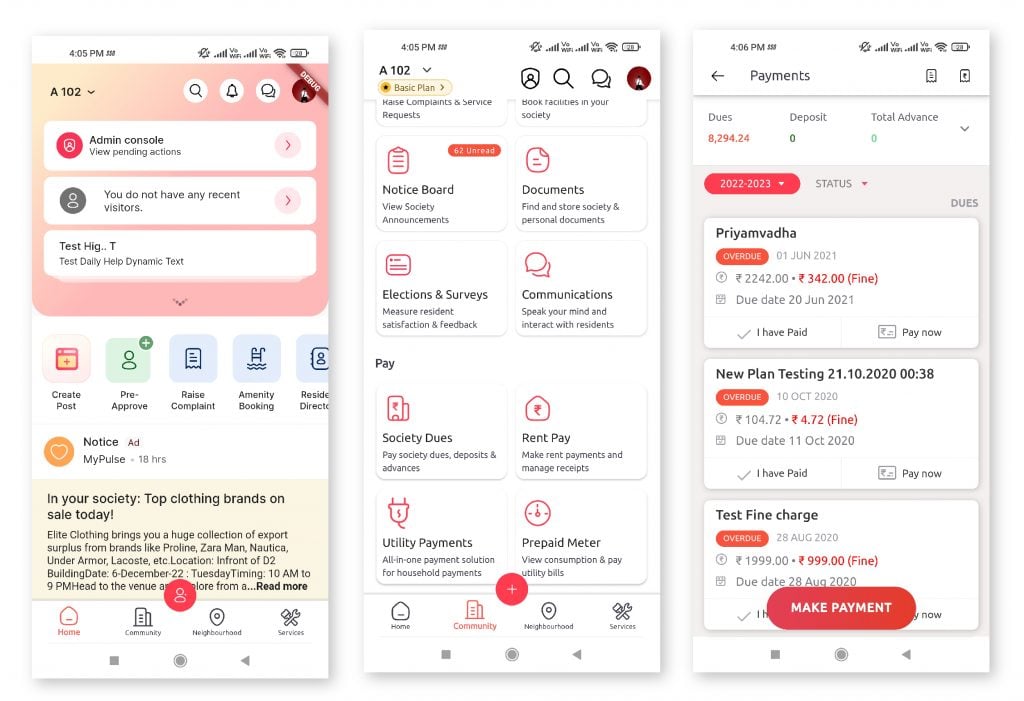
- Tap on the ‘Community’ tab
- Click on the ‘Society Dues ’ card
- Click on ‘Pay Now’ on the invoice raised
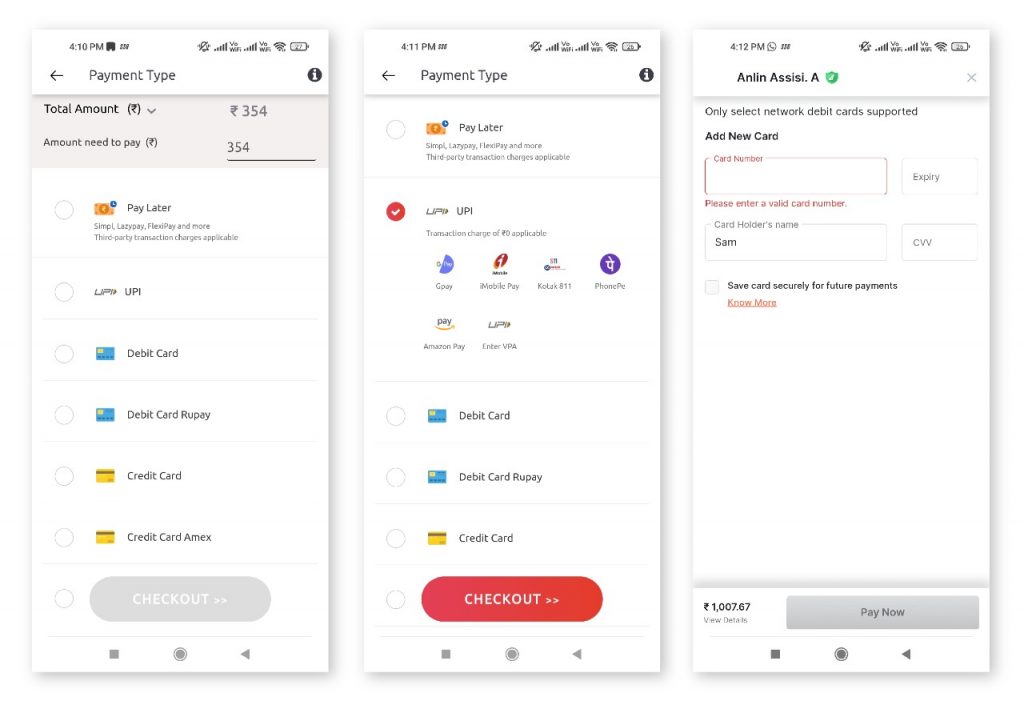
- Select the mode of transaction – Pay Later, UPI, Debit/Credit Card, Net Banking, Wallet and click on ‘Checkout’
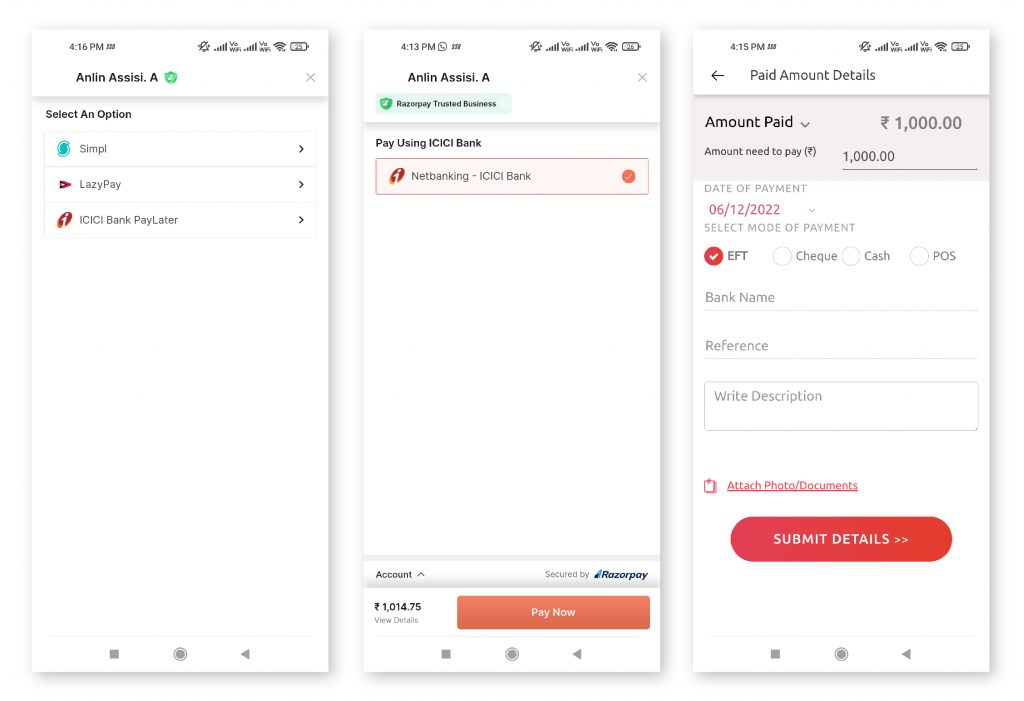
- Enter the details and click on ‘Pay Now’
- For Pay Later, select the option and enter the details
- For UPI, enter the UPI ID
- For Debit/Credit Card, enter the card details
- For Net Banking, select the bank and login
- For wallet, select the wallet and login
- The convenience charges are displayed on the screen.
**This feature is available under Mygate’s ERP Package. The end-to-end community management system comes with a number of other useful features including quick access to essentials, healthcare at home, digital society updates, and emergency alerts in case of crisis.
Contact your management committee or Mygate relationship manager to enable Payments for your society today!
Termites are known to be pesky intruders who can silently damage your property and assets if unchecked. Even though they do not cause harmful health effects to humans, they’re known to cause structural swelling, eat through wood, and at times cause allergic reactions in humans. If not treated, a termite infestation can cause serious damage to the foundation, floors, and ceilings of the home. Here’s how to make your dwellings termite-free.
Know where termites live
Termites are dry wood, damp wood, or subterranean. There are certain places where they like to hide like furniture, walls, doors, windows, floorboards, dry wood, or ground; subterranean termites prefer sources of moisture above ground. You can also find termites living inside cracks of walls, tree trunks, and house plants. They have huge underground colonies that might surface on top too. These are especially common on ground floors where homes are in close contact with the dirt.
How to identify termite activity in your house?
Tap on wooden furniture and walls. If it sounds hollow, there may be termites festering within. Another sign is holes in walls or wood. They may also make quiet knocking/clicking sounds from the insides of the walls. If doors and windows are tightening up and difficult to open and close it may be yet another sign if the surface feels porous. One of the most obvious symptoms of termite infestation is the presence of termite droppings. This is a dust-like brownish powder that gets collected on the ground or surface due to termite dropping their feces. It looks like sand or sawdust and can be light/dark brown or black, depending on the color of the wood.
Keep your apartment uncluttered
Prevention is better than pest control. Keep your inner and outer surroundings neat and clean in order to generate healthy living conditions. Don’t let waste, leftovers and discarded items linger in or around the house for too long. Declutter your home from unnecessary junk in storage areas (newspapers, old magazines, cardboard, etc) cupboards, drawers, underneath the furniture, inside the loft and other places which have piles of dusty things. Termite may not directly grow on all household objects, but the presence of clutter, moisture and wet dirt encourages its growth. If the atmosphere is too humid in and around the home, you might want to invest in a couple of dehumidifiers. Keep your home dry and adequately ventilated. Don’t let garbage pile up and take out trash frequently. You must maintain an 18-inch gap between soil/mud and wooden partitions of your home for prevention.
Preventive scrubbing, spraying and care
Regularly disinfect your countertops, cabinets, furniture, floorboards, door and windows (any other surfaces) with termite resistant spray made at home or good quality store-bought anti-termite sprays. Choose something with instant kill ingredients against termite and borers. While painting, you could also make termite killing spray at home. Mix half a cup of white vinegar with four tablespoons of lemon in a spray bottle and scrub surfaces thoroughly. Orange oil is another powerful treatment for preventing dry wood termites. Other than that, when you’re painting wood and walls, you can use an oil-based termite-resistant additive. Inspect cracked seals for termites and have them sealed by professionals.
Another solution is to sun dry pest-infested objects and furniture. Dry/steam clean mattresses and beddings to control bed bugs and wash linen at high temperatures. Use organic bug killers to get rid of cockroaches, fleas, etc., but make sure you read the label to differentiate between indoor and outdoor pests.
Inform tenants, staff and other society members
Ask family members, domestic help, watchmen, tenants, etc. to be on the lookout for signs of termites and report it immediately. Oftentimes, inhabitants such as tenants ignore the signs of termite activity thinking it’s not their responsibility if the situation worsens. Even if they’re not responsible for getting rid of the termites, they most certainly should inform the landlord of termite damage. Maintenance and service staff of your apartment complex should inspect all areas of the premises and common spaces because even if the infestation may not be in your home but can spread if it originates in any other part of the building.
Hire certified pest control services
Professional expertise is necessary when things go out of hand and termites have already entered the property. It’s best not to take the risk of DIY pest management as you might not even be aware of the extent of damage and prevalence of termite activity. It’s best to hire a vendor after reading reviews and reputation. Agencies will inspect the damage and recommend scientific techniques for removal and protection. You can also opt for yearly contractual agreement.
Other than traditional methods, you could also opt for eco-friendly extermination techniques so that there are fewer health and environmental hazards. They’re targeted at killing specific pests without causing strong smells and using chemicals. This is also useful because over time, pests may build resistance towards chemical agents.
It’s that time of the year again when we close our balance sheets for the last year and move to a New Financial Year.
Here’s a detailed video for a smooth and effortless transition
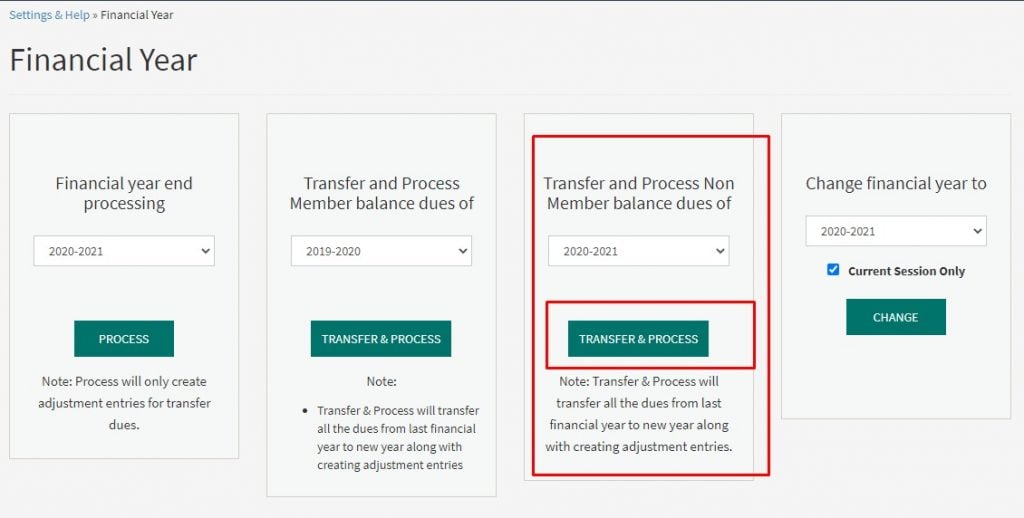
Go to Settings and Help > Financial Year > Click on the “Process” button by selecting the financial year as FY20-21.
Please note the due items will reflect automatically in the new financial year once the old financial year is complete. There is no manual effort required in carrying forward the same.
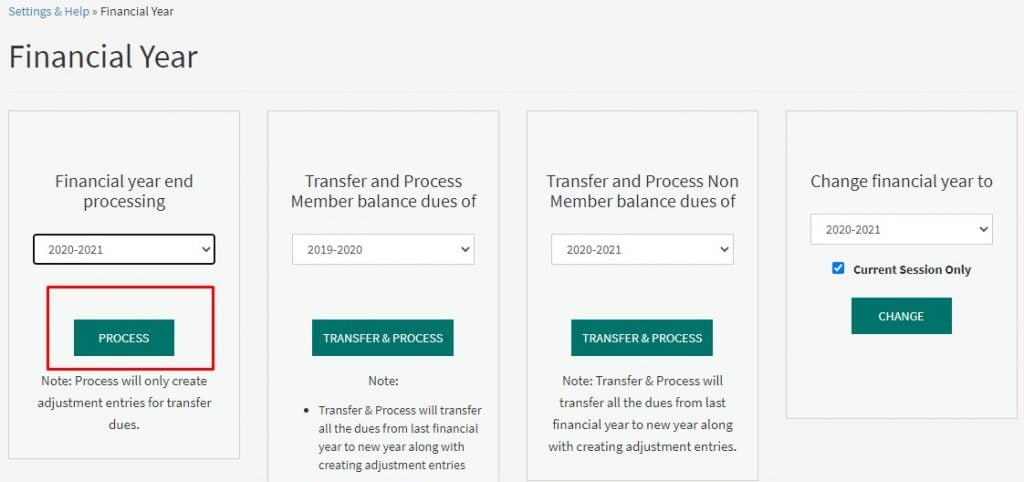
In the case of non-members, to carry forward the charges we need to choose the third option as per the screenshot. Please click on “Transfer and Process” by selecting the Fiscal year as FY20-21 so, the pending balances of non-members will be carried forward to the new financial year.
Please note that it’s a mandatory process that needs to be done to carry forward the non-member dues/balances to the new financial year.

Property dealings can go awry due to a variety of reasons even in a booming seller’s market if the relationship and communication between the homeowner and the real estate agent are not cohesive and honest. It’s your primary responsibility as a home seller to thoroughly vet your real estate agent before you can entrust them with the sale of your property.
Here’s a few vital questions.
Do you have a real estate license certificate?
Well-known real estate agencies usually display their credentials online/on-premises but if you’ve been referred to or stumbled upon an agent online or otherwise, you must ascertain that they have a legitimate practice with necessary legal certificates.
How much is your commission/agent fees?
As a rule of thumb, real estate agent commission is negotiable and depends on different types of properties. It is usually between 1% to 2% but of course, it could vary on last-minute sales, location, and value of the property, etc. It’s better than the agent is also not representing the buyer so there are no disadvantageous deals for either party. Usually, brokers/agents get paid when the deal is finalized and money exchanged.
Where will they list your property?
There are several digital options like property portals and online viewings, but an estate agent should have other avenues, circles, and connections to get the buyers and sellers across the door. Make sure you ask your estate agent his marketing methods, the sphere of influence, and networking strategies to gauge if his approach is solid.
How fast do homes in your category sell?
Inquire about the local real estate market conditions and get a generally estimated timeframe of the time it may take to sell your home. Each property sells at a different pace and there’s no right answer to this question. But a good real estate agent is privy to the number of properties for sale, time for listing, and closing of similar properties hence can give you a reasonable estimate.
How will the asking price be determined?
Real estate agents should be able to give you a CMA (Comparative Market Analysis) to arrive at the listing price which is the home value based on recent sales in the area and components like age of the property, a number of rooms, amenities, and other micro trends in the market. A responsible estate agent will arrive at an accurate value and determine a realistic asking price, while less reputable ones might quote high rates initially to get your business. You must keep your eyes wide open and do your own research.
What could delay or negatively impact the sale of your property?
Apart from the obvious red flags, you may be aware of (repairs, painting, and reconstruction), ask your agent if there are any potential pitfalls that could stop the sale of your house such as unusually low appreciation rates, local real estate market conditions, buyer’s market, quality of the neighborhood, availability of public utilities, and the need of upgrades.
How do you screen the buyer?
Your realtor should be able to tell apart genuine referrals and authentic online/walk-in prospects from fraudsters and suspicious parties by asking the right questions. Your realtor should have the experience and intuition to entertain only serious offers.
How many homes have you sold?
Whether you’re referred to a realtor or found them through online reviews, you must have a conversation with them about their general background, experience in the market, and actual data on the number of properties sold in your neighborhood and similar properties elsewhere. At the same time, don’t just go by the statistical track record alone. If the realtor’s temperament and values align with yours, trust your instincts.
Keep in mind that while asking relevant questions to your estate agent, if you find them having a tendency to fib or seem untrustworthy, you can always probe for further details to fact-check with other parties.
What can be done if the house doesn’t sell?
In the worst-case scenarios, does your estate agent have plans B, C, and D? Are they digitally savvy to lure in the right buyers? Do they have the right negotiation skills to rope in prospective buyers? There’s no harm in disclosing to the agent that you’re listing with other agents as well if such is your intention. Your agent should have the counter measures like readjusting the asking price, short sales, offer lease options, or other options as back-up plans.
Read More: What are Signs that you should sell your home soon
How will the offers be handled?
Real estate agents should not only disclose all offers made on the property to the owner but should also advise on which offer is the best in the context of buyer’s credibility, faster closing period, and recommend strategies like revealing competing bids to get the best and final price.
How will the offers be handled?
While interviewing different estate agents ask them how long their listings stay in the market and compare the numbers. It’s also recommended that you ask them the listing price and the actual sale price as a measure to check their skills.
It’s great to work with your agent on promoting the best features of your property like amenities, furniture, and fixture upgrades and gated community society management technology like MyGate. Tech-savvy millennial buyers are oftentimes sold on urban community-living solutions like secure and automated gatekeeping, domestic help tracking, digital payments, and real-time complaint resolution.
It’s common knowledge that Managing Committee and RWA members have their hands full with daily society issues, over and above handling certain monthly and periodic society management tasks. With Mygate’s diverse and intuitive ‘Task Assignment and Management’ functionality, a great deal can be set on auto-reminder/auto-update mode so that you never have to run around for chores at the last minute. Mygate has multiple easy-to-use in-built tools to handle the smallest to the most complex society management tasks with highly user-friendly features and customizable templates.
In practical matters, a society functions through the collaboration of MC, maintenance staff, service providers, and residents. Each stakeholder must do their part on time for everything to flow smoothly.
Common examples of routine and recurring management tasks done by MC, facilities manager, and/or service staff in a typical housing society:
1. Financial/administrative
- A monthly collection of maintenance dues
- Salaries of maintenance and service staff
- Invoicing members for bills and acknowledgment of payment received
- Society bank account maintenance (current/savings/FD)
2. Vendor payments
- Common light and water bill
- Waste collection
- Plumber, electrician, gardener, etc.
- Water tanker services
3. Maintenance
- In-site composting management
- Monthly inventory/supplies/hardware hauls
- Lift AMC and maintenance
- Service/Boiler room AMC
- Gardening supplies and disposal
- Overhead tank cleaning and maintenance
- Fire safety drills/safety equipment inspection
- Pool, gym, clubhouse AMC and monthly maintenance
- Booking amenities for residents monthly
- Solar panels/water/light meter/parking space routine maintenance
4. Miscellaneous
- Task list for society’s festivals and events
- Inspection, repair of electrical devices in common premises (light bulb/fixtures)
- Tasks and communication to be carried out for general/annual/special meetings
Why is it important to schedule society’s tasks?
Professional, swift, and precise management of society’s affairs is the prime responsibility of all committee members. Time management and nuanced scheduling is of the essence to get maximum work accomplished with minimum efforts.
Accounting, financial transactions, bill payments, and bookkeeping, even at a society level, is a set of complicated tasks which need meticulous attention.
Recurring tasks like monthly maintenance payments, lift maintenance visits, sewage treatment plant maintenance, composting unit maintenance, etc. need to be carried out at frequent intervals as required by the owner’s manual. For instance, failure to service the elevators or DC units could lead to potential accidents, injuries, and even fatalities in some cases.
Mismanagement of any of the society’s amenities, such as overbooking or biased booking of the pool, gym, clubhouse, etc. could lead to discontent and complaints against MC.
Running out of inventory like cleaning supplies, waste management tools, electronic supplies, and other utilities could lead to delay in daily general maintenance and repair tasks.
Delayed or stuck payments, either from monthly maintenance dues or pending payments to vendors can lead to disruption of common essential services like water and electricity, hence tracking and automation of financial transactions is imperative to avoid complications.
Lack of accountability within committee members and unruly assignment of responsibility can lead to chaos within the structure and leave a wide-open room for blame game and conflict.
It’s only logical to assign different tasks to different committee members and admin staff officially in one single interface on an all-in-one task management platform so that there’s complete transparency and accountability.
Setting up task assignment and management with Mygate app
1. Here’s how you can add staff
- Login to dashboard.mygate.com
- Click on People Hub icon present on the left-hand side of the screen
- Click on Add Staff option
- Enter the required details
- Click on Add
2. Here’s how you can create non-recurring tasks
- Click on the Society icon present on the left-hand side of the screen
- Click on Tasks option
- Under Non-Recurring Task, click on Create
- Enter the required details and click on Create
3. Here’s how you can create recurring tasks
- Click on the Society icon present on the left-hand side of the screen
- Click on Tasks option
- Under Non-Recurring Task, click on Create
- Enter the required details and click on Create
Why Mygate ERP?
Managing a society’s various routine and recurring affairs with mnemonic devices, post-it notes and phone reminders is like building a real house with Legos. You wouldn’t get very far and it would be impractical and inconvenient to live in.
Here’s why you should use ‘Task Assignment and Management’
- Auto assignment based on categories of tasks and status tracking
- Ability to add or remove staff members/committee members and reassign workflow assignment
- Easy to use interface
- Simple configurations to get you started
- Assignment of residents’ complaints to the relevant department, like plumbing, cleaning, electrician, etc. with the features to manage staff roster and track status of service requests and auto-escalation.
- Editable Vendor Master for lists of vendors with complete details like department, bank details, contact numbers.
- End-to-end asset management with Asset Categorisation where admin can assign asset management to service staff
- Complete inventory management assignment and tracking with location, usage, custodians, and department
- Auto reminders for Annual Maintenance Contracts with vendor details and contact information.
- Flexible slot configuration for amenities bookings on a per-flat/monthly basis with custom slots with minutes, hours, or days duration along with sending amenities booking notifications to the facilities manager.
- Automation of monthly maintenance bill payments based on date/period for auto billing to residents with customised billing options, auto-calculation of charges, and SMS/Email reminders for residents to pay on time.
- Timely auto-settling of bills through advance payments and arrears calculations.
- Auto-generation of receipt of payment and tracking dues and overdues for each resident in app.
As a resident of a housing society, there are many discussions and often debates to be had. Whether you’re part of the managing committee or not, as a member of a gated community, you have the right to engage in conversations and the responsibility to voice your opinion.
Some common examples of society communication topics include:
- Organizing festival celebrations, Independence Day, Annual Day, and other events
- Shortlisting and finalizing vendors, plans, and timelines for installing new assets like composting units, CCTV, smart meters, and other such endeavors for the betterment of society.
- Emergency situations like a break-in, fire, health scares like Covid, or urgent safety parameters.
- Discussions regarding any misconduct or conflict with respect to society maintenance staff, maids, drivers, any other.
- Feedback on implementation of any new plan, event, system (e.g. new revenue generation activities, garage sale, yoga workshops, cleanliness drives, waste management initiatives).
The importance of group communication
All society matters should be handled with transparency and participation. It’s vital that everyone is kept apprised of updates, decisions, development while being encouraged to give their inputs in the spirit of collaboration.
Oftentimes, residents may have internal conflicts or a general grievance/inconvenience regarding a problem. Open and honest resolution can only be brought about through peaceful negotiation involving all parties.
Residents may have questions about a decision or may need clarity on certain procedures and policies of the society. Answering them duly with transparency is essential to build trust and cooperation.
Benefits of using Mygate society ERP for online group communication (with examples):
1. Create online polls
Let’s say the event planning committee is not sure which centrepiece to go with on the day of Diwali celebrations, more routine tasks like which paint to choose for the clubhouse or more serious matters like how much penalty for litterers. It’s difficult to personally contact every one and count votes.
You can run online polls to gather opinions and answers to yes or no questions on society ERP apps in a few steps and make decisions instantly.
2. Invite residents for meetings
Need to call a special meeting with regards to an upcoming decision or an urgent society-wide announcement? Just select the number of people who must attend the meeting, and send them digital invites listing the time, agenda, and date. The same can be applied to committee meetings, however, the minutes of each meeting should be in accordance with the state co-operative housing society bye-laws.
3. Start forum discussions
There’s no better way to resolve a situation or have a civilized conversation over a topic than on a supervised group chat. Residents can not only engage in group conversations like a regular IM chat app but also comment on other participants’ ideas. Even feedback on a particular activity or executive decision can be openly discussed on the forum.
1. MyGate ERP – Creating Polls
- Login to dashboard.mygate.com
- Click on the Communication icon present on the left-hand side of the screen
- Click on the Opinion Polls option
- Click on Create New Poll
- Enter the required details and click on Create
2. Here’s how you can View Results
- Login to dashboard.mygate.com
- Click on the Communication icon present on the left-hand side of the screen
- Click on the Opinion Polls option
- Click on View icon against a Poll
3. Here’s how you can Create Meetings
- Login to dashboard.mygate.com
- Click on the Communication icon present on the left-hand side of the screen
- Click on Meetings option
- Click on Create
- Enter the required details
- Click on Submit
4. Here’s how you can Publish MOM
- Login to dashboard.mygate.com
- Click on the Communication icon present on the left-hand side of the screen
- Click on Meetings option
- Click on Past Meetings
- Click on View against the meeting you want to publish the minutes for
- Enter minutes of the meeting and other details and click on Post
The same MOM can be also Printed or Added to Society Documents for future reference via ‘Upload’
5. Here’s how you can Create a Discussion
- Login to dashboard.mygate.com
- Click on the Communication icon present on the left-hand side of the screen
- Click on Discussion Forum option
- Click on Create Discussion
- Enter the required details and click on Create
Annual society elections
Apart from the regular meetings, the society election is a massive endeavour for societies and needs to be conducted in a fair and efficient way. They are to be held on August 14 of every year at the time of the AGM, but most societies don’t strictly adhere to this date. In the wake of the Covid pandemic, even the government had allowed online election for housing societies. However, the elections are to be held in a secret ballot as per the mandate at the completion of five years of the sitting committee.
Each society must appoint a Returning Officer to ensure unbiased voting. To ease this process, the admin/login access to the election votes can be given only to the designated RO who’s in charge of the secret voting process and can access results. However, ensure that you appoint a fair and trustworthy individual who has everyone’s confidence. Because of end-to-end encryption and two-factor authentication, society management apps are completely secure to carry out election voting procedures.
Each state has housing society bye-laws that list the guidelines, timelines and protocols to conduct society election. For instance, Maharashtra allows a housing society with less than 250 members to conduct a month-long election procedure to cover voting lists, nomination, withdrawal and balloting/post balloting disputes and rejections. There’s a deposit fee involved and each contestant needs to be seconded by two members. To know the detailed laws of elections in Karnataka, follow The Karnataka Cooperative Societies Act here.
MC/RWA has to ensure that all required election rules, regulations, notices for nominations, last dates, and other pertinent details are followed according to the state bye-laws and relayed to the residents on time (for which society ERP can offer the feature of using a virtual notice board).