


Indian real estate market has not entirely tapped into the concept of open house hosting but it does have a bright future. An open house is a scheduled time in which a house or any real estate property is showcased to potential buyers. In the context of Indian real estate, the open house concept is not exactly as prevalent as in the west, but takes on a more practical form, as in virtual listings and pre-booked physical viewings.
Open house features
- You almost always never meet the owner since the open house is hosted by the real estate agent. (It’s not a rule).
- You’ll get all the necessary information about the house and the neighborhood while exchanging your own information.
- You may get to meet other potential house hunters and get a chance to get real estate information and other interesting leads.
- In most cases, photographs of the property or a virtual tour are already available online. Some luxury listings may be shown in only open house settings. It depends on the type of property (e.g. high-end and luxury properties) and the will of the seller.
Advantages of an open house
- Reliable marketing tool – Hosting an open house is one of the best ways to create buzz and publicity around your house. If it is organized professionally, it can bring forth multiple offers and even start a bidding war. Organizers of open houses use a variety of promotional strategies to market the property, such as social media posts/ads, digital marketing, offline networking circles, real estate portals, and other modes of advertisement. Eventually, this creates a steady stream of leads and an influx of walk-ins that you would not otherwise get with regular property listings. Open houses give you an edge and exposure in a competitive market as they shine a spotlight on your property.
- Free for all – Anyone can visit an open house and inspect every corner of the property to their satisfaction and get a prolonged visit. Visitors can assess the amenities and fixtures, take photographs and get all their questions answered by the estate agent in charge. There’s a slight pressure to wrap up the visit at a personal visit but not in an open house.
- Staging of an open house – Some staging ideas can help make your property on sale look even more attractive and welcoming. The pre-staging may include a virtual tour to interested buyers. Some staging tips used by open house organizers are
- Well maintained lawns and gardens
- Bright flowers, freshly painted walls
- Fresh linen, aromatic scents
- Finger snacks, refreshments, and beverages
In addition to that, a home with the latest appliances, security systems, and upgraded furniture is a plus point for an open house. On a side note, if a society has futuristic amenities like MyGate, intelligent end-to-end security, communication, and financial management app for gated societies, that makes a great selling point.
Disadvantages of hosting an open house
It involves some amount of financial investment depending on varying budgets. Open houses are not supposed to be empty, so you’d have to furnish your property and make it appealing to the lifestyle of the types of buyers you’re attracting. If you’re hiring a real estate agent to handle the sale, it means their commission has to be considered.
- Relocation woes
Many, if not most owners live in the house they want to currently sell. The traditional way is to set up a viewing based on leads and phone calls received from interested viewers while the owners (and family) are usually present at home. This is not the case with an open house.
There are two ways to handle the occupancy of the property if you want an open house.
- You’d have to vacate the property on designated days of the open house if you’re already living in the home.
- You’d have to move to another property and let the house be unoccupied until it’s sold (if that’s an option you have).
This may be challenging for homeowners who don’t want to be inconvenienced by temporary or permanent relocation.
- Lookers-on – There is always the possibility of casual home hunters or just curious browsers who may not actually be interested in a serious deal. Although the idea is that everyone is welcome in an open house, you’d have to be prepared to answer a lot of questions even though you know that the visitor will not buy the house.
- Security – Another issue is that of security. There may be trouble makers, vandals, or robbers who could be on the prowl. It’s ideal to have a guard/bouncer or at least not have unsupervised valuable items on display that can be stolen.
- Lack of personal attention – Sometimes serious buyers may not get the necessary amount of time and attention from the host if the footfall is too high. Some may wait it out, but others could just leave without having a chance to speak to the realtor if the viewing is too crowded and busy with other competing offers. It’s only natural that buyers prefer a personalized and instant approach that’s available during a private viewing.
Whether to host an open house or not depends on how much traction you want to build on generating interest in your property and if it’s feasible financially in terms of promotional expenses.
Freshwater is a rare commodity in the world. Out of 70% of all the world’s water, only about 2.5% is freshwater. The rest has to be treated by scientific technology. But not every household in India has access to fully treated or purified water available directly off the tap. What flows through our faucets is hard water with varying levels of chemical content.
What is hard water? How to identify it?
Hard water is water that contains salts, high mineral content, calcium, magnesium, bicarbonates, sulfates, and other impurities. It has the following indicators that you may find commonly:
- Dry scum on utensils/glassware even after washing them
- Scaling on pipes, plumbing fixtures, the surface of the toilet, and faucets
- Dry and itchy skin
- Blurry spots on appliances and objects cleaned with hard water
Such water is not fit for consumption by humans without proper treatment as the residue can cause health problems like kidney problems, cardiovascular or neural diseases. Indian domestic water supply is notoriously famous for its hardness, it corrodes pipes, water heaters and needs extra detergents/cleaners to get things cleaned.
Due to the shortage of treated water in India, many housing societies have to hire services of water tankers that provide water directly from the borewell, the quality of which is questionable. The soap doesn’t lather well, and hair becomes brittle and dry. What should the residents do to resolve this problem?
How to soften hard water
1. Industrial RO installation
One of the ways to ensure that all of the water that gets supplied remains harmless is to get a Reverse Osmosis water treatment plant which can drastically bring down the hardness of potable water. The term used to describe it scientifically is TDS (Total Dissolved Solids) which is the total amount of inorganic matter and minerals in the water. Studies suggest that the acceptable amounts of TDS in drinking water should be between 50-300 and anything above 500 is not fit for drinking. RO units have been known to reduce the number of TDS by 80% to 90% if the brand is BIS approved and reliable.
Housing societies can consider investing in one depending upon their society size and requirements. They can cost anywhere between Rs 20,000 to Rs 1.5 lakh.
2. Home remedies for hard water problem
Another safeguarding measure against hard water is to apply some tried and tested home remedies, although it may be stated that these are short-term solutions and need to be used again and again. You can boil hard water at home before drinking. When it comes to cleaning faucets, utensils, and appliances to ensure no spots remain, you could use some hot water mixed with all-natural/distilled white vinegar. Yet another hack is to use washing soda while doing your laundry. Some people also like to invest in a domestic water softener, which is used for softening bathing and cleaning water. It could cost anywhere between Rs 1500 to Rs 10,000. An individual whole-house water filtration system could cost up to Rs 20,000.
3. Water purifier
A healthy household must invest in a good water purifier for drinking water despite using any of the above measures.
Here’s what to look for when choosing a reliable water purifier
The three commonly used filtration technologies are RO, Ultraviolet filtration (UV), and Ultrafiltration. The first step to check the TDS levels of your housing society water supply in order to decide which one is the best for you. This can be done by buying a TDS meter online (Rs 150-Rs 4000).
After finding out the TDS levels, shortlist the water purifiers on the basis of the range of TDS mentioned on the specifications of the water purifier brand. If the brand doesn’t provide the type of purification technology and TDS recommendations, do not buy it, no matter how economical.
If the TDS level found in your water is above 500 ppm, you can choose an RO water purifier.
If it is below 200 ppm, you could go for a UV or a UF filter. To be doubly sure (or if the TDS levels are above 1000 ppm), you could also get a water purifier system that combines both technologies.
Keep in mind that RO systems consume a lot of electricity and pose a challenge of wasted water. It’s ideal if you explore systems that offer a water storage tank for sifted water that can be later used for cleaning purposes.
Last but not least, you could also consider a gravity-based water purifier that cleans drinking water equally well without needing electricity and is quite affordable but may not last as long as RO/UV systems and require more maintenance. As a rule of thumb, visit the brand’s website and check online reviews as well.
Over a year into the pandemic, there is still a lot of confusion around Covid-19. Last week, medical professionals from the Stanford Department of Medicine organised a webinar to explain how best to care for Covid patients. This week, they’re back with another live webinar “COVID-19 Q&A for Healthcare Professionals and Families in India”.
Hear out the eight expert panelists at Stanford University address questions about COVID-19 management and vaccines for healthcare professionals and for anyone caring for COVID-19 patients at home in India. The eight doctors from all around the globe will cover the following topics during the webinar:
– Covid-19 in children
– Covid-19 in pregnant/lactating women
– Blood thinners in COVID-19
– Long term outcomes of COVID-19 including effects on heart and lung
Date: May 26th, 2021
Day: Wednesday
Time: 8:30am-9:30am (India)
Everyone is welcome to join.
‘MyGate has received special permission from Stanford Department of Medicine to circulate this message among its societies’
For two months now, MyGate has been in conversation with various national and regional healthcare partners to organise vaccination drives at all our 18,000 societies. Here’s an update on the situation:
– Supply limitations: Supply is currently limited and mostly getting consumed in hospitals and health centres;
– Improvements forthcoming: Our partners are confident that the situation will change and they should start getting adequate vaccine supply in 3 to 4 weeks;
– Establishing safety protocols: Healthcare partners are still putting in place best practices for large vaccination drives outside their centres as they will be bound by government regulations for conducting vaccinations.
Owing to the above reasons, none of the healthcare partners have been able to initiate mass vaccination drives. However, all partners are eager and hopeful to bring vaccination camps to communities at the earliest.
We continue to liaise with our partners and are keen on seeing this effort come to life at the earliest. One thing that would certainly help this effort is an estimation of demand for the vaccine from our residents.
Please take a minute to fill up the survey.
Disclaimer
– Feasibility of the camp is subject to legal permissions, availability of vaccinations and number of persons registering for proposed camp in the society
– MyGate is only a facilitator in bringing the Partners to your doorstep. MyGate does not maintain, sponsor, or recommend any third party Partner, nor does it assume any responsibility for them, their services or accessibility.
– Signing up confirms your interest in conducting a vaccination camp in your society, but is not a confirmation of the vaccination camp itself
– MyGate will only be facilitating discussions; costs of the camp are to be borne by the society/residents
– Vaccination camps will be conducted at the society premises provided society adhere to guidelines provided by the Partner to meet government regulations
– MyGate is not responsible for any dispute arising out of or in connection with the use of the services provided by the Partners
– MyGate does not make any representations or warranties with respect to efficiency or effectiveness of the vaccine administered
Managing community operations is exhausting and manual procedures add to the struggle – like keeping a tab of move-ins and move-outs and verifying if all dues are cleared. But not anymore!
To make things simple and quick for you, we have introduced a digital move-in, move-out mechanism. With this end-to-end feature for both committee members and residents, you can now get rid of on-paper formalities.
Why Mygate move-in move-out?
Mygate is the first app in the market to have launched this feature, simplifying the comprehensive and scattered process of move-in and move-out to less than a few clicks. The complete flow is designed intuitively, keeping in mind the ease-of-use and maximum convenience.
Introducing the feature to the Society Dashboard will have the following benefits:
- Real-time information on the total number of move-ins or move-outs at any given time.
- Enable effective administration and never miss to collect move-in/move-out charges.
- Single dashboard to manage all move-in, move-out requests with up-to-date database.
- A known and accepted platform to define society rules and regulations around move-in or move-out
- A smart, convenient experience for your residents so they don’t have to run around the last minute with documents for permissions.
- During MC transition, pass the resident information easily in the form of digital records.
Configure Move-in Move-out for your community
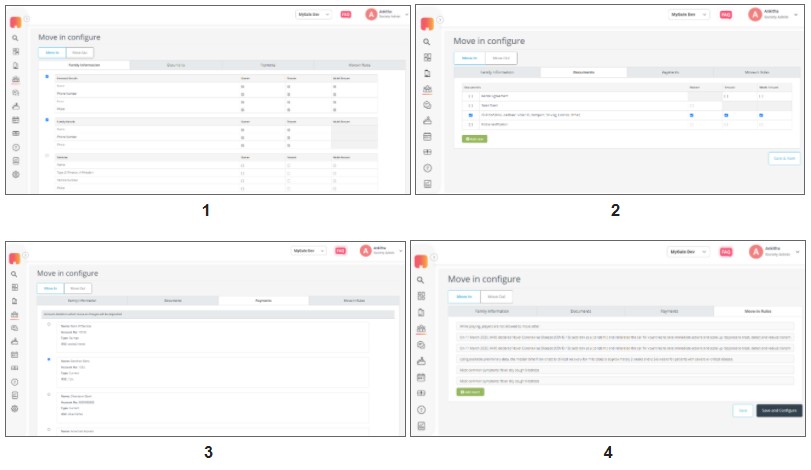
Click on ‘Configure’ on the landing page of the dashboard. Unless you configure the move-in and move-out for your community, it won’t reflect in the user application. If you need help with the configuration, please get in touch with your Mygate Representative.
Move-in Process Setup
- Enable/disable the fields on the Family page as per your society rules. Click on ‘Save & Next’ to continue.
- Add a list of documents you want the users to upload. Click on ‘Save & Next’ to continue.
- Add the society’s bank account details for the users to pay the move-in charges via the app.
- Type in the move-in rules in the comment boxes such as “Please adhere to the society clubhouse norms.”
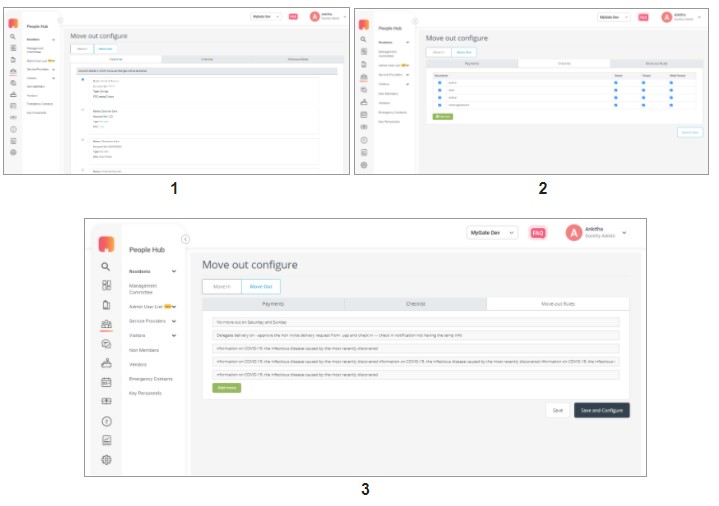
Move-out Process Setup
- Check if the Resident has paid the move out charges. And select the bank account to which the move-out charges have to be deposited.
- Create a move-out checklist for the users as per society rules. For example, a list of items they need to return before the move-out – parking tags, amenity ID, etc. Click on ‘Save & Next’ to continue.
- Next, type in the move-out rules in the comment boxes such as “Please adhere to the society clubhouse norms.”
Once the configuration is done, you can continue to manage the move-in, move-out requests.
Manage Move-In and Move-Out Requests
- This can be managed from a single dashboard. Check the statuses of the different flats and approve or reject the requests accordingly.
- If you decide to reject the move-in request, select the appropriate reason, and enter the comments that will help the user to modify the application and submit again.
Simplified Move-in Workflow
- Go to ‘PeopleHub’ > Select ‘Residents’ > Select ‘Move-in Move-out Requests’
- Admin needs to configure the Move-In process for their community as described above.
- Next, configure Payments. Account details in which move-in charges will be deposited can be added without the Bank Name. This is non-mandatory.
- Society Admin will be able to only add the “Move-in” Charges.
- Zero Move-in Charges – Payments module will not be displayed to the resident in Move-In application if the Move-In charges haven’t been configured or Move-In charges are Zero.
Simplified Move-Out Workflow
- Admin needs to configure the move-out process for their community as mentioned above.
- Move-out Request – Only the Move-out charges are required to be paid by the resident while submitting the Move-out application. Other charges like maintenance, dues, and security deposit will not be included in the Move-Out application. Other charges will have to be settled offline or through the Payments module in societies where accounting is live.
- Zero Move-Out Charges – Payments module will not be displayed to the resident in the Move-Out application if the Move-In charges haven’t been configured or Move-In charges are Zero.
Move-Out Requests that are deleted by the residents will be available on the Dashboard as ‘Cancelled‘ requests.
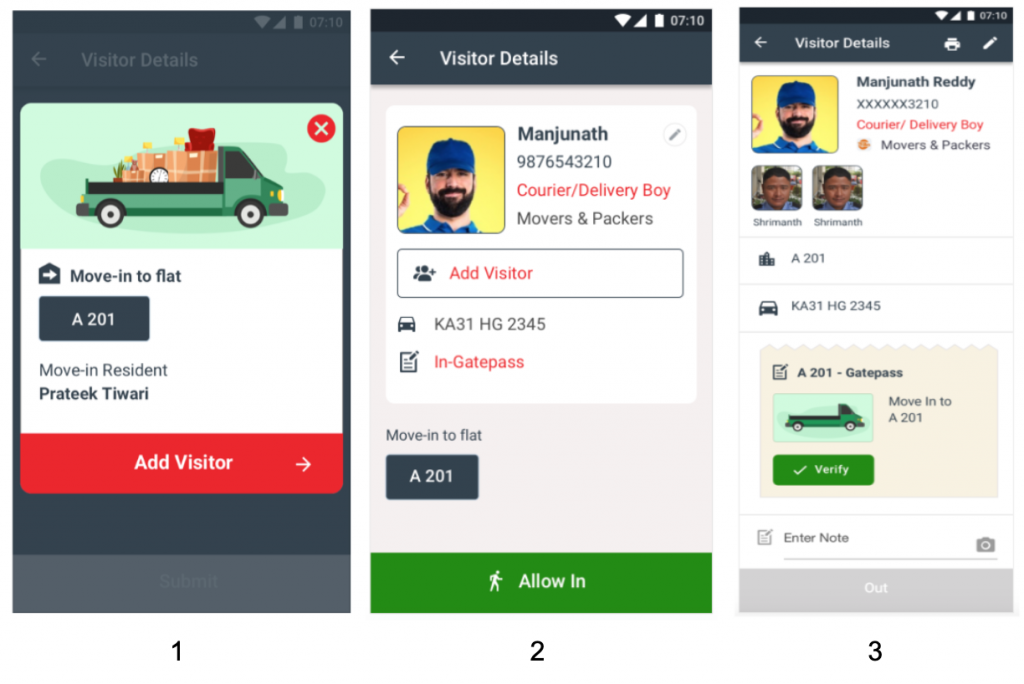
Guard App Move-in Gatepass
Once you accept the move-in or move-out request, a 6-digit gatepass is generated for the user that must be shown at the gate when the vehicle carrying the user’s household items enters and exits.
As the guard enters this 6-digit code in the guard app, it reflects the move-in or move-out request. Guard then creates the entry for the vehicle driver and allows the vehicle in. The same code is used when the vehicle exits the community.
Connect with your Mygate Representative to enable this feature in your society.
Community composting is a largely unexploited solution that is gradually getting its fair share of attention in India’s sustainability and waste management landscape. The power to harness the potential of waste lies with housing societies and gated communities today who can reap the benefits of large-scale composting, produce rich organic fertiliser, create organic community gardens, or even generate revenue from the sale of good quality compost.
What is community composting?
Composting is a natural method of waste disposal used to turn biodegradable or wet waste into organic fertilizer. When different waste generators such as small and large households within one or several societies compost organic waste jointly at a specific site (ideally within the society premises, but sometimes in a nearby shared space) it is called community composting. The compost is used as fertilizer for growing fruits/vegetables/herbs and gardening within the society premises as well as individual homes. It can also be sold through municipal buy-back programmes or farmer-connects. Community composting requires large-scale infrastructure that allows large volumes of waste to be managed as close to the source as possible and thus diverted away from landfills.
Benefits of community composting
- Increased environmental awareness among communities
- Less waste dumped in landfills and fewer garbage trucks in rotation
- Improved soil, air and water quality due to reduced use of chemical fertilizer
- Community empowerment through self-reliance
- Green and natural neighbourhoods
- Financial benefits through sale of compost
- Better utilization of resources to reduce society’s expenses
- Creation of organic kitchen gardens
- Better health and well being of people who consume this produce
- Increased biodiversity
Types of composting
- Aerobic composting is when the decomposition process occurs in the presence of oxygen-rich conditions. This type of composting is the most common in housing societies.
- Anaerobic composting is when the decomposition occurs in the absence of oxygen. This generally suits individual homes, but not large-scale operations. It works well only with kitchen waste but not huge quantities of garden rejects. It’s not as easily scalable as aerobic composting is.
- Vermicomposting is when worms (usually red wigglers and white worms) break down the waste to turn it into nutrient-rich compost.
Choosing the right composting model
There are several different composting methods available to housing societies although in-vessel composting (or vendor-based composting solutions) is preferred by most housing societies.
A housing society’s decision to opt for the right composting model is driven by the following factors:
1. Quantity of wet waste
According to the numbers, at least 60-65% of waste generated in India is biodegradable wet waste. In cities like Mumbai, 73% of daily waste is compostable wet waste. Extrapolation allows one to conclude that at least half of the waste produced by a household would be wet waste. A housing society of 200 households could produce between 150 to 200 kgs of waste in a day.
Monisha Narke, Stanford graduate and sustainability expert, says, “Meals are cooked at home almost daily, twice or thrice a day, so we end up generating biodegradable waste. As per our waste audits, on an average a family of 4 members generates upto 1kg kitchen waste, 60-70% of which is biodegradable waste, 20-30% is dry waste and 10% is non recyclable trash. If managed well, we can easily divert 90% of our waste into recycling.”
According to the Solid Waste Management Rules 2016, in-situ composting is mandatory for societies that generate more than 100kgs of waste per day, including residential societies/apartments with more than 100 units, and gated communities with an area greater than 5,000 square metres.
2. Budget
Based on the number of units needed for the entire society, the total investment can be divided among the individual houses. For instance, if a society of 100 households decides to install an aerobic digester worth Rs. 1 lakh with a capacity of 80kg per day, they’d have to invest Rs. 1000 each (and pay Rs. 100 as monthly operational cost).
To figure out which composting models are appropriate for your society, you can use SwachaGraha’s user guide which lists a good number of products and providers. Another resource to refer to is MOHUA’S Advisory on On-Site and Decentralized Composting of Municipal Organic Waste. It is a ready reckoner for housing societies and lists a range of products to compare price/dimensions/processing time and vendor details. The following classification has been made as per the size of the societies and the technology for composting.
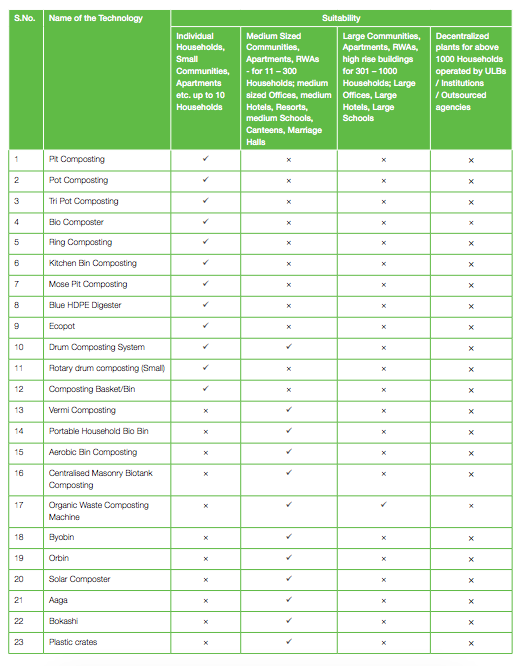
Before investing in a model, keep a few things in mind:
- Read user reviews and feedback online. Visit other sites to evaluate different models and their performance
- Ensure that the vendor is legitimate and empanelled
- Be aware of monthly operational costs
- Shortlist at least 5-6 models and compare the price per unit, waste handling capacity, infrastructure requirement, and maintenance needs
Besides the basic installation, most vendors can train your housekeeping staff, maids and security guards to handle, run and operate composting devices. They provide user manuals which include step-by-step instructions on the entire process, including the carbon-nitrogen ratio (brown and green materials) and the compost turning requirements. Large housing societies with ample budget or time/labour constraints even opt for contracting agreements along with the composting system so that hired professionals can take care of the entire society’s composting setup.
3. Space availability and location of the composting setup
A society needs to designate space based on the number of units and other factors such as aeration and protection from rodents and rain. According to Savita Hiremath, Bangalore-based journalist and composting expert who runs the blog Endlessly Green, housing societies in Bangalore have established successful composting techniques in common areas, terraces and even basements. She adds that though there may be certain challenges initially, residents quickly learn and adapt with enough practice.
Savita advises communities to do their due diligence by visiting the vendor site to check all components involved in an enclosed composting option. “The success of your compost lies in getting the recipe right. If societies have any doubts about the quality of their compost, they should get the compost tested in a lab to ensure it meets the standards.”
Regarding housing societies wanting to opt for composting systems other than in-vessel style, Savita, who is also a member of the Solid Waste Management Round Table says, “It’s not that housing societies cannot opt for vermicomposting, but it’s more prevalent in individual households and not everyone may be comfortable handling worms. Pit composting on a large scale is also possible, provided there’s enough space and housing societies are willing to take up a labour-intensive project. Besides, community composting is largely driven by volunteerism. Those who initiate the project are enthusiastic and proactive, while others may not be as motivated. But for societies that are willing to take action, there are plenty of resources online, a plethora of composting products and social media communities for assistance.”
Monisha, who is the Founder & CEO of RUR Greenlife, makers of RGGC bio-composters for small and large-scale composting, offers some words of caution, “Traditional methods like pit composting and vermicomposting have been extremely successful in composting vegetable peels and garden waste, however they pose challenges when we add citrus peels or cooked food. The high calorific value of cooked food releases heat which is not favourable to worms, while the cooked food in compost pits may invite rodents and pests that can lead to secondary problems.”
Why should housing societies avoid instant composters?
There are multiple instances where builders have installed 24-hour composters as well as societies that have fallen prey to automatic waste composters claiming to produce compost instantly. “These machines produce toxic smoke and burnt carbon which is detrimental to soil and plant health, while increasing the power bill to Rs 25,000 or Rs 30,000 per month. Societies should not blindly accept what a builder or a vendor offers. They must ensure that the model they choose allows for natural composting,” Savita says.
Monisha adds that concepts like 24-hour composting and 14-day composting are myths. “Composting is a natural process that requires 90 days to stabilise fully. Within 45-60 days, under right conditions it starts to smell earthy and is ready to be applied to the soil. The best method is to let nature do its job,” she advises.
How to use your society’s compost?
- Leachate/compost tea can be diluted (20 parts water-1 part leachate) and used as a spray for gardening
- Use the final compost for your own society, then distribute the leftovers to others
- Compost can be distributed among all residents to encourage them to take up balcony gardening
- Leftover compost can be sold to nearby bulk buyers or local farmers through a local network
The future of community composting
There is still lack of awareness among communities who either don’t know about the benefits of composting or are not interested in it.
Monisha cites 3 reasons why composting isn’t popular everywhere.
- Easy availability of avenues to throw the waste away and ‘not in my backyard’ mentality
- Myths that composting is dirty and smelly
- Lack of strict implementation of policies
But she is of the strong opinion that with increasing consciousness among people towards climate change and sustainability, the future looks promising. “India being a tropical country, the temperatures and other climatic conditions favour the natural composting process. As a futuristic approach, one must think decentralised composting at individual homes and in communities so that the waste is not traveling to another location to be composted or dumped irrationally. Through decentralised composting, one can mitigate massive CO2 emissions.”
Amarpreet Singh, Head of Business Strategy and Sales at Daily Dump, a design-led composting solutions company that makes Aaga composters, observes, “Seven years ago, nearly everyone who started composting in their communities was doing it for environmental reasons and to reduce their contribution to the waste problem. Over the years we have seen that due to fresh policies and stringent measures, communities have started composting as a way of adhering to the regulations as well. For a few months composting of wet waste took a back seat and the decisions to start composting were delayed. But there are encouraging signs of people coming back to thinking about wet waste management. Also because of working from home, there has been a rise in the number of individuals and communities wanting to garden and grow food in their premises.”
Savita advises communities to do their due diligence by visiting the vendor site to check all components involved in an enclosed composting option. “The success of your compost lies in getting the recipe right. If the societies have any doubts about the quality of their compost, they should get the compost tested in a lab to ensure it meets the standards.”
Community composting success stories
Several housing societies in Bangalore and Mumbai have produced amazing success stories of composting done right. For instance, a housing society in Mumbai has turned 4 tonnes of trash into 400 kgs of compost and 16 big societies in Mumbai who do on-site composting are donating compost to farmers. One society in Mumbai has been selling compost fertilizer to farmhouse owners at Rs 10-15/kg.
Housing societies in Bangalore are at the forefront of the composting movement, creating vegetable gardens with the compost they produce. Some produce up to 70kg of compost a day. Through a campaign called SwachaGraha Compost Connect, a brainchild of Solid Waste Management Round Table, the excess compost is taken from bulk generators to farmlands. The campaign has so far sold 60 tonnes of compost in about 40 truckloads. The idea was to encourage more farmers to turn organic and at the same time make it easy for societies to deal with their excess compost. The initiative addresses the issue of soil health on a macro level by taking the 3 Ms to degraded soil: Moisture, organic Matter and Microbes.
There is no dearth of techniques for societies willing to take up community composting. Although community composting takes research, participation and perseverance, where there’s a will, there’s a way.