

Society admins can now add, delete, assign new roles as per their convenience and what suits the functioning of their society using the Society Dashboard. Admins can also modify these roles and give permissions to the roles created at any time. MyGate provides admins 10 default roles and an option to create 5 more roles on the dashboard.
Follow these steps to create a new role…
1. Login to the MyGate dashboard (dashboard.mygate.com) using your admin credentials
2. Click on “People Hub”
3. Select “Admin User list”
4. Select “Manage Roles”
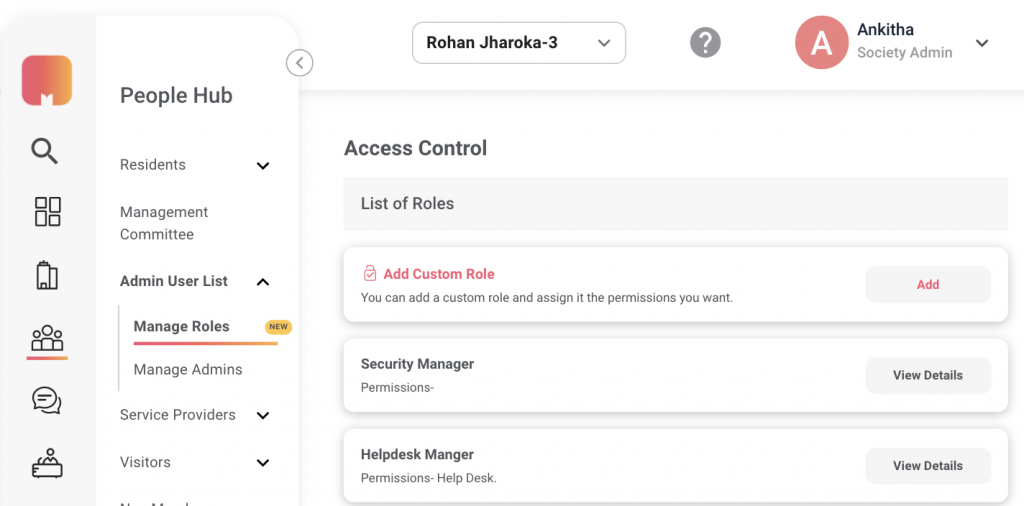
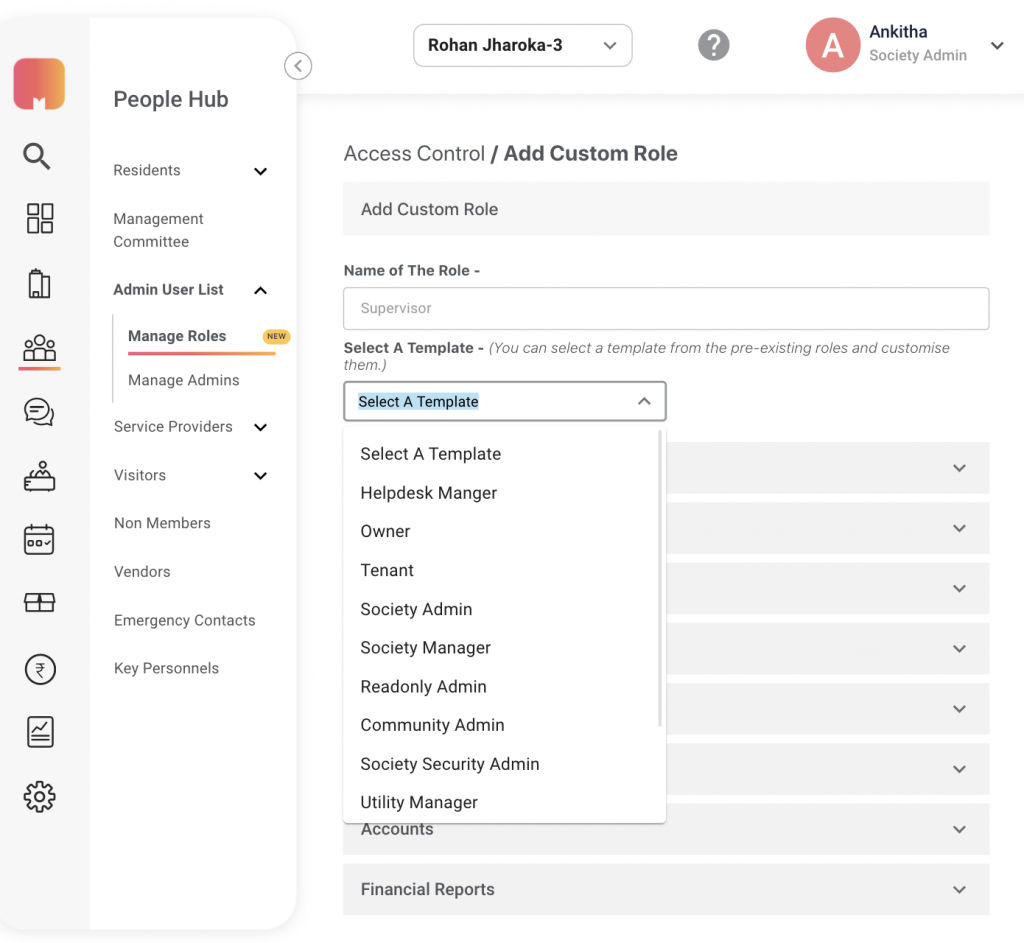
5. Add Custom Role with or without existing roles as a template
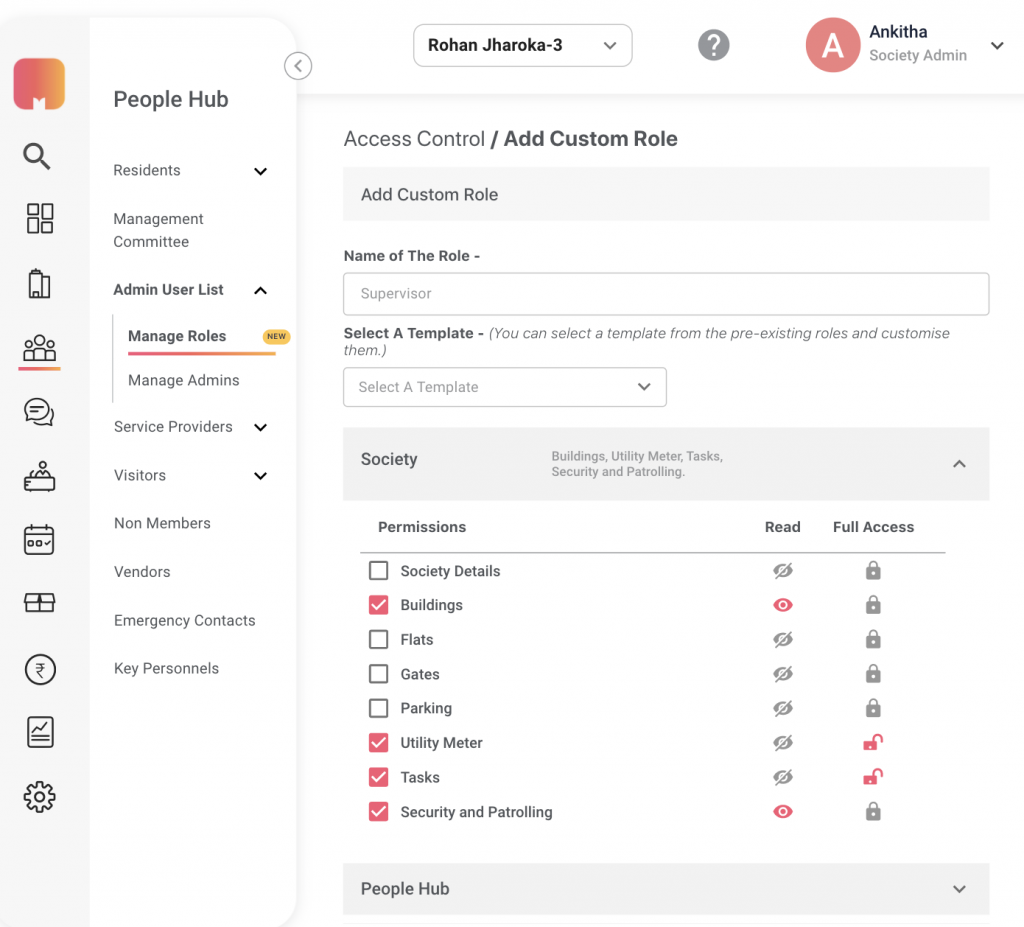
6. Select permissions based on the action the Role needs to take. Each permission can be assigned in 2 modes, ‘Read’ and ‘Full Access’ mode.
(A) Read: Only view access will be provided to the role of the selected feature
(B) Full Access: The selected role can perform all the actions of a society admin
These permissions can be modified in the future. Save the Role.
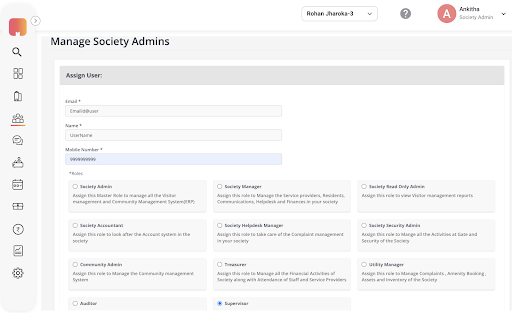
The created custom roles are assigned to the users via “Manage Society Admins”. Assign the Role to the user by entering the email ID, Name, and Phone Number.
For more information, get in touch with your MyGate Representative.
What’s new on MyGate
As more than half of the world is adapting to and even promoting remote working environments, housing societies shouldn’t allow themselves to conduct day-to-day operations poorly due to social distancing protocols. Adopting technology to run your society efficiently is an optimum solution for the foreseeable future.
Conducting group video meetings isn’t as tricky as you’d imagine, once you’ve gotten over the fear of the first dreaded rigamarole of getting everything organized among various committee members so that they can familiarise themselves with a new medium of communication. Digital natives may even have trouble with their checklists as the process involves group participation of diverse people.
Our guide will make it easier for Management Committees to hold society meetings online.
Whether it is the Annual General Body Meeting, Special General Meetings or Managing Committee meetings, they can all be conducted through video conferencing by following a few ground rules and preparing in advance.
Steps to follow before the meeting:
- Prepare the agenda for the meet
- Prioritise important topics for discussion
- Assign a time duration for each discussion so that every item gets enough time to be analysed and weighed according to urgency and importance
- Select the right medium to hold the meeting
- Send meeting invites to all participants
How to choose the right video conferencing app for General Body meeting during the pandemic
There are loads of free online meeting apps in the market, the most popular are Zoom, Skype and Google Hangouts.
However, the Ministry of Home Affairs has issued a warning regarding Zoom, stating that the app has major weaknesses that may make it vulnerable to data theft and hacking of calls midway. Several countries have banned Zoom, including US, Australia and Germany.
The MHA has also issued guidelines to use Zoom safely which you can read here.
Not all participants attending the meeting may be habituated to using video conferencing apps. Ensure you email a quick tutorial to assist participants in navigating/using the app so that they can join the group call and operate the app during the meeting.
Common group call etiquette for society meetings during the pandemic
- Send a meeting reminder on the day of the group call via email, WhatsApp or any other communication app.
- Appoint a moderator (Secretary/Chairman) to conduct the session.
- Make sure that the video/audio are on for each participant. Place the camera correctly, not too high or too low.
- Record the meeting for making the minutes later. All society meetings are required to have official Minutes of Meeting.
- Instruct the participants to have the meeting agenda in front of them (digital version/printout).
- Dressing appropriately for the meeting is a must. The physical settings of the room should be such that there’s enough light but no noise and other disturbances.
- Keep the app on mute when you’re not speaking so that there’s no distractions for other speakers.
- Do not speak out of turn or interrupt others when they’re speaking.
- Make sure each participant engages in the meeting and gets enough time and consideration while putting forth their views and suggestions.
- Keep body movements to the minimum and maintain eye contact.
- Do not carry on small talk and avoid discussing topics that are not in the agenda (unless something is pertinent to the topic).
- Chairman/Secretary should use the screen sharing options while discussing important financial reports, bills, legal documents, etc., to give the participants a visual walkthrough of the topic and inspire trust.
- Keep it short. While video conferencing is only a tool for replacing physical meetings, participants tend to get antsy and distracted when the meetings go over 30 minutes.
Things to remember
If you’re holding a special general body meeting, the pre-notification timelines will still apply, i.e. (5 day’s notice, minimum required quorum, and other proceedings), except everything will have to be done via email and no physical circulars should be handed to maintain social distancing protocols.
Know more about special general meeting guidelines.
Similarly, the notice period for organizing Committee Meetings also applies, which according to the bye-laws, are, “3 clear day’s notice of meetings of the Committee to all the Members of the Committee which shall state the date, time and place of the meeting and the business to be transacted there at, in consultation with the Chairman of the Society.”
The time to hold Annual General Body Meetings is usually August-September. Co-ops had been granted permission by the Maharashtra government amidst the pandemic to conduct their AGM as well as other day to day activities via digital platforms and further stated that decisions taken during such digital meetings will be considered valid.
Even if the threat of the virus subsides, virtual meetings may become the norm among housing societies as they provide all the conveniences of a physical meeting with the added perk of saving time.
As a potential tenant, you will have to make sure that the property you’re renting doesn’t come with any hidden or unexpected costs. While you’re surveying the home, you are already aware of the basic questions you might want to ask, like rent, tenure of the agreement, basic amenities like water heater, furniture, electrical appliances, etc. Check out our list of other equally important questions you might not remember to ask while the house-hunting process.
Is the security deposit amount fair?
There’s no standardised legislation for rental security deposits. But landlords usually charge between two to six months of rent as a deposit, depending on the landlord’s inclination, furnishings, and amenities in the house and the location of the property. If the amount is higher than six months of rent, you must negotiate with the landlord.
When is the rent due? How often does it increase?
Agree upon a date of rent payment that’s mutually convenient for you both, along with the method of payment (cheques/NEFT). Also, determine the grace period for payment. Landlords usually allow for a 7-10 day grace period from the due date. Rent is usually raised by 5-10% after a year.
What amenities does the property have?
Inquire what facilities are available for tenants to use on the premises, such as a gym, pool, sports complex, etc. If yes, ask about the rules, charges, restrictions, and timings for use.
Does the house have a gas pipeline?
Check if the house is equipped with a gas piping connection or has an LPG cylinder system. The former is ideal for a tenant, if not, check with the landlord if they’d provide you with an existing LPG registration that you can use during your tenure.
What is the penalty for breaking any clause of the agreement?
A rental agreement lists the number of items and fixtures in the house before moving in, such as furniture, electrical fixtures, electronic equipment, etc. You’ll be responsible for compensating the landlord if you damage anything. Before moving in, check if everything is in working condition. If the damage occurs due to other reasons, you can have it fixed yourself and present the landlord with the invoice. Similarly, if you break the lock-in period (3-6 months), you’ll have to forfeit a certain amount from the deposit.
What are the neighbors/neighborhood like? How safe is the building?
Confirm if there’s a guard on-duty 24/7. Also ask about the neighbours (type of people on your floor) and any special instructions you need to know about the neighborhood, e.g. ongoing construction work, nearby public transportation, etc.
What are the rules for guests/visitors?
Single tenants are often bothered by society to not invite guests overnight while others may be restricted to have get-togethers after hours. Find out if your landlord imposes such conditions on your stay.
When will the security deposit be returned after vacating the property?
Ideally, the landlord should return the deposit amount on the same day of the tenant vacating the house, however, if the landlord asks for a grace period for returning the deposit, include that as a clause in the agreement.
Is there free parking space available?
The tenant is entitled to get the landlord’s parking space.
Are the utility bills paid?
Make sure that the landlord agrees to pay any pending light, gas, or water bills from previous tenancies. Even if it’s a previously unoccupied home, there will be a monthly bill that the landlord needs to clear.
What is the extent up to which I can make changes within the rented house?
This doesn’t mean minor changes like moving furniture around or putting up new drapes. It means structural changes to the house of small and big kinds. For instance, if you have a split AC and the house is pre-designed with a window AC set-up, you’ll need the landlord’s permission to install the split AC. Drilling, installing your own fixtures, meshes, etc., will need to be pre-approved by the landlord.
What is the landlord/building’s policies on pets?
While some landlords may not have a problem with pets, society and the neighbours may take issue. Or it could be a pet-friendly building but the landlord may not want pets ruining their furniture and assets. There may also be a restriction on the number of pets and types of pets allowed in society.
How old is the building?
Landlords of older buildings may charge lesser rent but there may be problems associated with the building, like damp walls, broken fixtures, no parking space, etc. It’s better to know if you might face any trouble arising out of ill-maintained buildings.
Is the landlord willing to repaint/repair the house?
Upon the previous tenant’s vacancy, the landlord is expected to clean up the house and at least give a mini makeover to the house like repainting it or repairing any distressed parts of the house. If you find it’s in disrepair, such as leaky faucets, missing bulbs, damaged water heater, ask the landlord to fix it before you move in.
Be alert during the surveying/questioning stage and get a legally binding agreement made so that there’s no reneging from either party. Also, ensure that the landlord agrees to pay his share of the agreement registration fees/stamp duty at the registrar.
Enjoy contactless payments, instant receipts and great savings on society dues payments
The beginning of every month can be a stressful time. You’re keeping track of all the payments to be made – society dues, household bills, rent, and daily staff salaries. Add to this the hassle of having everything scattered across cash, cheques, e-wallets etc. Now remember that you might have to follow up with various people for receipts and acknowledgements. Already feeling exhausted?
This is where Mygate payments can be of help. It is a quick and easy way to pay and manage your community bills via a single app with a payment option of your choice and without hefty convenience fees.
Why pay society dues on Mygate?
- Contactless one-click digital payments
- View dues by date, month and year in the app
- Receive maintenance overdue reminders & never miss a payment
- Download receipts of paid dues and other society bills
- Pay via credit cards, debit cards, UPI or e-wallet options
- Payments will be acknowledged via SMS/Email
- 0% charges on RuPay Debit Card Transactions
- Access your entire transaction history in a single place
- Get updates on the current status of your payment
- Connect with Mygate support for payment related queries
How to pay society dues
- Tap on the ‘Community’ tab
- Click on the ‘Society Charges’ card
- Click on ‘Pay Society Charges’ on the invoice raised
- Select the mode of transaction – UPI, Debit/Credit Card, Net Banking, Wallet and click on ‘Checkout’
- Enter the details and click on ‘Pay’
- For UPI, enter the UPI ID For Debit/Credit Card, enter the card details
- For Net Banking, select the bank and login
- For wallet, select the wallet and login
- The convenience charges are displayed on the screen. Click on ‘Continue’ to make the payment
With Mygate Payments, you can also pay house rent, utility bills and domestic staff salaries the quick and easy way. Get started with Mygate Payments today.
**This feature is available under Mygate’s ERP Package. Contact your management committee or Mygate relationship manager to enable Maintenance Payments in your society today!
Mygate ERP comes with a number of other useful features including quick access to essentials, healthcare at home, digital society updates, and emergency alerts in case of crisis.

Laburnum Society in Gurgaon has much to celebrate. To achieve significant milestones in their journey to clean and green living, the residents have embraced the concept of mindful waste management and now champion the cause to anyone who wishes to learn and adopt best practices.
This condominium complex in sector 28 of Gurgaon houses 250 units and has an amalgam of multicultural influences. Their conscious waste planning supports a sprawling garden with a steady supply of compost from a well-organised composting system.
Pre-composting scenario in Laburnum Society
Prior to the launch of the waste management project, the garbage was disposed of through a vendor. However, there was no segregation since this was before the introduction of Solid Waste Management Rules 2016.
Turning motivation into solutions
It was the personal motivation that inspired a group of residents to take the first step. They reached out to influencers within the community to seek support and alliance. The group was able to enlist 11 volunteers to form an official waste management team. Everyone was on the same page and put in the work to create a strategy that would not only solve their waste management problem but also guarantee successful results.
The team put their brains together and came up with a plan. They visited 4-5 societies that had already been doing community composting. They also researched several composting models, recorded all the findings from society visits, and made a comparative analysis of every society’s composting system.
Finally, they chose Daily Dump’s Aaga which is an aerobic ‘hot pile’ de-centralised composter. The team found this solution to be ideal because it was an organic way to compost without using water and electricity. Aaga composters come in pairs – one pair is needed for every 18-20 homes or 18 kgs of wet waste per day.
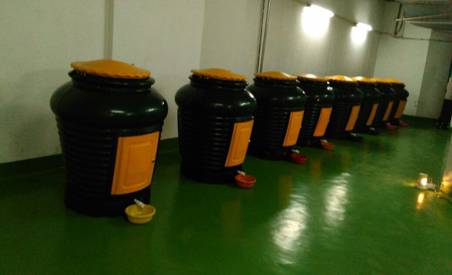
The team made sure that the residents were involved at every stage. Residents were sent emails a few times, keeping them informed of the composting initiative and their support was requested with gentle persuasion. At the same time, the Board Members were kept in the loop at every step of the way and nothing was executed without their approval. Pilot projects were taken up in some apartment blocks.
Gathering funds was also done with the standard procedure of the society. A budget was proposed to the Committee which was approved in the next AGM.
Building awareness was the next part of the project that the Waste Management team set out to do. The intention was to visit each household in the complex and clearly instruct the members on how to identify and segregate the different categories of waste. Since this was a lengthy and complex procedure in terms of the sheer amount of households and the fact that everyone had to be present to understand best practices first hand, a prior appointment was taken with each house and training was imparted in 10-15 minutes. The responsibility of residents to ensure adequate segregation, but the housekeeping staff and domestic help had to be trained for the rest of the endeavour. The domestic staff of residents were trained thoroughly in four batches in one day so that they could understand how to segregate correctly. The housekeeping staff received hands-on training on how to use Aaga composters correctly to begin the operations.
The system doesn’t require too much manual labour. The composters are rodent proof and the waste doesn’t need to be mixed or turned. Another benefit is that the composters is that they have an inbuilt tower that regulates the air so the society could ensure that no foul odour is produced.
Successes and challenges
Initially, it was difficult to ensure 100% segregation. A few households kept mixing dry waste like foil and paper into the wet waste. To remedy the problem, email reminders are sent from time to time to residents to ensure that new domestic staff is briefed on segregation.
Even though Laburnum society doesn’t measure output, they do compost around 250 kgs of waste daily and the process functions quite smoothly at present. Compost is distributed to residents for free. Every four months, each household can pick up 5 kgs of compost. There is a scheduled slot system for distribution and members have to bring their own bags to take home the compost. The compost is also used for gardening in the common areas. The society intends to not only continue composting wet waste but also has plans to further segregate dry waste and adopt best practices for recycling. The residents have been helpful and receptive throughout the entire journey.
Lessons for other societies
The team is able to give useful inputs to other societies based on their experience. They say:
- Do not go to war with either residents or the RWA. Their support and cooperation are essential.
- Be very sensitive, listen to everyone, reach out to the community with positive messages.
- Choose a system that does not waste water or electricity and don’t use any system that burns the waste and promises ready compost in 2 days. Compost is formed through a process of degeneration so give it time.
- Work very closely with the housekeeping team because they are the true waste warriors. Make them understand the ‘WHY’ of the initiative before you even get into the ‘how’. Provide refreshments when you meet; give them an annual award; let them feel proud of the SWM project.”
- Use epoxy paint for the waste management area and oil paint of a cheerful colour on the walls for good aesthetics. The area should be well-lit and citronella oil vapourisers can be used to keep it smelling good.
- Installing a couple of exhaust fans to ensure that there is no odour.
- The area should be kept spotlessly clean to keep rodents and insects at bay.
Laburnum is yet another ‘lead by example’ story that should resonate with other societies who may have contemplated taking action towards in-house composting and segregation but may have not found enough motivation. Personal drive combined with clever planning is key to getting the job done right. Most of all, alignment of minds towards a greener community is the secret ingredient that ensures success amidst setbacks.
Up until now, the rent control laws in Delhi have allowed for tenants to make huge profits of expensive properties in prime areas paying less than Rs 500 a month. Citizens have even appealed to the High Court to challenge the grounds on which it stands as redundant, unnecessary, and highly biased and to compensate landlords for the monetary losses and emotional/mental trauma due to tenant harassment.
In this article, we will take a comprehensive yet concise look at the basic provisions and problems associated with the infamous Delhi Rent Control Act 1958.
Background – how the Act came into place
Delhi Rent Control Act was established in 1958 and covers areas under the New Delhi Municipal Committee, Delhi Cantonment Board, and all urban areas under the purview of the Delhi Municipal Corporation.
The Delhi government deemed the Act necessary due to the arrival of economically weak migrant workers who came to live in Delhi in order to seek employment. Its purpose was to protect the rights of the tenants and to stop the landlords from evicting them unduly or forcefully and from abusing their power as property owners and charging irregular rents.
Provisions of the Act
Until the monthly rent goes above Rs 3500, the DRC applies. Any disputes and rental properties above Rs 3500 falls under the purview of the Transfer of Property Act 1882.
An amendment in 1988 allows the landlord to increase the rent by 10% every three years.
If there’s no written contract/agreement, the tenants are allowed to pay the rent by the 15th of every month and demand for a receipt.
If the landlord has done any renovation, he can increase the ‘standard’ rent but the charges cannot exceed 7⅕ % of total expenses incurred.
Tenants are allowed to sublet the property.
If the rent is paid duly by the tenant, the landlord cannot evict them.
The Act covers the control of rents and eviction, and of rates of hotels and lodging houses, and for the lease of vacant premises, units rented out for public hospitals, educational institutions, public libraries or reading rooms , and orphanages.
The tenants are liable to pay the following:
- charges, not exceeding fifteen percent. of the rent for the amenities as specified in Schedule II as agreed to between the landlord and the tenant;
- maintenance charges at the rate of ten percent of the rent;
- the property tax to the local authority.
Challenges created by the Delhi Rent Control Act
The Act is considered greatly archaic as even though it started out as a legal action to protect the rights of underprivileged tenants, it has created an opposite effect and become a means for tenants to exploit landlords.
As long as the tenants pay the rent on time, no matter how negligible, they’re protected under the law from eviction. Landlords see no benefit in repairing or structurally renovating ageing, dilapidated rental properties as they cannot fully recover the expenses from tenants and receive no noticeable increase in the rent even after three years of increasing it by 10% because the ‘standard’ amount itself is very low.
The only legal grounds on which the landlord can evict the tenants are non-payment of rent arrears within two months, subletting without prior permission, nefarious and illegal activities, not using rented premises for six months, or if the landlord wants to use the property for other bonafide purposes.
But this procedure is also tedious for landlords as they have to file a petition at the Rent Controller or in the Court and send a legal notice to the tenant which can also be contested by him. Maintenance of property becomes an expensive affair as the returns are not fair.
The proposed solution – The Model Tenancy Act 2019
Released by The Ministry of Housing and Urban Affairs in 2019 to address the current problems of rental properties in India, this Act intends to put in motion a fair and transparent system to provide impartial benefits to both tenants and landlords and to offer a quick resolution for rental disputes.
It proposes to form Rent Authority Department, Rent Court and Rent Tribunal, cap security deposit for two months, access to basic essentials, reporting every rental agreement to Rent Authority within two months, issuing a Unique Identification Number to each agreement.
Landlords will receive many benefits under the Act such as fixing or revising the rent by the tenant, if the same should be agreed by the tenant, and deduct the amount from the security deposit or can ask the tenant to pay the amount if he does carry out scheduled or agreed repairs in the premises.
When passed and implemented across the country, the Act aims to succeed in eliminating all ineffective and archaic rules like the Delhi Rent Control Act.