

We’ve all come across that obnoxious neighbor who bangs his door shut loudly to jumpscare people three floors down, dumps banana peels straight from his balcony on to the ground, plays loud music when the world is slumbering peacefully, lets his unleashed pet out in the open to bark and claw at unsuspecting passers-by, and, worst of all, the repeat offender who blatantly flouts every rule just to be a rebel without a cause. In all fairness, we all have committed some form of misdemeanor much to the inconvenience of our neighbors, albeit not always intentionally. This article covers the fundamental duties of a housing society resident in order to keep our occasional gaffes under check and help us understand the basics of acceptable behavior. Let’s take a look.
Maintenance of residence
Members and residents are required to keep their flats/homes and nearby premises clean and habitable.The residents should also maintain proper cleanliness etiquette while using common areas, parking lot, etc. and not throw litter from their balconies and windows.
Permissible structural changes
If any alterations or additions are in order, the residents should first submit an application to the Secretary of the society, providing him with the specific details of the process and plan.
Payment of dues
Members must regularly pay the maintenance charges and all other dues necessitated by the society.
Attend meetings
Bye-laws mandate members to attend at least one general meeting in five consequent years. But ideally, the residents should regularly check the notice boards for meetings and attend them for their own benefit. Members should also participate in the annual and special general body meetings to stay updated with the affairs of the society.
Follow bye-laws
Residents should be well-aware of society’s rules and obey the provisions of the bye-laws.It is highly recommended that members obtain a copy of the model bye-laws from the Secretary of the society.
Allow inspections
The Secretary, after prior intimation to the member, inspects the flat/home to inspect its conditions and to ascertain if any repairs are needed. Members have to allow for such inspections at a mutually convenient time.
Carry out repairs
If the Secretary recommends any repairs, renovations based on his inspection, the residents should carry them out at their own expense with the help of society-appointed architect. If they fail to do so, the society carries them out after giving a notice to the member and recovers the dues from him.
Storage of dangerous/unauthorized products
Residents should not, without prior permission of the society, stock any toxic or combustible goods which requires a permit from a competent authority.
Not conduct unlawful/criminal activities
Residents must not use their homes or society premises/property to engage in criminal and illegal activities of any kind. Serious legal action/penalty could be imposed if the members are found guilty.
Respect neighbor’s privacy
Residents should not be found intervening in the private matters of their neighbors unless solicited for their counsel. Behavior such as snooping through their mail, spreading rumors and creating disharmonious scenarios is unacceptable.
Build good rapport
Residents should maintain good relationships among one another to prosper as a society collectively.This includes being neighborly, cooperative and helpful when situations demand.
Report wrongdoings
If however, as a resident of a society, you suspect any suspicious behavior, criminal leanings, misuse of residence, financial malfeasance or any other incident of misconduct that is in breach of society bye-laws, you should immediately bring it to the notice of the managing committee.
Not create nuisance
Residents should not hold loud parties at odd hours so that others are not inconvenienced. While using the playground, residents should follow the time schedule for usage so that loud noises do not disturb other members.
Pet etiquette
Members should not keep pets, including but not limited to birds, dogs, cats, reptiles, etc. without obtaining prior permission from the managing committee. The society, on the other hand, should make clear guidelines regarding keeping and maintaining pets as per provisions adopted in the model bye-laws or making a resolution in any general body meeting. Members are required to train their pets so that they do not cause harm or nuisance to other residents and also wash their pets regularly so that no foul smell emanates around common areas during play time or daily strolls.
Maintain records and documents
Residents are required to maintain and safeguard all documents, agreements, share certificate, and other paperwork that is executed between him and the society.
Using residence for personal business
If a resident intends to use his flat or home for the purpose of business such as a yoga/meditation class, dispensary, coaching class, baby nursery, beauty parlour, or any other venture, they could do so as per society bye-laws. However, any code of conduct made during general body meeting should be followed and members should ensure no other resident is subjected to nuisance or trouble by their profession.
Parking responsibilities
Parking areas allotted by the society are the member’s rightful slots outside of which they should not park their vehicles. Other vehicles such as bicycles, children’s scooters should also not be haphazardly parked within society premises or placed in common areas without prior permission.
Provide accurate information
At the time of application to co-operative housing society and at the time of registration, members are mandated to submit correct and verifiable information regarding themselves with legitimate documents. Fraud in identity, omission of vital information and misrepresentation of facts are not allowed.
There is always that small percentage of people who need to be explicitly told these commonplace rules that arise from common sense. Most of our good behavior instinctively stems from an empathic, understanding human nature, which is why we would not intend to do that unto others which we would not have done unto us. At the end, we must not only be familiar with our duties as a member of a society, but also abide by them for an ideal co-habitation in a gated community.
A cooperative housing society is a beacon of good governance and peaceful co-existence. An unfortunate but true reality is that some societies meet with an untimely demise and move to dissolution by choice and sometimes by coercion. This article explores the various factors for the dissolution of the society and step-by-step procedure to be followed and sheds light on unavoidable consequences as a result of dissolution.
Why does housing society dissolve?
The most common reasons for a housing society to be dissolved are bankruptcy, inability to meet its objectives, involvement in illegal acts, inadequate number of members, ceasing of functioning over a period of time, contravention of law, or irreconcilable dysfunction.
How a society dissolved?
A society can be dissolved by a) its members b) the Registrar c) the Court or d) the Government. Below is the procedure for dissolution.
- A special body meeting has to be called upon where it has to be decided if the society intends to dissolve forthwith or at a later time agreed upon by the members.
- A notice should be sent to the members, creditors, vendors, and to any associated societies and entities with which it may have entered into a contract.
- Such a resolution should be passed by 3/5th majority votes.
- As per the rules of the society, disposal and settlement of the society has to be undertaken. This includes settling claims and liabilities.
- Within 15 days of the authorized resolution at the meeting, the society should send a copy of it to the Registrar, as without their approval, the resolution cannot be considered valid. A report of the settlement has to be sent along with details of any surplus left over. If the State Government is a member/contributor/affiliate of the society in any form, its approval is needed for dissolution too.
- The Registrar inspects the case and if he is satisfied with the due process undertaken by the society and ensures that no liabilities or assets, he passes the order to dissolve the society and deletes the name of the society from the register of societies and issue a certificate of dissolution to the society.
- If the Registrar is not satisfied after review, he issues a notice in the official gazette (the cost of which is to be borne by the society) of the proposed dissolution, thereby inviting objections, appeals from members and for the disposal of unpaid dues towards claimants and creditors within 2 to 3 months.
- If no objection is raised and no member comes forth to appeal against the resolution, the order is considered passed after the expiry of the time period of 2-3 months. If an objection is raised during that period, the order is not considered in effect until the Appellate steps in and takes the process ahead.
Section 13 of the Societies Registration Act 1860 includes the following provision – “In case of any dispute relating to adjustment of affairs of a society in case of dissolution, the matter has to be referred to the Principal Court of Civil Jurisdiction of the District where the Registered Office of the society is situated.”
There have been instances where the society does not intend to dissolve itself but the Registrar or the government intervenes and dissolves it for the following reasons:
- unlawful activities
- object clause has not been fulfilled
- members are below the required number of seven
- contravention of the provisions of the Societies Act
- society has ceased to function for more than three years
- society is insolvent and cannot pay its debts and liabilities
Before passing such resolutions, the Registrar asks the society to produce a show-cause in order to stop the dissolution. If the Registrar is not satisfied with the show cause, he may move the court for resolution.
No profits for members
Once the society is dissolved, its activities come to a standstill, and even after the settlement of claims and pending dues, the profits (if any) are not distributed among the members. Instead, the law states explicitly that profits are handed over to ‘some other society, to be determined by the votes of not less than three-fifths of the members present personally or by proxy at the time of the dissolution’. Some states have a subsection clause which states that if the members decide by a majority, the property after settlement may be conferred to the State Government for utilisation in any other project.
As such, a society founded on strong rules, efficient financial management and watchful managing committee members thrive for a really long time, handing over its reins to its inheritors in a sound and wholesome manner. If a society is truly dysfunctional and can no longer bear its own burden, or if deemed by the Registrar to be involved in criminal acts, its Managing Committee should turn to the rightful legal procedure for dissolution to avoid further repercussions.
Are you establishing social distancing rules within your community? Maybe you’d like to spread the word. But, how? Print-outs on the society notice board are sure to go unnoticed with everyone at home all the time.
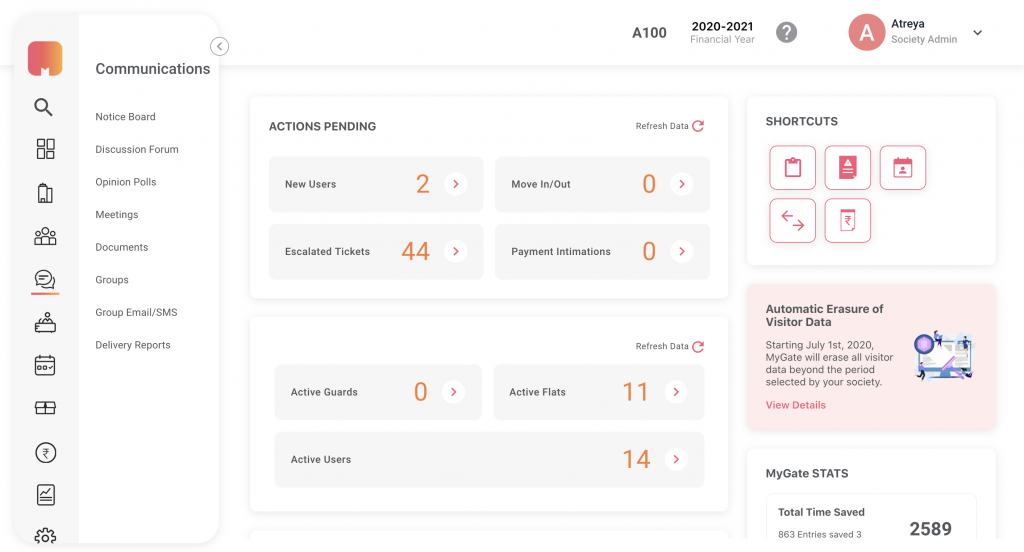
Well, here’s a solution. With the ‘Communications’ feature on Mygate, you can broadcast community updates and always keep residents aware of what’s coming via bulk SMS and bulk email. The Communications feature also allows you to discuss society matters, create polls and send meeting invites, while residents can initiate and participate in need-based, in-app discussions.
What can be done with ‘Communications’ ?
Send Bulk SMS and Bulk Email: Available to the admins
Do you want to provide the list of essential vendors to all the residents of your society? Choose the Bulk SMS or Bulk Email feature to broadcast crucial messages to residents and ensure they don’t miss out on important community updates.
Start a Discussion: Available to admins and residents
Have ideas to maintain social distancing within the society? Check into the ‘Communications’ section and pen down your suggestions to start a discussion. What’s more, you can also participate in other discussions, and comment on other ideas that excite you.
Are residents not following the social distancing rules implemented in the society? Don’t stress! Just start a discussion in the ‘Communications’ section and solve this issue. Want to get in touch with a resident? The discussion forum can also be used as Yellow Pages within the society.
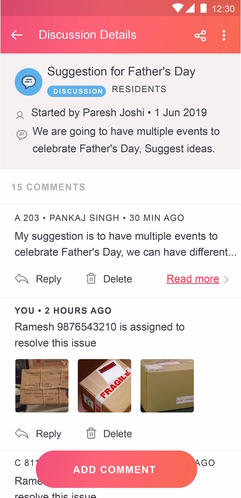
The ‘Discussion Details’ screen lists multiple ongoing discussions with an option to add a comment or leave a reply.
Create a Meeting: Available to the admins
Looking to call for a meeting (over Hangouts or Zoom, maybe)? The ‘Meeting’ feature will help you create an invite just as you would do on iCal or Google Calendar. It allows you to list the meeting description, agenda, date & time, and select groups to send it to (committee members, owners, tenants, etc)..

The ‘Meeting Details’ screen lists the meeting whereabouts such as description, agenda, venue, date and time, and attendees.
Run an Opinion Poll: Available to the admins
Create opinion polls to understand what your residents want and make quick decisions. ‘Should vegetable vendors be allowed inside the community?’… run a poll and know what the residents want.

Your latest feeds on the ‘Communications’ screen showcasing current meetings, events, polls and discussions.
How It Works
1. Open the Mygate app;
2. Click on the ‘Community’ tab on the top right section of your screen and select the ‘Communications’ card.
3. You can either directly start a discussion by tapping the ‘Start Discussion’ button or choose an option from the ‘Type’ drop-down at the top left section of your screen.
4. As per your need, you can choose to create a meeting, start a discussion or run a poll.
5. Recent interactions are listed on the ‘Communications’ screen. You can comment, hide, turn down or accept meeting invites using the quick actions provided.
Contact your management committee or Mygate relationship manager to enable Communications for your society today!

Bylaws are a set of instructions and rules for a society to function. They come into effect once the housing co-operative is formed and are universally applicable to everyone. They are formed on the basis of the state’s co-operative societies act. However, based on the structure, requirements and membership, there are various permutations and combinations in bye-laws that a society can adopt at the time of registration and get them approved from the Registrar. Expansive as the bye-laws are, they do not always have the solution or workaround for every unforeseen circumstance. As it evolves, a society has the right to amend its bye-laws as per provisions of the law.
A society can amend its bye-laws when a pre-existing bye-law fails to meet its current situation or need adequately. For example, if your society followed a per square feet rule to arrive at a monthly maintenance charge, but underwent redevelopment and now wants to apply a hybrid maintenance calculation. In such a case, the amendment is necessary. Some societies may be facing a problem with meeting the required quorum for general body meetings and may want to reduce the required number. Others may be struggling with code of conduct within members and want to insert specific sub-clauses with respect to maintaining cleanliness, instructions to use common areas, etc. Many societies also incorporate a new penalty system to elicit better compliance from its members. Societies often put out new rules on notice boards or hand-deliver them to the members instead of amending bye-laws. However, to amend the bye-laws is a surefire policy to ensure the new rules are applied effectively.
Procedure to amend Bye-Laws
No bye-law can be amended or altered unless the members have been notified 14 days before the general meeting in which the amendment resolution is to be passed.
- The society should pass a resolution to amend a bye-law in the general body meeting after giving a notice to all its members with respect to the proposed bye-law.
- The resolution should be approved by 2/3rd of the majority from among members present in the meeting.
- From the date of the meeting in which the resolution was passed, the society should submit the resolution to the Registrar within two months.
- You are required to submit the below-mentioned documents when you send an application (with a non-judicial court fee stamp of Rs 25) to the Registrar:-
- Copy of the existing bye-laws and the revision/ amendment to be made along with substantial reasons that justify the amendment.
- Four copies of the bye-laws as they will appear after the amendment, signed by the Managing Committee’s authorized office bearers.
- One copy of the notice given to members about the proposal of the amendment of the bye-laws.
- Any specific documents required by the Registrar
Once the Registrar receives the application, he examines the proposal thoroughly and after he is satisfied that the amendment is for the benefit of the society, solves a particularly persistent problem, helps better functioning and is not in contradiction to co-operative societies act, he registers the amendment and gives the amended version of bye-laws to the society, certified and officially approved.
If the Registrar fails to close the application within 2 months, he should pass it on (within 15 months from the end of the 2-month window) the same application to an officer on a higher designation than him within the same office.
If the Registrar finds that a modification to the proposed amendment may be needed for it to be more effective, he suggests it to the society, explaining the rationale in writing.
Can the Registrar amend the bye-laws without the society’s own initiative?
If the Registrar believes that a particular amendment to the existing bye-laws is in the interest of a housing society and serves a bigger cause of the co-operative movement, he has the power to direct that amendment to be incorporated by the society within a specific timeframe decided by him.
The Registrar makes it mandatory to implement the amendment within the given timeframe. If the society fails to do so, the Registrar gives them an opportunity to present their case and justify the failure to abide. An issued and certified copy of the amendment is provided to the society which makes it legally binding. The society can make an appeal if there are any justifiable constraints in the amendment, however, it should be noted that the legal power remains with the authority to impose an amendment.
Ideally, all members should obtain a copy of the bye-laws from the housing society’s secretary, so that when an amendment takes place, they have a frame of reference to fall back on and understand why the amendment was made in the first place. The society is required a copy of bye-laws in its office for members’ perusal.
As a regular resident of a housing society, it can be tough to imagine the behind-the-scenes operational framework that holds the entire bulk of a gated community. A significant aspect of a well-run society is how it maintains its records so that when push comes to shove, no fingers can be pointed on a misplaced agreement or a missing register entry. Here’s where the conscientiousness and even the dexterity of committee members is tested. So how should a society preserve and maintain its records and what records are to be maintained permanently and which ones should be managed for the long term? Let’s find out in this article.
Record Maintained by society
A society is liable to maintain the below-listed records on a permanent basis:
- Minutes of Meeting Book of general, special and annual meetings
- Member Register
- Register of Shares, Debentures and Bonds (with counterfoils)
- Stock Register/Dead Stock Register and Property Register
- Cash Book
- General and Personal Ledgers
- Model Bye-laws
- Audit and Inspection Reports/Notes (internal and govt auditors)
- Audit Rectification Reports
- Library Register
- Investment Register
- Fixed Deposit Ledger
- Purchase and Sale Register and all pertinent correspondence
- Power of Attorney Register
- Declaration Forms and Nomination Forms
- Indemnity Bonds of lost share certificates/lost receipts, etc.(if any)
- Membership applications
- Shares Applications along with Share Transfer Applications in a separate section in the Share Register
- A book of rules, codes of conduct, bye-laws, bye-law amendments, Registration Certificate, leaflets, circulars, notices, etc.
- File of official communication with Registrar, local authorities, municipal corporation, other societies, banking/financial institutions, Auditor, Architect, Builder, Contractor, etc.
- File of Conveyance Deed, Title, Contracts, Agreements, Insurance Policies, Loan Applications/Grants
- Sanctioned Plans, Layouts, Allotment of flats, shops, etc.
- Staff Records
- Sinking Fund Register
- Bank Passbooks, Annual Statement Accounts, P&L reports, etc.
Record Maintained by society for 5-10 yrs
Other records to be maintained for a minimum period of five to a maximum of ten years:
- Collection and Bills Receivables Register
- Records of defaulters with interest and paid/unpaid columns
- Repair/maintenance records
- Expense/purchase/earning register for society’s functions/ rented out premises, etc.
- Complaints or grievances filed by members, vendors, any other
- Branch Ledgers/Draft Register
- Payment slips with counterfoil
- Staff salary book
- Inventory Register
- Current/saving bank account records, pertaining correspondence
- Account opening records/ branch records
- Cheque Books, Current and saving account deposit/withdrawal records and ledgers
- Specimen Signature Forms
- Loan (lending/borrowing) Ledgers and (minimum to maximum) Credit Limit Register
- Cash vouchers and petty cash registers with payment received counterfoils
- Credit Register with creditworthiness reports
- Other books and records necessitated by the managing committee for maintenance
Why should a society maintain proper records?
The simplest and the most compelling answer to that question is accountability. Over and above that, it is also mandatory to comply to the housing society’s record preservation laws clearly described in each state’s model bye-laws, Co-operative Societies Act and Cooperative Societies Rules. The Committee’s Secretary and Treasurer are jointly responsible for preserving, maintaining and updating all and any records mentioned above. The Registrar, government (and even members) have the right to inspect society’s records (especially audit reports) with a general or special order and call for them to be produced after a notice. Once the Managing Committee’s duration in office is completed, the handover should be done in the first meeting of the new managing committee. Office bearers who fail to handover records with due diligence are penalised under the law and the Registrar may decide to bar them from contesting elections too. The records should be made available to members for inspection. Immaculate record keeping discourages committee members from any fraud or embezzlement and leads to a definitive paper trail in case if any unintentional mix-up occurs.
How should a society preserve its records?
The Secretary is responsible for keeping the records safe within the society’s office. If not, the society should preserve them at another fixed location. Many societies make digitally scanned copies of important records with back-ups, a highly recommended measure for safekeeping. In a society with over 50 to 100 members, many societies hire a salaried office manager and at times even multiple managers (full time or part-time) assigned to each block so that the recordkeeping is well taken care of along with overall supervision. However, such a person should be qualified with a diploma in co-operative housing society management or qualified as per the directives of the Commissioner for Co-operation. Smaller societies usually entrust the Managing Committee office bearers with record keeping duties. Societies can find free crash courses on record maintenance online in order to educate themselves in the essentials of record keeping.
Another vital ingredient of record keeping involves destroying old records. After several years of operation, records keep piling up, making it highly cumbersome and inconvenient for the office bearers to safely preserve them or to even find space to keep them. This is the reason why a provision has been made by the Commissioner of Cooperation in agreement with the Registrar of Co-operative Societies for societies to be able to destroy their records after a prescribed period of time. Of course, the records that are to be maintained permanently cannot ever be destroyed. So the office bearers have to be careful while sifting through records to make sure only the dispensable ones are removed for disposal. The ones that can be disposed off, however, have to be first compiled and circulated among every member of the Managing Committee so that no oversight can occur and if anything crucial is put out for destruction in error, many pairs of eyes can help identify the mistake. Only after the committee members have approved the records for disposal, can the final destruction of records should commence. Shredded paper can be sent to a recycling plant instead of being dumped in a landfill.
Running a gated community smoothly requires managing utilities, amenities, and security efficiently. Mygate platform supports the Management Committee (MC) in automating these tasks, ensuring seamless operations and a convenient, organized, and satisfying community living experience for all residents.
This week, we had the opportunity to interact with Prasad Shetty, one of the nine members of the MC at Beary Harmony Homes, Hennur, Bangalore. Mr. Shetty explained to us how the committee is adopting a mix of practical and digital solutions to ensure a hassle-free, more secure experience for its 150 families.
What made you feel the need for a society management app?
It was required because ultimately the older ways of communications were failing. We were repeatedly facing issues with the intercom. The security guards were making intercom calls to the residents, unaware of the fact that there is no one to answer on the other end.
Also, we wanted to minimise human errors in ensuring safety at the main gates, and this could only be achieved by automation, digitisation – in short, modernisation. I was aware of Mygate and heard a lot of other people in my network using it. However, we were looking to hire a security agency that was thorough with the app.
How is Mygate helping Beary Harmony Homes?
Residents now know who is seeking entry approval and can control who is coming to their house, that is the biggest thing! The other aspect is the notice board, all on one app. you don’t have to access different apps or check emails separately to keep track of community-wide announcements.
The security process is streamlined with the approval and denial system in place. Otherwise, traditionally, residents would get a call from the security intercom every time there was a visitor. The delivery management has become smooth. Whenever the delivery guys come in, Mygate showcases the executive’s details for the residents to be aware of who should they expect and when.
How are the residents accepting the change?
Oh, they’re absolutely fine! Initially, of course, there were a lot of questions and varied views. It took some time to get all their apprehensions removed gradually. We had to show them value and had to deal patiently. Once the residents started using it, they realised the benefits and they are pretty comfortable now.
What makes your job challenging as a member of the committee?
In a community, the challenges comprise dealing with different mindsets and behaviour patterns. Trying to get everyone used to a certain way of living and adopting new standards is always difficult because there are so many people involved. So, getting everyone on the same page is a humongous task and a continuous challenge.
So, how do you tackle this challenge?
We have to make people understand the value and utility. If there are traditional systems that are not yielding desired results, we have to get rid of them. At the same time, a new initiative has to be launched to achieve the desired objective, for which we have to get people on board and promote it.
We conduct monthly meetings where we invite everyone to come and talk to us if they have any particular issue. We address concerns one-on-one so that people don’t feel left out. In fact, we have weekly meetings among the committee members to brainstorm, evaluate and plan around how the community experience can be improved.
How has Mygate simplified your life as a committee member?
Mygate’s platform streamlines accounting, billing, community management, and security. Bill payments are smooth, visitor management is seamless, and the Management Committee has full visibility into every activity, making society administration efficient and hassle-free.
What other solutions are adopted to offer a better community experience to all?
Well, we have introduced practical solutions like waste segregation. The wobbly stones in all the staircases are replaced with a slip-resistant material to offer a better grip. Also, our building is equipped with a ramp that runs until the lift for wheelchair access in case of medical emergencies. We have provided a wheelchair, ready to be used by anyone in need.
We have reduced the power consumption by more than 20% over the years. This is achieved by turning off the lights in common areas when not required and keeping the electricians and office management on their toes to see that power is not wasted.
We reward our housekeeping staff with hampers to keep them motivated. As a practice, we engage in regular discussions with residents and leave the floor open for them to share concerns or ideas, at any time.