


India’s Electric Vehicle (EV) market is growing rapidly, with around 2 million vehicles expected on the road by 2026. To meet their charging requirements, it is estimated that the country will need 400,000 stations and, as 80% of charging takes place at home, Resident Welfare Associations (RWAs) will soon be expected to provide the necessary infrastructure.
This document contains all the information an RWA needs to know on EV charging infrastructure, from why it’s needed and its costs to implementation and safety precautions to be taken. We have also included information that would be useful in selecting a configuration for your society and answered queries likely to be brought up by the wider resident body.
RWAs & EV charging infrastructure
Only a small number of RWAs today offer charging infrastructure, but this is changing rapidly as sales increase and the government, too, makes charging infrastructure more attractive. Several states have already released EV policies to increase uptake of EV infrastructure. Incentives range from financial incentives (Maharashtra and Delhi) on installing charging stations to providing property tax rebates to societies. A few state distribution companies (e.g. DISCOMs) are providing dedicated connections for EVs with subsidised tariffs.
1. Current legislation
The Ministry of Housing and Urban Affairs (MOHUA) amended its Model Building Bye Laws (MBBL) 2016, to recommend that 20% of all parking spots be equipped with EV charging. It also states that the building premises will have to have an additional power load, equivalent to the power required for all charging points to be operated simultaneously, with a safety factor of 1.25. The amendments are applicable to all buildings except independent residences.
Going forward, EV charging would be a mandatory requirement for new buildings as well as existing ones. Impending Government of India regulations mandate installation of charging points in housing societies, provision of power backup and allocation of a certain amount of dedicated power for charging EVs.
The Ministry of Power’s recent guidelines mandate all states to notify EV charging infra mandates for RWAs, office spaces and commercial establishments with parking provision. Over the next 6-12 months, there will be compliance requirements that every RWA will have to adhere to.
2. Growing interest among RWAs
A recent survey conducted by MyGate among 500+ RWAs confirms that more of them are interested in installing EV charging infrastructure within their societies in response to growing EV adoption among their residents.
Box 1.1: Results of survey conducted by MyGate among RWAs
3.2% of the societies have already installed EV charging infrastructure
24% of the societies plan to install EV charging infrastructure in the next 6 months
21% of them aim to install it in the next 6-12 months
30% of the societies surveyed plan to install EV charging infrastructure in the next 3 years
33% RWAs in Mumbai & 31% in Pune aim to install EV charging infra in the next 6 months
40% RWAs in Bangalore and 37% in Pune aim to install EV charging infrastructure in the next 1-3 years
Currently installed infrastructure was highest in Bangalore (8%) followed by Pune (3%) and Delhi (2%)
3. Challenges
The Automotive Research Association of India (ARAI) recommends using electric vehicle supply equipment (EVSE) to charge any EV safely. But most RWAs today are not providing exclusive infrastructure for EV charging.
Since EV ownership is still nascent, the need for EV charging is still considered an individual one. Most EV owners are currently charging their EVs through common power sockets in the society parking. Others take a direct electric line from their existing residential connection to their parking lots where they use 15A/240V sockets for charging. A few 2-wheeler EV users (with removable batteries), charge the batteries in their homes. Such ad-hoc solutions are a logistical challenge for residents and are not designed for safe EV charging. They could lead to a lot of unsafe wiring, posing risks of fire accidents and electricity load issues during peak usage. As EV adoption increases, it could become a potential hazard. Neither of these approaches is scalable or sustainable.
A few RWAs have set up community charging sockets where several vehicles can be charged simultaneously at one location, but they face challenges in metering and billing of users.
Box 1.2: How to safely allow residents to draw power directly from their homes to their parking lots
RWAs need to carefully evaluate the safety concerns arising from ad-hoc electrical connections. Consider the following safety guidelines:
– Define cabling standards for residents to follow during private installations
– Route the cabling through your electrical contractor or have the implementation monitored by your electrical supervisor to avoid any potential threats
– Install a low cost charge point with adequate safety layers to protect against load surges and voltage fluctuations. Charge points with auto-power cutoff options on full charge and additional safety features are safer than a regular 16A socket
4. Available solutions
Every RWA should plan its charging roadmap right from the initial adoption stage. Once a society has 5-10 EVs, it can install common charge points in the community/ visitor parking lots. Installing community chargers will encourage more residents to make the switch to EVs.
Electric vehicle charging is available at three levels based on the rate at which a vehicle is able to recharge. Higher levels indicate faster charging rates but are also typically costlier and may require upgrades to a site’s electrical infrastructure. The following sections provide a brief overview of the various levels of EV charging.
Table 1.1: Comparison between different charging methods
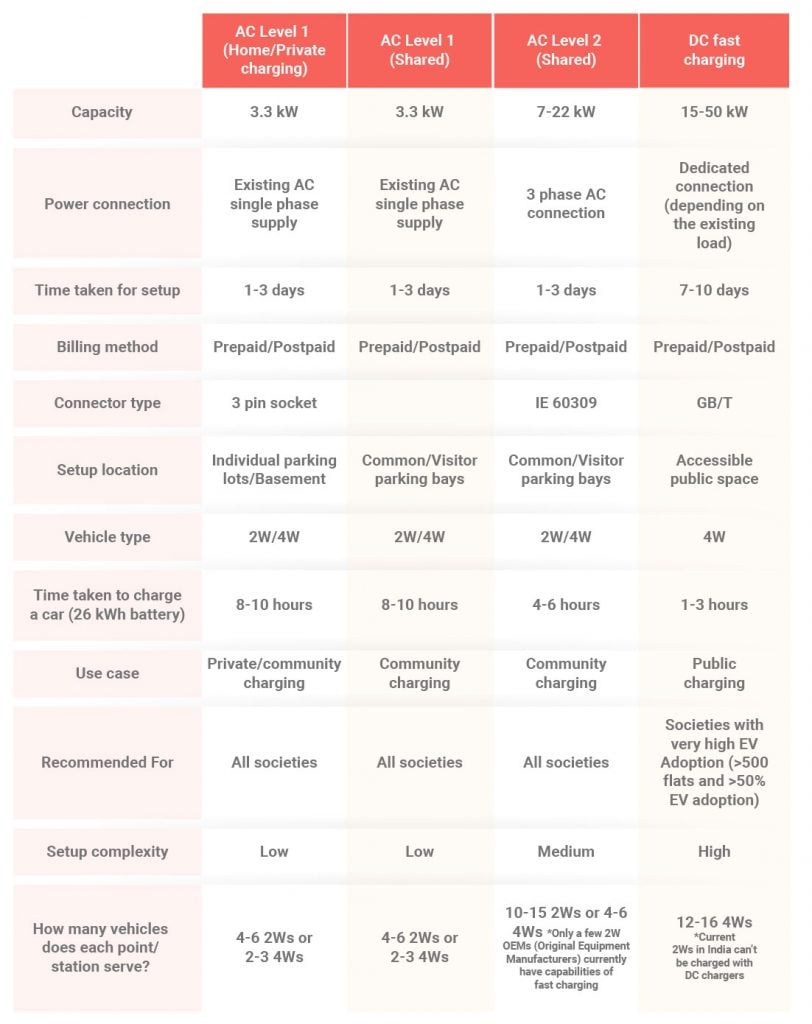
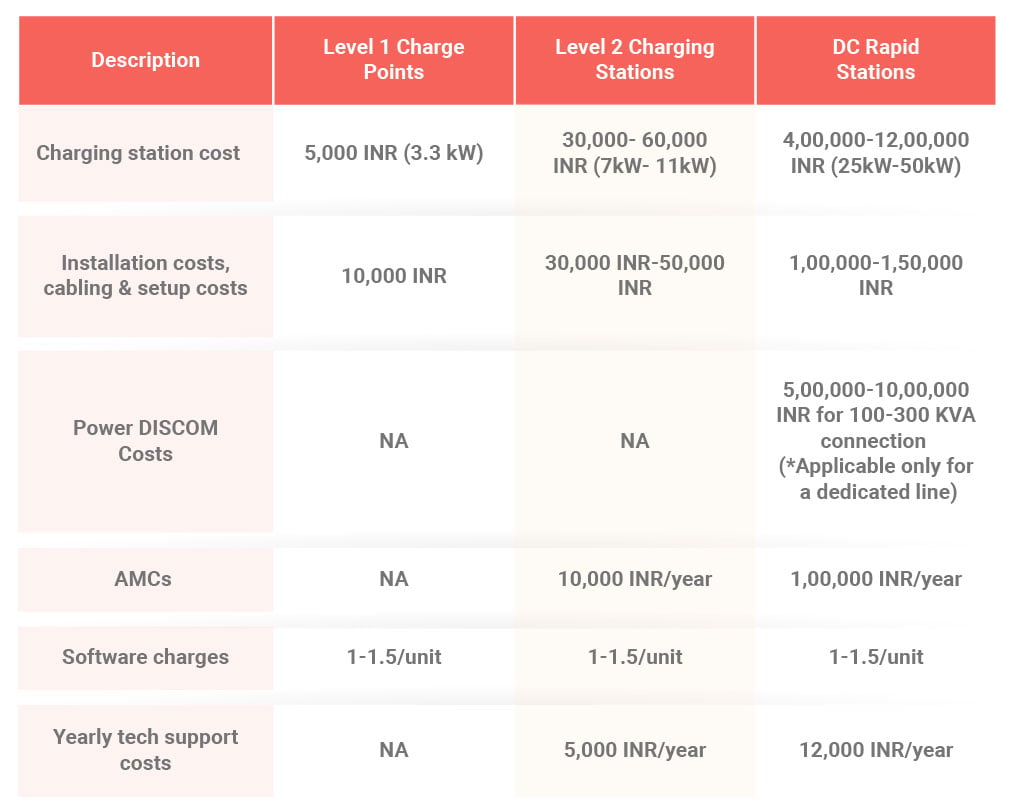
Table 1.2: Installation, setup and maintenance costs for charging stations
Box 1.3: Common pitfalls to avoid
1. DC rapid charging
This is the fastest EV charging option and an expensive one, costing between INR 5,00,000 – 10,00,000/charging station and it requires significant upgrades to a site’s electrical system. Current DC charging stations in India are designed only for 4-wheeler charging and they aren’t compatible with 2 wheelers. Further, not all EVs are equipped with the hardware required for DC charging. For certain battery types, DC charging reduces overall battery life and should be used only for emergencies or out station travel.
Each DC charger can fully charge upto 16 vehicles (4W) in a day and a society can choose to install 1/2 DC chargers on its premises for emergency fast charging. For the initial adoption phase it is recommended to opt for AC level 1 & level 2 charging stations. However, RWAs with >500 flats can consider upgrading to DC Rapid infra when the EV adoption is >30-50% & there is a requirement from residents for rapid charging.
2. OEM-specific charging stations
Few vehicle manufacturers (2W/4W) are also deploying their own charging stations for community charging which are compatible only with their vehicles. While individual residents are free to choose OEM-specific chargers for their personal charging needs in their private parking lots. However, RWAs can avoid installing them for community charging. Choose chargers that are OEM agnostic and suitable for all vehicle makes and types.
Implementing charging infrastructure
RWAs looking to install EV charging stations in their apartments can follow the steps outlined below:
1. Estimating demand
Conduct a resident survey to estimate the current demand for EV charging and anticipated future demand. Keep in mind that EV adoption is expected to grow rapidly as more models become available and there is a wider acceptance of EVs. Based on the current and anticipated number of EVs, estimate the peak electricity requirement.
Individual charging points or community charging stations?
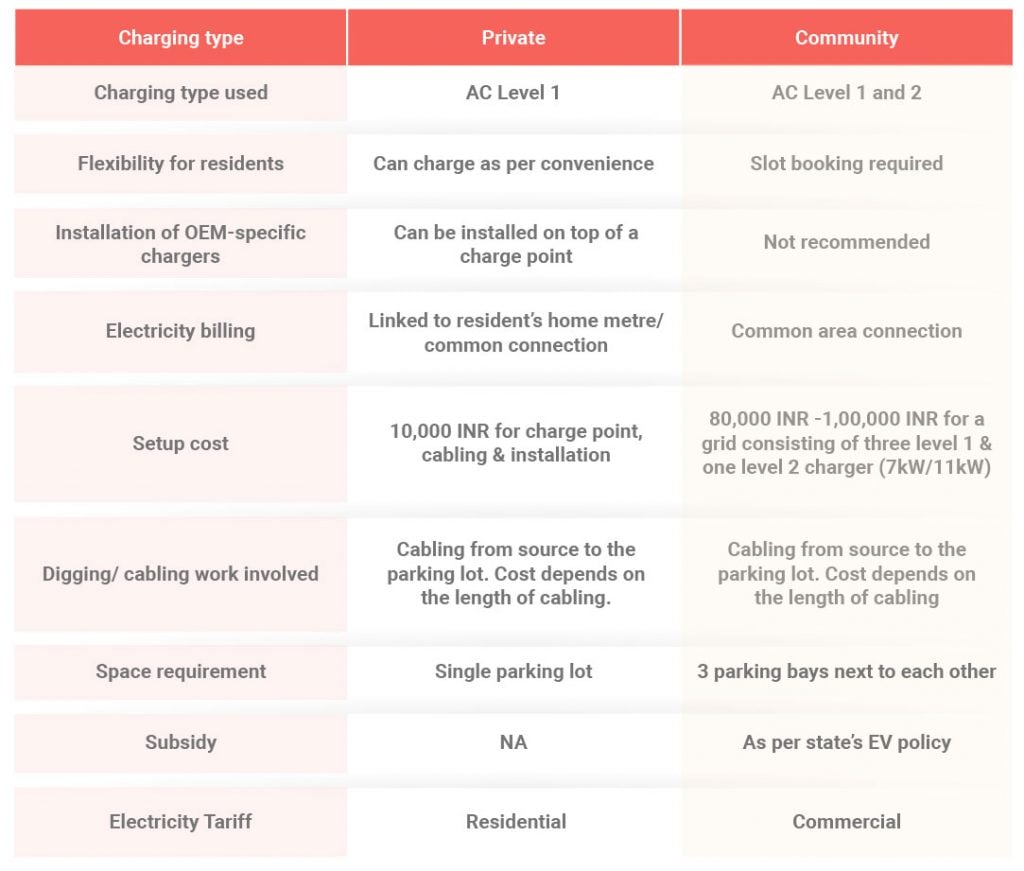
RWAs can adopt a phased strategy for installing EV charging infra. When the adoption levels of EVs are less than 5%, RWAs can make common charging points stations available for residents. However, this isn’t sustainable as EV adoption increases. A long-term and more convenient solution would be to provide charge points in the private parking lots of residents preferably from the available spare load or through a dedicated EV connection from the power distribution companies (DISCOMs). In bangalore it is BESCOM). RWAs can also make provisions from individual meters for low adoption phases. However, while considering this option remember that this might cause safety issues if the cabling process is not standardised. Please consult your electrical contractor and evaluate future safety and scalability issues before going ahead with connections from individual meters.
Table 2.1: Three-phase charging roadmap for RWAs
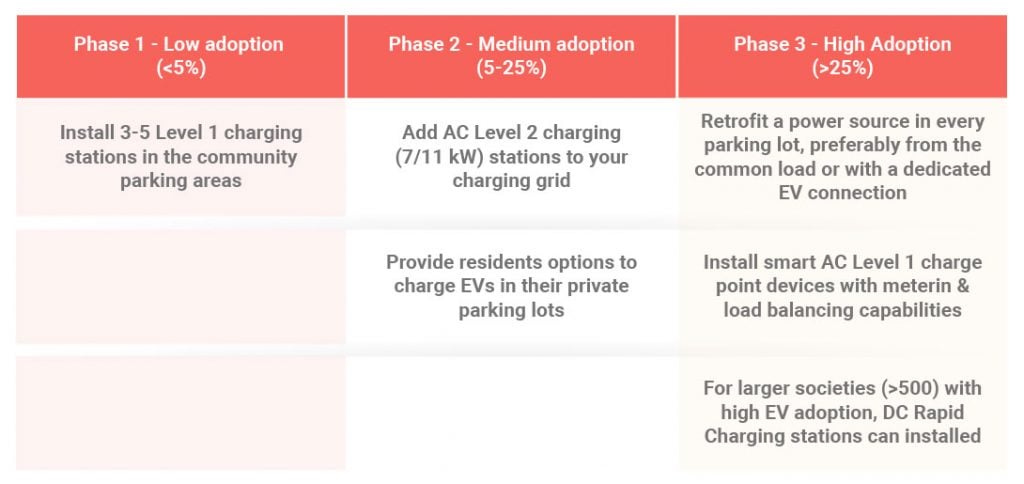
Table 2.2: Comparison between private and community charging
Box 2.1: Licenses and permissions
For private and community charging using the existing connection or spare load, no permission is required from DISCOMs. However, in case an RWA chooses to take a dedicated connection for EV charging and avail special tariffs or subsidies, it will require an approval from the DISCOM for the new connection.
2. Deciding ownership model
Have an electrician/EV charging provider evaluate your property to determine if EV chargers will need to have electricity supplied from a common load meter or if it is possible to have EV chargers individually metered. The metering arrangement will largely drive the decision on your grid design. A feasibility check of existing load capacity will also need to be conducted of charger types, cable size and load capacity of the society. Evaluate your peak load requirements considering various levels of EV adoption & plan backwards.
Box 2.2: Steps to perform a feasibility check
1. Calculate the additional peak load required depending on the number of EVs in your society. For eg. if you have 30 4W EVs and 20 2W EVs, your peak load requirement would be 130 kW (For 4W – 30*3.3 kW = 99 kW + For 2W- 20*1.5 kW = 30 kW)
2. Most RWAs have a common spare load which can be used for community charging stations. This does not require special permission from DISCOMS
3. Divide the spare load available to the rating of the charger. This will give you the exact numbers of chargers that can be placed. If 100 kW of load is available, you can install 5 Level-2 chargers of 7 kW and 20 Level-1 charge points of 3.3 kW
4. Based on load, determine the size and type (aluminium/copper) of the cables
5. Divide the whole basement into multiple zones depending on the area. Determine the source of power. Lay down proper cables and establish junction boxes
6. From the junction boxes, place proper cables to the charging points for individual charging points
7. RWAs can set up Level 1 and 2 charging points with the society’s spare load and upgrade their infra once EV adoption increases
3. Electricity requirements
Determine how electricity will be supplied to EV chargers. RWAs can use power either from the existing common load or from individual meters. Keep in mind future grid monitoring and load balancing capabilities that will be needed as EV adoption among residents rises.
If there is existing spare load for setting up community charging stations, RWAs will have to provide a reliable power source and the service provider can take care of cabling and charge point installation work.
In case the existing load isn’t sufficient, RWAs will have to apply for a new connection for EV charging and hire an electrical contractor to provide a power source close to the charge point locations for the CPO to install charge points/stations. There are service providers available in the market who can take up turnkey projects for end to end implementation too (which includes liaising with your DISCOMs and setting up the entire infra).
Box 2.3: Common questions about electricity supply
Can EV chargers be solar powered?
EVs can be charged from any power source which provides a minimum output of 3.3 kW (power from a normal 16A socket). Level 1 and Level 2 chargers can be conveniently plugged to a solar connection. However, for DC rapid charging solar power might not provide sufficient load (in an RWA setup).
What can be done with the spare capacity available in the sanctioned electricity load for the society?
RWAs can conveniently install community charging stations from their available spare load after accounting for sufficient factor of safety for peak loads.
How can RWAs maximise their load to EV charging station ratio?
A few service providers have smart grid and load management capabilities which maximise the number of vehicles that can be charged simultaneously by adding a layer of smart load controllers on your grids.
GoI mandates smart metering for new connections. What will be the future impact of this on EV charging?
Indian power DISCOMs will soon charge variable tariffs for electricity usage depending on load peaks. While considering different options for EV charging, ensure your service provider’s software is intelligent enough to optimise vehicle charging depending on the tariff rate and ensure that the bulk of the charging is done during non-peak hours.
4. Scope of work
Table 2.3: SOW & responsibility matrix

* Cabling and DISCOM charges are subject to metal price variation
5. Cost sharing
Once the general design of your EV charging setup is ready, research available government subsidies and property tax rebates and determine who will cover the costs of each component. A few questions to consider:
- Will the RWA cover the cost of electrical upgrades and conduit, while individual residents purchase and pay for installation of their own EV charger?
- Will the RWA recover these costs through increased maintenance fees or will the residents share the initial setup costs ?
- Will the RWA work on a CAPEX/OPEX (capital expenditure/ operating expenditure) model with a Charging Point Operator (CPO)?
For the initial phase of adoption for installing level 1 and level 2 chargers, the investment on infrastructure is low. Hence societies can utilize their available corpus from the maintenance budgets. As EV adoption increases (>25% residents), RWAs can undertake the future-proofing work and split the cost among the residents. Refer to table 3.1 for a sample calculation.
Table 2.4: Evaluating capex and opex models
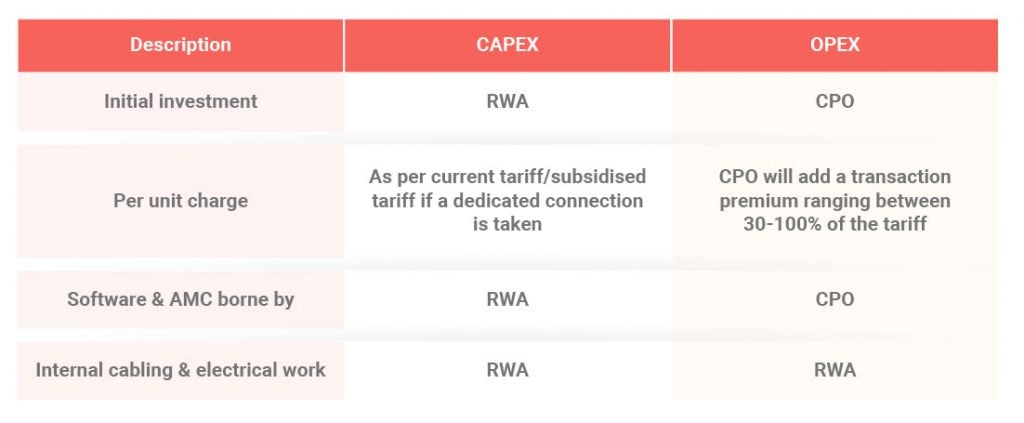
Recommendation – The cost benefits of EV charging for residents (in comparison with fuel prices) can be attained only when daily costs of vehicle charging are low and affordable. Opex models, though initially attractive, will make the recurring payments a burden later. Given that the initial capex required for AC Level 1 and Level 2 charging is not very high, RWAs can choose Capex models over Opex.
6. Locations for charging stations
EV charging requires space to set up charging stations or charging docks. In housing societies, this space is allocated in the parking areas. RWAs need to keep a few things in mind while installing community charging stations:
- Power source: Availability of a dedicated parking space, preferably close to an existing power source. This also reduces installation & cabling costs
- Accessibility: The parking area reserved for EV charging should be accessible to both visitors and residents
- Passageway: Sufficient passage space must be available for safe entry/exit of vehicles
- Covered parking: While most of the charging stations are IP certified & all-weather proof, it is recommended (wherever possible) to have the charging area covered to increase the longevity of the infrastructure.
Box 2.4: Some questions to ask while choosing a service provider
EV service providers offer charging services to EV users by connecting them with different charging networks operated by CPOs.
RWAs can partner with a service provider or automobile OEM for charging station provision. Ask the following questions before selecting a service provider:
1. Does the service provider have a viable business model?
Charging infra is long term infrastructure investment by RWAs. So, ensuring the service provider has a viable, sustainable and financially stable business model is important to avoid fly-by-night operators
2. Does the provider offer customer and technical support?
Charging stations require regular maintenance of hardware and software. While choosing an operator, ensure they have an on-ground service presence in your city and provide 24/7 remote support. Clearly document service downtimes and breakdown SLAs for provider to adhere to
3. What is the scale of your provider’s charging network?
Most EVs are charged at home, workplaces and other public places. Choosing an operator with plans to expand to an omnipresent network will benefit your residents and standardise their charging experience wherever they are
4. Does the provider adhere to safety regulations?
Refer to the Indian Standards in the annexure and ensure the service provider adheres to required safety protocols
5. Does the provider offer vehicle & hardware agnostic services?
There are several charging station OEMs ranging from global multinationals to Indian OEMs. RWAs can choose between any of the available OEMs. Also ensure you have the scope to upgrade your hardware in the future. EV charging technology is an evolving space and over the decade, better, quicker and smarter options may be available in the market. Thus, portability is an important point to keep in mind. Try to avoid vehicle OEM chargers which work for limited vehicle types and models
6. Is there scope for future integration with society enterprise resource planning solutions (ERPs)?
Evaluate your operator’s tech stack and future integration scope with your ERP for seamless payment collection and reconciliation
7. Will the provider help you upgrade your infra in case of future expansion?
Charging station infrastructure will need constant upgradation and expansion based on EV adoption within RWA
8. Does the provider assist with obtaining a new electrical connection, if needed?
Service providers with the ability to execute turnkey charging infra projects can help while dealing with multiple vendors and stakeholders for deploying charging infrastructure
Box 2.5: Important safety guidelines
Indian standards for charging points mandate various safety parameters to be used by charging station providers. Here is a list of features to watch out for.
Electricity/ electrical components
– Earth presence detection
– Over current & short circuit protection
– Over/under voltage
– Surge protection
– Temperature protection
– Ingress and all weather protection
– Earthing to prevent overload and electric shock
For Level 2 & Rapid charging stations, look for:
– Residual current
– Emergency alarm with a stop button
– Protection against electric shock
Ensuring future-readiness
Access to charging infrastructure in residential societies is essential to enabling higher rates of EV adoption.
Short term solutions
Given the current low EV adoption across societies, options to provide community charging stations from the common load could be a viable low cost solution. For retrofitting existing apartment complexes, drawing a connection from individual resident metres on an ad-hoc basis is a short term solution that might pose issues while scaling it up for all parking lots. It is important to consult an experienced electrical contractor before finalizing your EV charging roadmap.
Long term solutions
For long-term safety, a better approach is to have a dedicated power line taken from your DISCOMs for the EV grid and a connection provided from the common electricity line. While this is an expensive proposition requiring some capex requirements in the short term, in the long term, it is a most viable solution. Payments can be made along with the monthly utility payments.
Smart charging
There are various grid models that can be deployed to predict how much extra electricity will be needed to cope with the rise of the EV. For example, if people charge their cars simultaneously – say when they come home from work – it will put a heavy strain on the grid, potentially leading to blackouts.
But an increase in ‘smart charging’ could help address this. Smart charging grids with a combination of charger controllers and load balancers will allow vehicles to draw power only when it is readily available, avoiding peak periods, yet ensuring vehicles are fully charged when required.
Costs involved in futureproofing
The following costs might be incurred to futureproof your apartment parking in case of existing load shortage.
Table 2.5: Sample costs for future-proofing a housing society
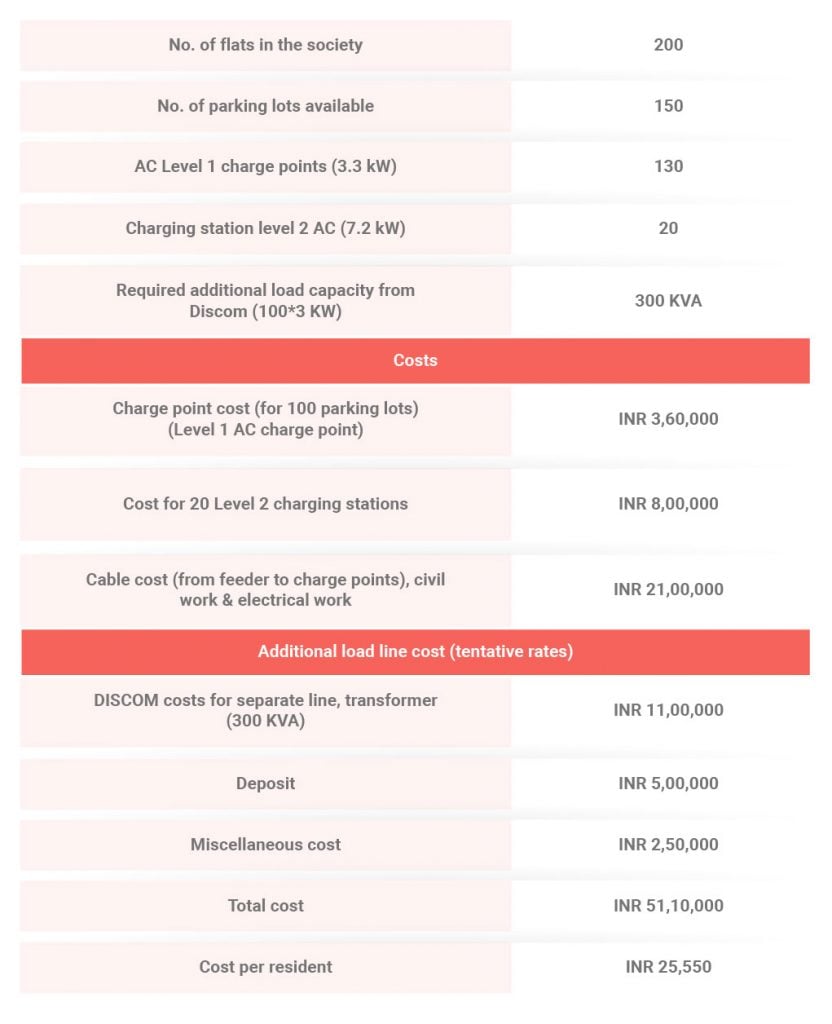
*These are approximate calculations & actual prices might vary from city to city based on local DISCOM costs
Content by Bolt Network and MyGate
All content in this article is the copyright of Vivish Technologies Pvt. Ltd.
About MyGate
MyGate is India’s #1 community app. It benefits thousands of housing societies, developers, society facility managers, and millions of homeowners in every Indian city with an ERP tool and a system for e-commerce players to better manage their deliveries. Founded by ISB/IIM/IIT alumni, MyGate has been named one of India’s Most Innovative Start-ups (by INC 42) and India’s Coolest Start-ups (by Business Today).
About Bolt Network
Bolt Network was founded with the dream of making electric vehicles more accessible by easing and accelerating the transition of emerging markets to cleaner mobility. Bolt Network has installed over 1,200 charging points across 60 Indian cities, services over 5,000 active monthly users and has an installed capacity of over 3,600 KW. The company aims to build a smart, safe and connected world for electric vehicle users with BOLT – the world’s largest peer-to-peer charging network.
To enquire about EV charging infrastructure in your society, please fill the form
Cooperative Housing SocietyThe dreaded rodent menace can be bad news for your car as they land up chewing on wires and cables. This means you will have to spend a lot of money repairing the car. Not only are they a menace, but they are also unhygienic and carry a host of diseases. Rodents are definitely not welcome into the cushy comforts of your car, let alone anywhere else.
Here’s what housing societies and apartment complexes can do to keep this problem away:
1. Keep the area clean
Generally, rodents stay away from light and hide in cracks, holes, and undergrowth. Check the designated car parking area to ensure there are no breeding spots or hiding places for rodents. If your parking is in the basement, keep an eye out for unused boxes and trash cans. Ensure the trash cans are cleaned out every day and no food is littered around your parked car. Avoid parking near trash cans as a general rule. If the area around the car is kept clean, rodents will have a tough time seeking shelter. The area should be litter-free, clean, hygienic, and devoid of clutter. Rodents shouldn’t find a conducive environment to live around your vehicle.
2. Keep the food away
Food is something that can attract rodents. They also need to eat for their survival. Food left around your car or even in it can attract rodents. Parking close to a garbage can should be avoided at all costs. If you are parking in an indoor parking area, make sure there is no food strewn around your vehicle. If you have children, check to see if they are eating in your car. Declaring your car as a no-food zone could help keep the rodents away.
3. Use strong smelling oil (peppermint, neem)
Rodents don’t take kindly to strong-smelling oils such as peppermint or neem. So you could use these oils to keep them at bay. Apply a few drops of oil to a piece of cloth or cotton balls and place them strategically in your car to repel all rodents, but especially mice. The process should be repeated many times to keep them away successfully.
4. Keep the lights on
Well-lit places don’t interest rodents, as they find comfort in dark and dingy places. Rodents also dislike light, especially when they are resting. So either parks in a well-lit area or consider switching on the lights where the car is parked. Ensure the area has ample lighting.
If the area is well-lit, some people even leave the hood of the car open to let light in. This will discourage the rodents from finding places to hide or build nests inside the car. Leave your car doors open for short periods of time so that they are being exposed to direct sunlight.
5. Seal any entry
Ensure there are no gaps in the car for rodents to make themselves comfortable in your car. At times, they might chew through something and enter the car. In case that happens, find the entry point and sell it with mesh or putty. They are small enough to squeeze through tiny holes so ensure you check the car properly and seal any holes you might find. Additionally, rope in your mechanic and they will be able to help you better.
6. Rodent repellent gadgets
Electric gadgets can be used as a rodent deterrent as well. Finding an ultrasonic rodent repellent will be easy. They are simple to use. They emit a sound that can only be heard by rodents. The frequency of this is quite high and ultrasonic. Gadgets like these come with motion sensors and can prevent the nesting of rodents. This is a strong, one-time solution.
7. Other animals
If you have a pet dog or cat, they could keep the rodents away. Cats can sniff out rodents and hold them off from making a home in your car. Dogs too can keep away rodents as they will be skeptical to approach an area where a dog lives. Cats and dogs are biological deterrents to rodents.
8. Rat traps
These may seem inhumane, but traps can keep the rodents away. Sticky traps found in the market have a good amount of glue on them that will keep the rodent from moving. Leave a bait and wait for the rodent to walk into it, literally.
9. Rat poison
The oldest trick in the book can also be dangerous. Hiding poison in food for rats is common to target rodents. The rodent might find the poisonous food, ingest it, and might die inside the vehicles, open space within parking areas or corners, etc, and leave a foul smell. It’s best to exercise this option with care.
These are some methods that have worked well for most societies and complexes that have rodent problems. It could work for yours too!
For more reads on how to better-living conditions in apartment complexes and societies, click here.

The Covid-19 pandemic has taught us that technology can play a key role in helping each other and accessing assistance in times when face-to-face interactions are best avoided. An aggregator of crucial information such as emergency contacts, contacts for medical assistance, details of service providers, and vendors for essential goods all within close reach is ideal for any neighborhood. As proximity plays a key role in access to resources during times of quarantining, lockdowns, numerous state- and self-imposed restrictions, a hyperlocal information repository is pivotal in helping communities get on with day-to-day life.
But first, what is hyperlocal?
Hyperlocal refers to information that is related to a defined community. The main focus of this is to address the specific needs of the people belonging to that specific geographic location. Though the term has been around for decades, originating in the 1990s referencing local television news content, hyperlocal is now often associated with the use of mobile phone apps and GPS technology to provide users with area-specific content.
Why is a hyperlocal information repository important?
Today, MyGate community management apps provide users with a space to contribute to and reference important contacts with its ‘Infocentre’ feature. In a single directory, members of the same housing society or gated community have access to a wealth of information related to services in and around their neighbourhood.
Maintaining and contributing to a repository of hyperlocal information is an ideal way to build community connections and lend a helping hand to neighbours as well as local vendors, service persons and businesses. All useful information and recommendations of goods and services available locally can be found via one dedicated platform, making access convenient and quick.
The main benefits of a hyperlocal information repository
In case of emergency
Local doctors, dentists, pediatricians, specialists and emergency services can all be listed in one place, making finding appropriate medical help quick and hassle-free. For residents who have moved to a new neighbourhood, an information repository with good medical contacts is a huge boon to set their minds at ease and be prepared in case of an accident or illness.
Supporting locals vendors
India has a huge unorganised market of vendors and service persons. These sellers are often on the move around the neighbourhood, going where their clients need them, and depend largely on word of mouth for business. With a local directory, finding tried-and-tested services through recommendations is a breeze for residents, while helping vendors sustain their businesses in these trying times.
Supporting home businesses
If you are looking for online or outdoor classes or a good tiffin service, you can also browse through your neighbourhood directory to find something conveniently located and support your local talent. Home business owners too can post their goods or services for sale, giving them exposure to thousands of potential clients.
Get household services to your home
From cleaning services such as rug shampooing and deep cleaning for the home to beauty needs such as facials and pedicures, residents are able to find rated businesses and service staff who are close-by to book home appointments. You can have your TV repaired or your table fixed without having to step out of your home and go to a store.
Perhaps the best part of a hyperlocal information repository that is available online is that each entry can be rated, rewarding local businesses for quality and good service. At the same time, it provides residents with a wealth of information and ratings to make informed decisions.
Disclaimer: Thank you for visiting our site. The information provided by MyGate (“we,” “us” or “our”) on https://www.mygate.com (the “Site”) is for general informational purposes only. We strive to provide our readers with accurate information that helps learn more about the topics. It is not intended as a substitute for professional advice. We do not accept responsibility for the accuracy of information sourced from an external entity or take personal/ legal responsibility for your use of this information.

In the last decade or so, the importance of e-commerce in our lives has increased exponentially. But it has been the Covid-19 pandemic that has made e-commerce usage increase tenfold. From groceries to medicines, clothes to appliances, when getting out of the house is near impossible, ordering online saves the day. And perhaps the next big evolution in the e-commerce arena is the rise of what is known as ‘Community Group Buying’, a means in which residents in a specified area can purchase goods in larger numbers for lower prices or with special offers, making it a win-win scenario for buyers and sellers alike. The idea is rapidly catching on in residential areas and more and more tech platforms are catering to these consumer needs.
What is community group buying?
For those who may not be familiar with the concept, community group-buying is essentially buyers forming a group to place bulk orders for goods or services, often receiving a discount or other benefits for the order. Here are a few ways in which it can benefit those who participate:
It’s an obvious solution – Residents in gated communities come in the hundreds and, in many cases, even in the thousands. Most residents have similar household requirements – think things like cleaning supplies, food staples, grocery items, and pet care products – so planning and purchasing weekly for these items can be very straightforward. It then makes buying in bulk for the entire community an obvious choice, given that so many of the community’s needs are homogeneous, saving big on money when discounts are offered as well as on resources such as transport costs as delivery is done all together. Today, apps such as the community management platform MyGate facilitate group buying in gated communities and housing societies making the process seamless and advantageous.
Buying in bulk = cheaper – Sellers are often willing to lower their prices, offer sizable discounts or special deals when large orders are placed. With community group buying, residents can negotiate the best prices because they are bringing in big business. This can considerably bring down the monthly expenditure for each participating family or individual on standard expenses such as grocery bills.
Customers can get better service – When you buy a product or service as an individual customer, it can sometimes be hard to get services, refunds, or returns in case something goes wrong. Often, a faulty lightbulb or torn packet of flour may not seem worth the hassle of constantly chasing a seller who, to be fair, maybe too busy to prioritize one single customer. However, when sellers are guaranteed lucrative business through bulk orders, they tend to be more inclined toward timely and effective customer service. Because business from communities is larger enough and guaranteed at regular intervals, sellers go out of their way to meet their customers’ needs.
There’s more access to local deals – India has a large sector of unorganized sellers who usually gain customers through word of mouth. With community group buying, the goods of these sellers can be available to residents with the click of a button. Through apps that facilitate community group buying, residents in a society can purchase things like fruit and vegetables from local farmers, milk from local dairies, or organic washing liquid from a small outfit, all recommended but not necessarily easily available under other circumstances. What’s more, community group buying can do wonders in helping small businesses gain traction in the competitive market, ensuring their quality products stick around.
It’s really convenient – Above all, community group buying spells utmost convenience to all those involved. For residents, having goods delivered to their doorstep is a boon, especially during the pandemic when going out for groceries and other products is not always possible. With recurring deliveries, buyers can have a fixed list of products that they get at regular intervals, not having to worry about restocking certain pantry staples or running out of household supplies.
The residents of societies and gates communities have immense power in the community group buying space. This realization among buyers has made group-buying gain popularity and more and more communities are adopting the approach, reshaping the e-commerce space. Together, residents can make sure their needs such as home, health, and grocery supplies are met and delivered to their doorstep, and at lower costs.

EMF (Electromagnetic fields) from cell phone towers have always been a cause of concern for the residents who live nearby. The emittance of these waves, which fall in between FM radio waves and microwaves in the electromagnetic spectrum, have not yet been proven to damage DNA cells. However, their risks have not been ruled out, either. The World Health Organisation’s International Agency for Research on Cancer (IARC) states that radiation from cell phone towers is “possibly carcinogenic to humans” and may cause a form of brain cancer called glioma. Because these cell phone towers are emitting radiation throughout the day in relatively higher intensities, it could pose serious health issues. So what can you do to help protect your apartment from cell phone tower waves?
If your building has a tower on it or is close to one (within 500 meters or so), it’s best to take precautions to lower your exposure. We list out some options.
How to measure EMFs at home
Before you resort to protective measures, it’s important to review how much you are being exposed to EMF radiations. There are EMF meters available that can record the intensity of the radiations. After taking the readings, you can begin your plan of action to help shield your home.
Get EMF protection paint
This type of paint can help shield against this radiation, preventing the waves from entering your home. The paint can be used as you would use any other wall paint and can be applied to inside or outside walls. Once painted, regular colored paint can be used on top of the protection paint to suit your personal tastes.
Use protective fabric
Fabrics that have the ability to shield against radiations entering your space are a great way to protect yourself and your family. These come in the form of net curtains that are designed specifically to block out EMF radiations, making them a great solution for your windows that cannot be painted as suggested above. The fabric can also be used in other ways, such as a canopy for your bed for extra protection. The fabrics come in different brands and styles so it is best to speak to an expert and browse options to see what suits your needs and personal style the most.
Another way in which you can shield your windows against the entry of these radiations is with a special film made to protect against EMFs. These are available in rolls online and can be applied directly to the window and cut to fit whatever size is necessary.
Target main living areas
If shielding your entire home is not feasible, target the areas in which you frequent the most. For example, if you spend most of your day in the bedroom, choose to paint that room with EMF shielding paint and use a bed canopy of shielding fabric to reduce exposure during the long hours when you sleep at night.
Pay attention to symptoms
Even with protective measures against cell tower radiation, you still could be affected, especially if you reside close to a tower. In case you have health issues such as recurrent headaches, cognitive problems such as memory loss, or mood swings, it’s best to speak to a medical professional who can ascertain the cause and way forward. Close monitoring with EMF meter readings is also helpful to determine the extent to which you are being exposed to the radiations. If your building houses a cell phone tower on its roof, it’s worth considering staying floors lower or moving home to reduce the intensity of your exposure.
In every apartment or society, there are a few places all residents are not allowed to access. Only the managing committee and apartment personnel can access these areas. The restricted common areas in the building are although within the tenant’s perimeter, they are not allowed to enter it in most cases. In some cases, the landlord will have some access to these restricted areas. The restricted areas also are labelled so for the safety of the residents. So its best to adhere to them.
Here is a list of places that most apartments and societies have termed as restricted to their residents.
1. Electrical closet
The electrical closet is where the entire apartment or society’s electrical connections are managed. It’s best to let the experts handle it and ensure that you stay out of the electrical closet. The closet is usually only operated by technicians as the controls are super sensitive and one wrong mistake can cause a power outage and inconvenience a lot of people. Some apartments ensure the electrical closet is “child-proof”.
2. Mechanical closet
This closet usually houses the HVAC systems( Heating, ventilation, and air conditioning controls) of the entire apartment. This might be located in a common area or outside your unit/flat. Wherever it is located, it’s best not to fiddle with the controls or enter the closet as it contains very sensitive controls that can control several appliances in your home. The mechanical closet is usually locked and entry is for personnel only.
3. Maintenance break rooms
It’s ideal to have break rooms for the maintenance personnel who work so hard. The room is where they can rest, stretch their limbs and grab a bite when hungry. It’s best to leave them undisturbed for the short time during which they rest. Residents mustn’t be allowed into the break room or use it.
4. Storage rooms
The storage rooms in apartments and societies house all the maintenance equipment that the maintenance personnel uses to keep the society clean. The equipment used could be expensive and its best not tampered with. Children should be kept out of the storage rooms at all times. The only ones who can access the rooms are maintenance personnel.
These rooms can be used to store lawn mowing equipment, cleaning equipment, and other things.
5. Communication duct
The communication duct can have telecom cables, internet cables or broadband, and any other communication-related wiring. Apartments set up a separate duct for these cables as hampering with them will inconvenience everyone. The latest trend is that of fiber cables and most apartments have these installed for the internet. These make buildings ready for the future as they have a high bandwidth of the internet. It’s best to stay out of this room and let only personnel in.
6. Gas bank/ Gas station
This could be a dangerous area to be in. Normally, apartments don’t keep gas cylinders enclosed in a room as they can be dangerous. A gas leak can cost you high as it can blow up with just a tiny spark. The gas cylinders are usually kept in the open, under a shed. It’s best not to let children play near this area as they can tamper with the cylinders that can lead to fire etc.
7. STP stations
STP stands for Sewage Treatment Plant. It has been made compulsory for apartments and societies to have an STP plant. The plant is supposed to take in the waste and drain water and purify it before it’s used for other purposes like gardening etc. It’s best to steer clear of the STP plant as they have toxic waste and sludge. Especially children should be kept away from the STP station as even the fumes emitted from there can be hazardous to your health.
8. Water pumping stations
The plumbing water station in an apartment is one of the most important stations as it supplies water to the entire apartment complex or society. The pumping stations are off-limits to everyone but apartment personnel. The pipes used to transport water to the apartments are sometimes flimsy and can be only handled by plumbers. The pressure around these pipes also can be high, so it’s advisable not to access these areas. A sudden pipe burst could result in fatal injuries. Moreover, if any damage is made to these pipes, it can hamper the water supply throughout the society.
9. Garbage collection room
Most apartments have a collection room dedicated to garbage. This is where further segregation of wet and dry waste takes place. The garbage that’s collected throughout the apartment complex is gathered here and then sent to the garbage trucks. This definitely falls under the restricted area in the apartment. All residents should stay away from the collection room. The smell of wet and dry waste is unpleasant and will lead to you falling sick.
10. Lift machine room
It’s horrifying to be stuck in a lift when it malfunctions. The lift machine room in the apartment mans the smooth functioning of the lift. It’s best to keep away from the room as fiddling around the room can lead to a lift malfunctioning. The breaking down of the lift in a high-rise building especially can cause inconvenience to the entire society.
11. Terrace
Terraces on high-rise buildings or apartments are usually off-limits to all residents. The door leading to the terrace is usually barricaded or locked and the keys are with the apartment personnel. It’s best to stay away from apartment terraces to prevent any accidents from occurring.
It’s best to find out which areas are restricted in your apartment complex prior to moving in. The managing committee will be able to give you a list of places that are off-limits.