

Starting in April of 2019, the Government India planned to replace all of the country’s existing meters with smart prepaid meters. The topic was again touched upon during the Budget Discussion 2020. This initiative improves billing and collection and is a step in the direction of providing electricity for all. Many residential societies have already introduced the prepaid meters in their community and many more are in the process of doing so.
What are the benefits of Prepaid Meter?
- Consumers can choose their own service provider and rate as per their requirement
- Saves cost on manual metering, billing and collection
- Consumers can track their electricity use and plan their power purchase better
- Recharging your power can be done digitally and instantly
- Power thefts can be easily spotted and prevented
Mygate aims to make community life as smooth as possible by offering necessary assistance in one place. With our new ‘Prepaid Meter’ feature, residents can track their electricity consumption and recharge their installed meters. Mygate has partnered with leading meter vendors such as Crystal , Elmeasure and Radius. Any society that has installed meters from these service providers will have this feature automatically enabled on their Mygate app.
How Prepaid Meter works?
Click the ‘Community’ icon on your shortcuts
- Click on the ‘Prepaid Meter’ icon
- You will now be able to see your power usage for the month
- You can click on any transaction and see the breakdown of how many EC, DG and CAM units of power were consumed
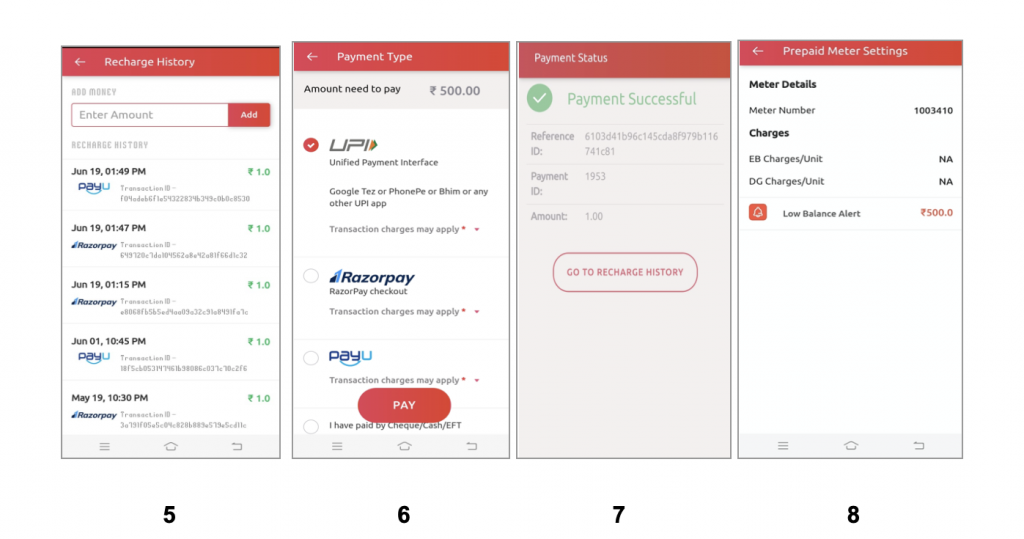
- Click on the ₹ on the top right corner or on the ‘Add Money’ button on the bottom if you need to recharge your prepaid meter
- Click on any of the payment options to recharge your meter
- Once you have clicked on your desired option and completed the payment, you will see a pop up displaying the ‘Payment Successful’ message and details of your transaction. If you click on the ‘I have paid by Cheque/Cash/EFT’ option, you must make this payment to your management committee and the society admin will be notified and take care of the payment process
- To see your meter details such as Meter Number, EC and DG charges etc., you can click on the ‘Settings’ icon on the top right corner.
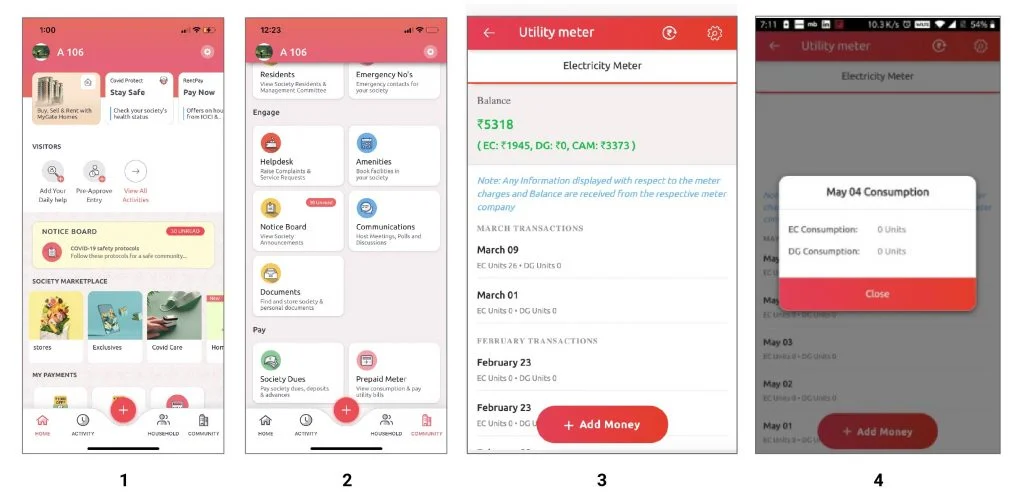
This feature allows you to recharge your meter easily, budget your electricity expenses and monitor your power usage. With this new service, Mygate endeavours to make this transition to a smarter future seamless and effortlessly.
Contact your management committee or Mygate relationship manager to enable Prepaid Meter for your society today!
To say that India has a garbage ‘problem’ is a gross understatement. Of the 62 million tonnes of waste urban India generates every year, less than 80% is collected and only a meager 22% is processed. Mumbai and Delhi alone generate approximately 11,0000 and 8,700 tonnes of solid waste per day respectively.
So far, dumping mixed waste in landfills has been a key part of India’s waste management strategy but landfills emit methane – a greenhouse gas roughly 21 times more potent than CO2. The fumes of landfill gas, when inhaled, cause respiratory problems, especially in children.
Residents of areas surrounding landfills are forced to consume water poisoned with leachate and no water purification system can make the groundwater around such landfills potable. If we continue to dump garbage at the current rate, it is estimated that by 2047, India will need 1,400 square kilometers of landfill space (or the combined area of Chennai and Hyderabad).
Not all the blame lies on the government. We as consumers and citizens have limited civic awareness on clean living and healthy disposing. We can raise our green quotient substantially with the right education and training on waste management and ceaseless promotion of ‘trash’ talk.
The best way to get rid of waste is to not produce so much of it in the first place. To begin with, let’s understand the categories of waste produced in housing society..
Types of household waste
1. Organic Waste
- Liquid waste – Food leftovers, fruit/vegetable peels, waste tea powder, coffee beans, landscape and pruning waste, other green waste, processed food, raw food materials, meat and bones, food-soiled paper, eggshells, leaf plates.
- Dry waste – Newspapers, magazines, brown paper, paper bags, paper packaging materials, ribbons, strings, leaflets, notebooks, wood, furniture.
2. Non-organic Recyclable waste (solid rubbish)
- Plastic – Plastic bags, containers, jars, bottles, covers, caps, milk pouches, food packets, soda bottles, wrappers.
- Metals– Utensils, batteries, pipes, nails, tools, aluminium foils, metal scraps, tetra packs, wires.
- Glass– Bottles, plates, cups, shards, mirrors, ceramics.
3. Hazardous waste
- Insect sprays, syringes, diapers, sanitary napkins, cleaning chemicals, bleach containers, corrosives, flammable liquids, solvent-based paint, car batteries, e-waste, bio-medical waste.
4. Inert Waste
- Sand, concrete, clay, subsoil, rubble
Domestic waste management system in India – Rules
The usual practice in apartments and societies (also known as bulk generators of waste) is that the housekeeping staff collects garbage door to door which is then collected from curbsides by the municipal corporation or authorised waste collection agency. The ‘dump everything in one garbage bag’ approach that some people follow poses a massive challenge of waste sorting. It’s next to impossible for waste collectors to manually segregate dry, wet, and toxic waste without hurting themselves, not to mention the endless hours wasted in separating and sorting through tonnes of trash collected daily.
In 2016, the Ministry of Environment revised Solid Waste Management Rules, whereby it mandated segregation of waste at source to turn waste into wealth by ‘recovery, reuse and recycle’. The new rule make waste management the responsibility of the waste generator so that it can be handled in an efficient, decentralized manner without overburdening the limited public resources and infrastructure. They also stipulated that within six months of the notification of the Rules, local authorities must draw up a comprehensive waste management strategy according to their State policy. Thus, the Solid Waste Management policy of each Indian city is governed by the unique bye-laws framed by its urban local bodies. The provisions of many of the bye-laws are common across states.
How do the Solid Waste Management Rules 2016 apply to housing societies?
Waste generators have to segregate waste into three streams, ‘Biodegradable’ (wet), ‘Dry’ (plastic, paper, metal, wood, etc) and ‘Hazardous’ (diapers, napkins, cleaning agents, mosquito repellent, etc).
The Solid Waste Management Rules 2016 identify any entity producing more than 100kgs of waste per day as a bulk generator including housing societies with more than 100 units or communities with an area greater than 5,000 square metres. These entities must process, treat, and dispose of their biodegradable waste within their own premises through composting or bio-methanisation. This process of in-site composting, minimise the transportation costs and environmental impacts of moving organic waste.
As a bulk waste generator, your duties include:
- Segregation at source: Waste must be segregated into 3 categories at the point at which it is generated before it is handed over to the collectors. The categories are: biodegradables, dry waste, and domestic hazardous waste
Rationale: To promote ‘waste to wealth’ or allow as much valuable material to be recovered, reused or recycled from the waste collected.
- Safe disposal of sanitary waste: Residents must securely wrap used sanitary waste like diapers and pads in the pouches provided by the manufacturers of or in a suitable wrapping material. In the case of broken glass, blades, and used needles, they should be wrapped tightly in the newspaper while handing them over for collection.
Rationale: To protect waste collection staff from injuries and contact with material contaminated with body fluids.
- Disposing construction and demolition waste: Material including sand, concrete, clay, subsoil and rubble is to be stored by the society in their premises until it is handed over to the collector.
- Event etiquette: An event or gathering of more than 100 guests in your society requires the segregation of waste at the source before handover. (Some bye-laws require event organisers to pay a cleanliness deposit which will be refunded after the event if the concerned authority is satisfied that any waste that was generated has been collected and transported to the designated place. If the space is not clean within 12 hours of the event, the deposit will be forfeited)
Rationale: To promote decentralised waste management.
- Spot fines: The rules prohibit the throwing, burning, and burying of solid waste on streets, open public spaces, or in drains and water bodies. Violation of these norms as well as dumping of waste in vacant plots and non-segregation of waste carry a spot fine, the amount of which is fixed by the local body
Rationale: To penalise deviant civic behaviour and reduce public littering.
- User fees: Housing societies are required to pay a charge for availing services such as garbage collection, transportation, and disposal from their premises by authorised municipal waste collectors. City-wise fees vary based on the bye-laws of different Urban Local Bodies and municipal corporations.
Color coding waste for disposal
Each household could collect trash in different colored garbage bags or use black garbage bags with coloured strings to tie them up according to the type of trash; e.g.:
- red for sanitory/hazardous,
- Green for biodegradable,
- blue/white for plastic, etc.
- Societies should also erect color-coded receptacles in common areas, provide gloves, masks, and other protective gear to maintenance staff, and impose fines on residents who breach waste handling codes.
For a society aspiring to be more meticulous with their waste segregation, we suggest an elaborate seven bin system, i.e. black for general dry waste, blue for mixed recycling/metals, green for food and garden organic waste, red for hazardous waste, yellow for paper, purple for plastic/e-waste, grey for others. Color coding may vary according to the general consensus.
The 3 R’s of waste management – Best practices for housing society do to comply with the SWM Rules?
Many have heard of Reduce, Reuse and Recycle, but not everyone cares enough to incorporate them in daily living while some are completely uninitiated in the golden rules/guidelines for proper waste disposal. The golden rule is – the less you buy, the less there’s to dispose.
Find some tips below to help you get started:
1. Reduce
- Avoid disposable products like paper plates, razors, paper towels, gloves, etc. Instead, buy long-lasting items that need not be bought again and again.
- Carry your own shopping bag or a jute bag while going shopping to avoid plastic bags.
- Buy products in bulk and with minimal/recyclable wrapping so there’s that much less packaging to throw away.
- Switch to digital news/content, don’t accept flyers/leaflets, use fewer notebooks and physical cards/gift wrappers.
- Switch to organic diapers and sanitary napkins.
2. Reuse
- Repurpose broken furniture and used bottles to create new DIY products like trays, hangers, toilet holders.
- Recreate bags, wash clothes cushion covers from worn clothes.
- Reuse fruit skins to make face masks, and wet tea powder to fertilize plants.
- Reuse old jars, cloth bags, metal containers, boxes for storage .
- Make arrangements to compost organic waste in-house, sell it or use it for community gardening
3. Recycle
- While shopping, look for recycling symbols on the wrapping that tell if the product is made of recycled material or if it can be recycled.
- Have a monthly tie-up with a local recycler/scrap dealer who can collect dry paper, newspaper and plastic waste from the society.
- Recycle dry cell batteries and electronic items at your local electronics store that accepts recycling options.
- Use eco-friendly alternatives such as biodegradable decorations, cutlery and gift wrap
The question of fees and fines
The Rules say that a state government can adjust the Property Tax to incorporate SWM cess or charge specific User Fees separately. They will determine the fee based on:
- Current number of households in each settlement area
- Status of collection service such as door-to-door collection, community bin collection, or non
- Frequency of collection
- Level of service desired by the housing society; and willingness of the households to practice the 3R approach
- Willingness and ability to pay
So it is safe to say that the more waste you generate the more you end up paying as User Fees. It’s similar to the ‘pay per use’ system, except you pay as much as you throw.
In Mumbai, the base user fee for a household producing less than 100kg waste is Rs 60. In Bangalore, residents will pay Rs 200 for door-to-door collection in addition to a SWM cess payable as part of the property tax collected annually by BBMP. The cess goes towards the overall cleanliness of public spaces in the city, including street cleaning and clearing of black spots.
The Polluter Pays Principle has been an effective way of ensuring compliance in Europe and the US. The Municipal Corporation of Mumbai has started penalising housing societies up to Rs 15,000 for non-segregation and processing of wet waste on their premises. Bulk generators may even face disconnection of power and water supply, and possibly jail time. The Municipal Corporation of Greater Mumbai has also allowed societies to collect fines (as per member consensus) from repeat defaulters and households that fail to segregate.
In a different approach, the BMC Commissioner has offered 15% rebate on property tax to housing societies that segregate their waste, compost organic waste, recycle dry waste and reuse and greywater. A society following any one process gets a 5% rebate.
Frequently asked questions
What are the government guidelines for wet waste disposal?The government states that biodegradable waste should be processed on-site through composting or bio-methanation as far as possible. New townships and group housing societies are being made responsible to develop in-house waste handling and processing biodegradable waste.
What’s the wet waste management norm in Bangalore?In Bangalore, the Mahanagar Palika mandated that any apartment complexes that collectively produce more than 100 kgs of wet waste per day will have to do in situ composting.
How do I process wet waste in Mumbai?In Mumbai, BMC has made wet waste treatment mandatory according to new DCR for buildings, is charging a fee to collect wet waste and even offering tax rebates on property tax for societies who segregate and compost waste. As per rules laid down in 2017, if a complex produced 100 kgs of daily wet waste or has an area of more than 20,000 sq meters, BMC did not collect the waste. Societies have to now compost on-site.
How can I solve the wet waste problem in my society?To reduce the load on landfills, societies must install an aerobic bio composter (organic waste converter) in their premises to recycle wet waste. Options are available between manual and automatic composting machines that can cost anywhere between Rs 25,000 to Rs 6 lakh. Alternatively, try vermicomposting.
What if I don’t segregate at source?Non-segregation and littering can get you a ‘spot fine’, the amount of which is decided by the local body.
Can I burn waste?
Burning waste in streets drains, open spaces, in or around the home (basically anywhere) is not allowed.
How can a society dispose of sanitary napkins safely on-site?Sanitary napkins incinerators are available in the market from Rs 5000 to Rs 25,000 and upwards.
How do I segregate used sanitary napkins?They are to be properly wrapped and segregated into the category of dry waste/non-biodegradable waste.
Conclusion
It is vital that the MCs/RWAs stay updated about the latest developments in SWM Rules and Compliance by following municipal/city civic portals and MoHUA/ Swachh Bharat Mission websites. Rapid growth is projected for the domestic and global waste management markets in the coming years. Housing societies are a significant part of the landscape of any city and they play a crucial role in its waste management. It is thus important that housing societies are well informed and well-equipped to stay proactive in waste management at local, state and national levels.

What is Ganesh Chaturthi?
Ganesh Chaturthi also called Vinayak Chauth is a Hindu festival that celebrates the birth of Lord Ganesh. Lord Ganesh is known by 108 different names and is widely revered as the remover of obstacles, the lord of wisdom and a symbol of prosperity.
How is Ganesh Chaturthi celebrated?
This 10-day festival marking the birth of Lord Ganesh is celebrated across India with pomp and aplomb. The festivities commence on the fourth day following the arrival of a new moon in the month of Bhadrapada. Close to a billion people celebrate Ganesh Chaturthi as one of the biggest religious events in India. The rituals start with Pranapratishhtha by which the deity is invoked into a murti or idol. The idols are brought home and installed in elaborate podiums by communities across the country. The Shhodashopachara rituals include 16 forms of paying tribute to Ganesha, these prayers are offered over 11 days. Following the Uttarpuja on the last day Anant Chaturdashi, the statues are paraded through the streets, accompanied by much singing and dancing, and then immersed in the nearest water body.
What are the environmental impacts of the festival?
- Non-dissolvable materials used: The idols are generally crafted using plaster-of-paris, clay, plastic and cement containing substances such as calcium sulfate hemihydrate which do not dissolve completely. This pollutes water bodies.
- Rise in toxicity: The use of non-organic paints made of lead and mercury considerably affects aquatic life. These substances not only reduce the oxygen levels in the water but can also poison our water sources for several years.
- Increased solid waste: The idols are usually bedecked with decorations, plastic flowers, clothes, lights and more before being immersed. This careless dumping adds to pollution. This accumulation of waste can also lead to the breeding of mosquitoes and other vermin that can cause several diseases.
- Increased electricity consumption: Most podiums and pandals make use of excessive light and huge sound systems that consume excess energy while contributing to light and sound pollution.
- Use of public water bodies: Water bodies such as rivers are home to various aquatic life, irrigate our lands and are the primary water source for huge populations. Polluting these water bodies can lead to long term environmental effects and harm those who use the water.
Considering the environmental impacts, it is our core responsibility to make sure our festivities do not harm the environment. A few steps are all it takes to celebrate our favourite god while reducing environmental strain
10 ways to celebrate an eco-friendly Ganesh Chaturthi in your housing society:
- Eco-friendly Ganesh Idols
There is a choice of eco-friendly idols available today like ones made of alum that quickly dissolves in water and purifies water, ones made of red soil and fertilizers and containing plant seeds that can be placed in an accompanying pot and watered until it dissolves, ones made of chocolate that can be immersed in milk and more. Most states have banned the use of plaster-of-paris idols. The management committee should ensure that idols made of plastic, thermocol and other hazardous materials are not permitted. The society should collectively advocate idols made of biodegradable material like unbaked clay, coconut or soil.
- Eco-friendly Ganpati Decoration
Materials like thermocol, plastic, fibres, plaster-of-paris etc. should not be used for decoration due to their non-biodegradable nature. Use of materials like paper, wood, cloth, organic colors etc., should be encouraged when decorating the society pandals and idols.
- Sensible disposal techniques
(i) Make sure flower garlands, cloth and other decorative material are removed before immersion of idols.
(ii) Clothes & food items like coconut, fruits etc. should be donated and not wasted.
(iii) A society compost pit should be made wherein all the biodegradable items – including flowers used for decoration etc. can be disposed of. The eventual compost can be used within society gardens.
- Restrict music to avoid noise pollution
Avoid or minimize the use of loudspeakers as it causes noise pollution. Studies suggest loud sound can impair hearing abilities of infants. Additionally, animals both domesticated and strays are adversely affected by the loud noise.
- Energy Conservation.
While lighting up the community pandals use energy-efficient lighting fixtures like LED diyas or traditional earthen lamps. Make sure that excessive lights are not used, which can lead to waste and light pollution.
- Temporary immersion tanks
Instead of immersing the idols in public water bodies, temporary immersion tanks can be set up in the community. All the society members can come together and make use of this immersion tank for visarjan. This prevents the pollution of public water bodies while keeping the roads traffic-free.
- Chemical free rangoli colors
Encourage the use of natural colors for rangoli and for idol decoration.
- Use of biodegradable plates and cups
Limit or ban the use of plastic disposables. The community can opt to use Pattals made of plants, trees or biodegradable plates for prasad distribution. When organising the festivities in the community, the committee could alternatively arrange for a potluck and make arrangements to donate the leftovers to the needy.
- Limit the size of Ganesh idols
Ganesh idols should be limited to no more than 5 feet high. Idols larger than this use a considerable amount of resources and cannot be immersed fully.
- Raise awareness on eco-friendly practices
The management committee should take initiatives to educate the residents about the festival, its significance and the importance of adopting eco-friendly practices.
While honouring our traditions, it is important to do our bit to not disturb the ecological balance. With strong initiatives from the management committee and the co-operation of the residents, you can do your bit to celebrate an eco-friendly Ganesh Chaturthi.

Last year, 21 out of 30 cities in the world with the most air pollution were found in India. India is also the world’s 5th most polluted country in terms of air quality index. A study showed that 4 out of 10 Indians are breathing in 5 times the safe limit of particulate matter in the air. Shocking but totally believable considering how adept we Indians are at leaving really critical problems to solve themselves.
Why do we need trees around us?
We already know the air we breathe on the roads isn’t exactly pristine oxygen made in heaven. Rather, it’s made up of a whole lot of ingredients freshly brewed in hell, such as nitrogen oxide, carbon monoxide, sulfur dioxide and hydrocarbons.
But we’re not safe at home either. Our indoor air quality is significantly lowered by the presence of Volatile Organic Compounds in our daily life products like disinfectants, cleaning agents, polish, paints, cosmetics, sprays and fuels made up of organic chemicals. VOCs are benzene, formaldehyde, xylene, toluene, ethanol, butanol, acetic acid, methylene chloride, acetone… it’s safe to say the list of air pollutants in our atmosphere is not small. These pollutants can cause strokes, immune system disorders, lung cancer, respiratory problems and a host of other diseases in humans.
That’s why we need trees, we need to be close to them, surrounded by them, entrenched in them even.
A trip down science class memory lane would help us remember that trees absorb harmful chemicals, toxins, particulates in the air, soak up all the CO2, nitrogen oxide, carbon emissions, greenhouse gases in the air, filter them through their pores and restore oxygen back into the atmosphere. If the trees of the world absorb one-third of the global pollution each year, they can easily clean the air in and around your society and in your homes. Find out below the wonders of nature that can help purify your toxic surroundings.
Best outdoor trees for apartment complexes
The ideal spots to plant trees within your society premises (apart from the garden of course) are the edges of walkways, the periphery of the gates, open spaces on the parking lot edges and community squares.
1. Ficus Religiosa (Peepal tree aka Bodhi tree)
Benefits of the Peepal tree are manifold. Not only is it a champion at releasing oxygen 24 hours a day, it is also used as Ayurvedic medicine to cure disorders like asthma, eczema, diarrhoea, skin diseases, blood purification, poor appetite, constipation and about a dozen other conditions. It’s a deciduous native Indian tree, therefore widely available. They release phenomenal amounts of oxygen, clean the air and help protect the ozone layer. Under the Peepal Tree, the Buddha is said to have achieved enlightenment and yes the rumours about ‘evil spirits’ residing in peepal trees are just that… rumours.
2. Syzygium cumini (Jamun tree aka Java plum aka Black Plum)
Jamun trees are dense in foliage, have huge canopies, are known to grow up to 30-35 feet and yield plums for 70 years once planted. It can flourish under adverse tropical and subtropical climates as well.
3. Azadirachta indica (Neem tree aka Indian Lilac)
The perfect tree for drought-prone areas, the Neem tree has an extraordinary capacity to fight against air and water pollution. It is touted as India’s green warrior against deforestation, CO2 emissions and overall air quality deterioration. It has special self-healing capacity and to reduce the effects of pollutants like sulphur, dust and gaseous particles. A study by NEERI in 1996 showed that the Neem tree is the most effective weapon to fight urban pollution.
4. Saraca asoca (Ashoka Tree aka Sita Ashoka Tree)
A sprawling evergreen rainforest tree with leaves that change colour and bright orange flowers, the Ashoka tree has the most luscious foliage. It is high in medicinal value to cure menstrual disorders as well as skin irregularities. The tree is widely recognised as a remedy for dust pollution in the atmosphere. Be careful not to confuse it with the false Ashoka tree which is a lofty pyramidal symmetrical tree.
5. Nyctanthes arbor-tristis (Night-blooming Jasmine aka Parijat aka Harshringar)
It’s impossible to miss the sweet fragrance of night jasmine, a small tree with a celestial aroma that emanates from its star-shaped white flowers. Even though its flowers drop during the night and the tree looks sorrowful during the day, two reasons are enough to plant the night jasmine, its aesthetic value and intoxicating scent. Think of it as Mother Nature’s favourite brand of air purifier.
Best indoor plants to purify the air inside your house
1. Aloe Vera
Top of the list is the healing plant of aloe vera that not only works wonders on the skin but is also an effective disinfectant against burns and cuts. It also helps get rid of any remnant pollution from chemicals, home cleaning agents, formaldehyde, benzene, VOCs, paint, etc.
2. Snake Plant
Also known as Mother-in-law’s Tongue, this plant will help you clean up putrid air in humid places, including the smell of cleaning agents. It converts CO2 into oxygen while you sleep so they’re ideal to place inside the bedroom.
3. Rubber Plant
Indian rubber bush or rubber fig with its shiny bottle-green leaves can grow up to 50 feet tall. Don’t place it under direct sunlight but let them breathe in bright light. The large leaves of this popular house plant are capable enough to absorb air pollutants or harmful toxins.
4. Areca Palm
These plants grow to be tall, sinewy and bright green. They are attractive, smooth (sometimes golden) and are the highest-rated natural air filters that can remove toxins like Xylene, Formaldehyde and Toluene. They are excellent air humidifiers when the air around the -home is too dry.
5. Lady Palm
Made up of pretty glossy fan-like leaves, the Lady Palm possesses strong air purifying properties that can remove effects of Formaldehyde and ammonia from the air.
It’s easy and rewarding to go green. Read up on the internet about the basic propagation of trees and plants in your ecosystem, visit your local nursery to explore, touch and feel indigenous species or order common saplings, tree/forestry/ plant seeds online.
With the increasing levels of pollution and the alarming levels of environmental degradation, it is necessary that every individual does his/her part in protecting the environment. For those of us who live in a residential society, it is essential that our societies adopt a sustainable way of life. Once our societies adopt greener ways of building the homes, managing the facility and conducting everyday business. Innovative green initiatives can help forge a sustainable community that works towards a better world and leads healthier lives.
Benefits of Going Green in the residential community
- Reduced water consumption: By using recycled water for flushing and landscaping needs, the water and energy consumption cost is cut by 30-40%. Residential societies could also opt for rain harvesting systems that will take care of water scarcity during summer.
- Reduced energy consumption: By introducing solar panels and energy-efficient lighting, the residential society can drastically reduce dependence on non-renewable energy resources. This also cuts down the average electricity bill of a home by up to 40%.
- Reduced carbon footprint: Adopting energy conservative housing practises considerably reduces the carbon footprint of the society as well as the members residing there.
- Better waste management: The society can adopt organic waste management systems, composting and on-site recycling. This reduces waste streams and benefits the environment.
- Protected natural biodiversity: Societies can opt for natural flora for their landscaping needs. This not only uses far less resources than exotic varieties saving the society a lot of money. This is also a sustainable way of protecting local plant life.
- Enhanced resident health: For societies that want to ensure the health of their residents, the architecture must use natural light and air circulation. The societies can also declare common areas as ‘No Smoking’ zones which while promoting residential health also reduces air pollution. Further, societies must use chemical-free insecticides and pesticides to upkeep the foliage.
- Cooling cost savings: Most green buildings choose to add thermal mass for insulation that keeps walls and roofs radiate less heat into the room. Double glazed windows lower heating, saving on air conditioning costs.
- Sustainable building practices: Societies can use eco-friendly, non-toxic and native materials in the construction like bamboo and autoclaved aerated concrete to minimize strain on local infrastructure and provide comfortable dwellings. Further, societies can also use eco-friendly fixtures like CFL bulbs, solar chimneys and even use natural paint for better indoor air quality.
- Reduced maintenance costs: The use of sustainable materials in the construction makes the building more durable while the installation of energy-efficient systems considerably reduces operating cost for the management committee.
- Improved environmental awareness: Societies are advised to raise awareness and educate their occupants on the eco-friendly lifestyle thus, creating a community that is eco-friendly and sustainable
What can residents do to keep their society green?
- Be more active: Be an active member of your management committee, so you can voice your concerns and promote initiatives that protect your environment.
- Reduce, reuse and recycle: Try to reduce the amount of waste leaving your home. Make sure you segregate the waste and recycle or donate as much as possible.
- Conserve water: Help the community out by saving water at home. Take shorter showers, regularly check the pipes in your home for leaks, turn off the tap when shaving or brushing your teeth and use your washing machine smartly.
- Buy your produce locally: Try to gather your society and encourage them to buy your produce locally directly from the farm. This minimizes packaging while helping out your local farmer.
- Initiate carpooling: Try to create carpooling groups within the society to keep pollution at a minimum and economise daily travel.
- Go plastic-free: Try to avoid single-use plastics and try to get your society to avoid using plastic in common areas and during social gatherings. Opt for eco-friendly alternatives in your homes and in society.
- Conserve electricity: Always turn off the fans and lights when leaving a room. Try to conserve electricity as much as possible. Always check your electrical appliances for malfunctioning. Try to replace old lights and appliances with energy-efficient alternatives and unplug unused chargers and devices.
- Organise social drives: Organise social drives to collect old clothes, toys and appliances in the society, so you can donate them instead of contributing to landfill. Try to initiate planting trees and social gardens.
With a little thought and co-operation, your society can go green. Reap the economic benefits of these initiatives while considerably reducing ecological impact.
The Indian government is working on becoming a serious player in the renewable energy game. By 2022, it hopes to achieve the target of 100 gigawatts in solar capacity.
Few Facts:
- As of March 2019, India had already installed 28 GW of solar capacity, four times more than the previous year. Source – IEEFA.org
- By the end of 2019, India’s solar rooftop power generation capacity was 4375 mW, more than 70% compared to 2018. Source – Business Standard
Why do residential societies need to ride the growing wave of renewable energy? We’d be lying if we said that lower light bills aren’t the main reason. Societies in Mumbai, Pune, Delhi and Bangalore have successfully reduced their light bills by 65-70% after installing solar panels on the rooftops, saving lakhs in electrical bills annually.
At a community and national level, every society that adopts renewable energy alternatives helps reduce global negative environmental impact.
What is a solar panel?
Technically made of smaller photo-voltaic cell units, solar panels generate Direct Current (DC) by allowing ‘photons’ or the light from the sun to separate electrons from atoms. The solar inverter takes the electricity from the solar panels and converts them into Alternating Current (AC) electricity which is supplied inside the households through power grids.
Why use solar panels in apartment complexes?
- Reduced electricity bills
- Common spaces, lifts, water pumps can be powered without using main supply
- Curbs negative environmental impact
- Long term investment
- Lower maintenance costs
- Easy installation even post apartment construction
- Safe and recoverable
- Has strong government support
Types of solar panels for residential buildings
There are two main types of PVs currently in use:
1. Monocrystalline
These are made of single-crystal of pure silicon, thereby allowing more room for the electrons to generate more electricity from the light of the sun.
2. Polycrystalline
Fragmented silicon slabs (not pure silicon) are melted together to form wafer panels. These are also known as multi-crystalline solar panels.
Difference between mono and poly panels
| Monocrystalline | Polycrystalline |
|---|---|
| Black in color | Blue in color |
| Energy efficiency is 17-20% | Energy efficiency is 12-15% |
| High price | Low price |
| Works with low sunlight | Gives less output in cloudy weather |
Concentrated PV panels (CPV)
Available in low, medium and high concentrations, CPVs are considered the future of solar energy with curved mirror surfaces and lenses placed strategically and are recommended to be integrated into the building at the design stage. Even a low concentration CPV panel can produce 2x more energy than regular PV panels whereas multi-junction HCPV is known to be 40% or more efficient.
Installation and cost
Equipment needed for installation are solar panel modules, mounting/racking system, electrical wiring to connect with the general power system, solar inverter, (charge controller and lead battery for off-grid systems).
Grid-tied vs off-grid solar systems
On-grid systems are connected to the local power grid and have a lower installation and maintenance cost. If your system produces more energy than you use, the surplus is fed into the main system and turned into credit which you can cash out. A net metering system is installed to track usage which eliminates the need for battery storage or back-up. But the supply is disconnected during power outages.
An off-grid system is self-sustaining and independently installed from the main supply and uses batteries for power storage. They are perfect for places with lack of electricity grid or inconsistent supply. Maintenance is required for the generator and battery, not so much for the panels.
Depending on the type of solar system (off-grid or on-grid), sq feet and generated watts, prices will vary from one manufacturer to another.
Off-grid system for an apartment complex approximation
On an average, an off-grid system installation would cost Rs 800,000 to Rs 1,60,000 lakh including batteries (1-2 KW). However, the government provides a 30% subsidy for residential rooftop solar panel installation. Additionally, there is 80% accelerated depreciation offered by the rules of the Income Tax Act. However, if more kW are required, the price can go up. For instance, a 10 KW system can cost up to Rs 7,00,000. However, an on-grid 10KW system can cost around Rs 4,50,000 which means that the lowest 1KW can cost between Rs 65,000 to Rs 75,000 depending on types of panel and inverters.
Frequently Asked Questions
What’s the warranty period of solar panels?
Minimum 15 to a maximum of 25 years. Installation warranty is 2-5 years.
Should I use Thin Film solar panels for my apartment building?
These are less expensive but short-lived and space-consuming, thus generally not recommended for residential buildings.
What certifications should I be aware of?
Solar panels should be approved by MNRE (Ministry of New and Renewable Energy), and fulfil requirements of IEC 61215/ IS 14286 and IEC 61730 Part I.
Which are the types of solar inverters?
String inverters are the most commonly used residential solar inverters. However, microinverters + power optimisers are also gaining traction.
What’s a smart solar inverter?
They have algorithms for real-time monitoring through an app, usage pattern detection and predictive data insights on demand and supply.
What are the rooftop requirements for solar system installation?
Best positioning for maximum sunlight is facing south. The roof should be repaired if damaged and be sturdy enough to bear the load. According to the government, a grid-tied 1 kW rooftop system requires 10 sq metres of shadow-free area. Click here for government requirements for grid-connected rooftop systems.
How do I apply for a grid-connected rooftop solar system?
You can make an online application at https://solarrooftop.gov.in/ for Delhi and www.mahaurja.com for Mumbai. Other states also welcome online applications.
How do I select the vendor to get Central Financial Assistance?
According to the government, the beneficiary should select a valid selected vendor of the State Nodal Agency through bidding, empanelment, rate contract against MNRE sanctioned capacity.
It’s imperative that you conduct enough research on configuring the type of solar system you wish to install by comparing prices, services and overall cost-effectiveness offered by private manufacturers providing off-grid services as opposed to grid-connected rooftop systems.