

Are your society residents missing out on vendors coming to your gate? Are they instead taking the risk of stepping outside amidst the lockdown, looking for essential items? Not anymore!
Many MyGate communities are now using the app in unique ways to help residents. One of them is by setting up notifications for the arrival of vendors on the app. This helps society residents stay informed each time a local vendor with daily essentials arrives at the gate.
How your community benefits
– Residents do not miss out buying essentials as they are always notified of a vendors’ arrival
– Safer environment within the community as residents do not have to venture out looking for essential items
– Minimal social interactions, maximum social distancing
There are two ways to set up Vendor at Gate Notifications for your society:
A. Resident opt-in notification:
1. Make a digital profile of each vendor. This would create a 6-digit code for this vendor. – guard app
2. Circulate the vendor names via MyGate notice board or society chat groups and ask residents to tag them to their flat (as they would add a daily help).
3. Security guards will enter the vendors’ 6-digit code when they’re at the gate
4. Residents would receive instant notification on vendor’s arrival
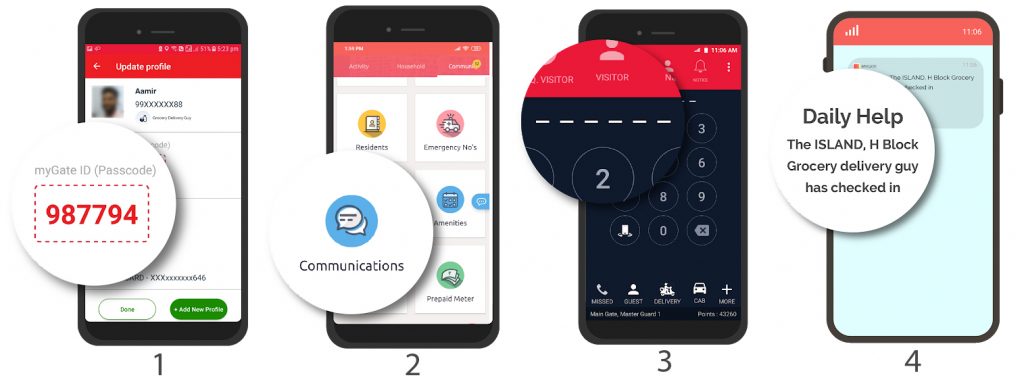
B. Community-wide notification:
1. Make a digital profile of each vendor. This would create a 6-digit code for this vendor.
2. Security guards will tag these vendors to all the flats in the society.
3. Security guards will enter the vendor’s 6-digit code when they arrive at the gate.
4. All residents will receive instant notification on vendor’s arrival.
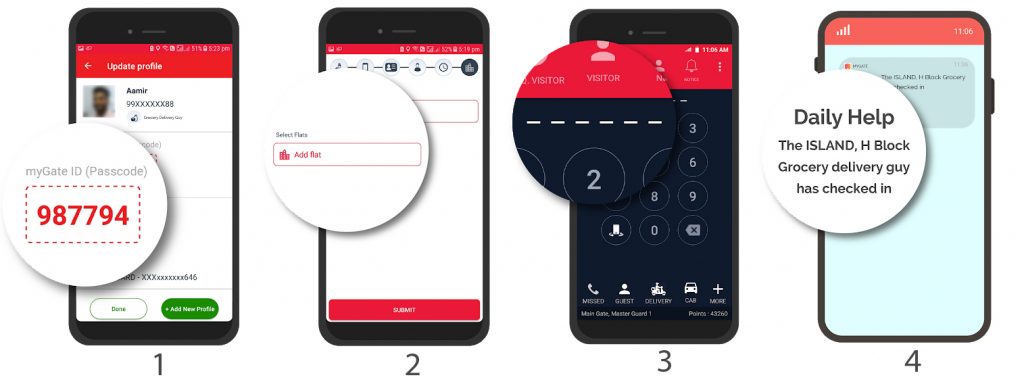
Note:
To ensure this does not lead to a crowd at the gate, we recommend taking the following precautions:
1. Maintain at least 1 metre (3 feet) distance while standing in queue
2. Wear a mask at all times
3. Avoid touching your face
4. Regularly and thoroughly clean your hands
 Connect with us on WhatsApp
Get offer details for your society
We were covered by The Ken on 6th April 2020 in the article ‘Covid-19 casts businesses into three concentric rings’. In it, they discussed how “companies like MyGate, which have become a part of the official response to the crisis, are in the best possible position” after the Covid outbreak.
If you have a subscription to The Ken, read the entire article by clicking here.
Here are a few snippets from the article:
The article describes MyGate as being part of ‘The Magic Ring’, reserved for companies that have become part of the official response of Covid-19. It states, “…The new order… consists of companies that have become the official lockdown product or service picked by authorities. MyGate, a security management app for apartment complexes, has tied up with the Karnataka State Police to become the official pass issuing platform for all companies that operate as an essential service.”
It then recounted the story of how the partnership came to be, and the benefits that have accrued to the city of Bengaluru as a result of it. It states, “The Bengaluru Police called Arisetty (MyGate CEO & Co-founder) on the first day of the lockdown for a solution that would automate the process of issuing passes. Until then, companies were queuing up for passes at the various Deputy Police Commissioners’ offices, turning them into Covid-19 hotspots.
“The Bengaluru Police was directed towards MyGate by one of its senior officers who had been with Nasscom for three years and knew the market, said Anucheth MN, Deputy Commissioner of Police, Whitefield. In times like this, the government couldn’t wait for companies to submit bids for such projects.
It was a project right up MyGate’s alley. “MyGate is a gatekeeper,” said Arisetty. “We issue passes to those who are authorised to go through the gate and reduce friction. We used the same concept for the entire city.” All MyGate had to do was tweak its gatekeeping app, which is used in 9,000 gated communities with 1.6 million homes across 14 cities. The new, modified app is owned by the Karnataka State Police but operated by MyGate. After a pilot in Bengaluru’s Whitefield area, it was rolled out city-wide on 30 March. The app has since issued over 137,000 passes to over 20,400 organisations. That’s only a small fraction of the number of passes the companies applied for, according to the police.”
It also shed light on upcoming plans for the company. “To prevent misuse and backlog, MyGate is planning to roll out an API-enabled solution where passes will be generated only when an order needs to be delivered.
The API integration was something MyGate had implemented for its own gatekeeping product.
“We did the API integration because we wanted to make sure only a background-verified delivery executive is entering the complex,” said Arisetty.
“It was also to make it a seamless process. The idea was to give better security while bringing convenience.” Companies will have to approach the Karnataka Police to sign off on the API integrations.
The State Police hopes to roll out this system after it establishes round-the-clock helplines. Police authorities from Telangana and Kerala, too, have approached the Karnataka Police for this solution, according to DCP Anucheth. Arisetty is confident that MyGate has built a scalable solution. “The API integrations will mean seamless pass issuance in other states too,” he said. If the administrations give the go-ahead, MyGate can roll out the new solution in as many cities as required.
Working as a part of the official response not only gives companies visibility, but it also sets them up well for a post-Covid world. MyGate is not looking to acquire any new apartment complexes at this time, but the APIs of thousands of companies integrated with the app is a gold mine. These relationships could become a moat that makes MyGate more attractive than its competitors.
For the full article, click here.
Every generation of every culture prefers ‘new and improved’ over ‘old and rusty’. Commuters have replaced petrol-run cars with electric ones, schools have replaced paper assignments with e-assignments, and even the government has replaced highway cash tolls with FASTag.
What old fixture that has outgrown its use can you get rid of while planning a new development or launching a new society? Most immediately and obviously, the top redundancy is – the old-school intercom.
Whether you’re a builder, a newly formed housing society, or a registered co-op going for redevelopment, your foremost priority would be to adopt smart ways to keep unnecessary expenses at a bare minimum. At the same time, you wouldn’t want to compromise on essential amenities and live in the dark ages. Thus we urge you to reconsider the familiar ole’ intercom and compare it against the virtual or e-Intercom. After all, the smartphone revolution has only just begun and fruits of the digital loom are bountiful and free.
e-Intercom works FOR you, unlike the old-school intercom that makes YOU work for it. Find out how.
Virtual intercom Vs traditional systems
- Wireless vs wired gatekeeping: Traditional intercom systems require wiring, cabling, and installation of physical devices (telephone/speaker). Virtual intercom is app-based or web-based and requires no wiring or expensive installations.
- Remote access vs physical access: Regular intercom has zero mobility, which means that if only you’re physically present in your apartment, you can be notified of a visitor. With virtual intercoms, no matter where you are, you can receive a push notification letting you know who’s at the door. If there’s no one home or if there are children home alone or elderly parents who shouldn’t have to be inconvenienced, you’d best have a virtual intercom set-up so that you can send away any unnecessary or unwanted visitors without bothering anyone, even when you’re in the office, in commute or out of town.
- Comfort vs inconvenience: Remote feature is a blessing in other scenarios too, e.g. when there’s a disabled family member who can’t be expected to keep answering the intercom, or if you’ve met with an accident or injury and are bed-ridden, or even if you’re enjoying a lazy Sunday afternoon in your bed and don’t want to walk to the intercom. App-based intercoms are always handy, hence super convenient.
- Utility vs waste: Let’s accept the fact that most residents hardly use their intercom. They answer it when they already know that a friend, family member, service or delivery man is expected. Some even keep it off the hook most of the time as they don’t like being disturbed by misdials. At other times when you’re not home, a package or person is sent away without you ever being notified if the guard on duty changes and doesn’t pass on the message to the incoming guard. Missed opportunities abound with regular intercoms, but not with virtual intercoms. Your smartphone is the first and unmistakable point of contact, so nothing unnecessary comes your way and no message/visitor goes unrecorded.
- Enhanced vs basic safety: Old school intercoms are audio-only two-way communication systems with limited call storage capacity while smart intercoms have audio-visual communication capabilities with HD quality, virtual dial pads, log reports, secure multi-user interface, control desk monitoring and management, and cloud storage. This results in advanced security. Every visitor has his own virtual log with recorded personal information. For instance, if a sketchy delivery man who has behaved inappropriately in the past shows up at the gate, not only can you identify him visually but also through his log, and once a red flag is waved, he can be sent back without allowing access.
- Affordable vs costly upgrade: Even the most basic intercom phone costs at least Rs 1200 and a good quality one would cost Rs 5000 per piece, so if you do the math by multiplying that with the number of apartments, it could cost a lot even after a massive discount. For a decent PBX, you’d have to invest at least 3 lakh for a 500-unit apartment complex, including hardware, installation, and maintenance. If you want to go hi-tech, you can have wireless cloud-based video intercom systems for half the price of the hardware-based system that has affordable monthly plans, but they’d be a regular, long-term monthly expense. If you are keen on keeping it even more economical, you can opt for an app-based intercom system that needs no hardware installation or monthly charges and is absolutely free.
- The only circumstances under which e-Intercom wouldn’t work is if there’s no internet, if you’re in a meeting and cannot use the phone, if you’ve decided to ignore your smartphone and unsee all notifications/calls for whatever reasons or if it’s switched off due to no battery.
Options for housing societies
A new housing society can choose an app-based intercom since it would be a great way to remain cost-effective while being seamlessly connected.
An existing/old society without an intercom can set-up e-intercom to have complete intercom facilities at zero price.
A society with traditional intercom can get an upgrade for all your residents by hooking them up with e-Intercom so that they can avail push notifications on their smartphones, get added security and enjoy the priceless convenience of remote gatekeeping.
Why choose Mygate e-intercom
A simple, smart and meticulous gatekeeping app, Mygate provides a free feature called e-Intercom to residential societies that sign up as members.
When there’s a visitor at the gate, the security guard registers his personal information such as name, mobile number, and the apartment they intend to visit. A photograph and company information of delivery personnel is also registered on the guard’s version of the app. The member then receives a notification from the guard on the resident version of the app, at which point, the member can grant or deny access to the visitor via the app. If the member doesn’t respond to the push notification, an auto-generated IVR call goes to his registered mobile/landline number. Upon a positive response, the guard allows the visitor to enter. If at all, the member doesn’t respond to either of above communication (due to bad internet connection, switched off the phone, or any other reason), the guard uses the regular intercom as a last resort.
Mygate e-Intercom feature is free of cost and requires no additional hardware and installation except a Mygate app. Download on your Android or iPhone to register.
Indians have always been savvy with real estate investments and consider a home to be their greatest tangible asset. In a growing economy, it is not uncommon for homeowners to resell their residence for a good profit, the most common reason for transfer of shares in a housing society. Other than that, residences see transfer of shares if the owners pass it on as inheritance or in the event of the death of the original member, transfer ownership to other family members, pay off debts in the form of property or other personal reasons. A flat in a housing society could change multiple hands in its entire lifecycle. Model bye-laws have extensive provisions for such exchanges; these rules if followed duly make the transfer of shares a fairly easy and unencumbered procedure. In this article, we will list down all the steps a member needs to follow while transferring ownership of his residence.
What are the pre-conditions before the transfer of shares in a housing society?
- The person who intends to transfer his shares has to give fifteen days’ written notice to the society.
- The transfer should be made according to the bye-laws of the society.
- All pending dues to the society from the person who is transferring shares should be totally cleared.
- The transfer should be duly registered in the records of the society.
- No shares can be transferred unless the ownership has been held for at least one year (unless there is a court order for transfer)
- Any charge in favour of the society on the share so transferred will continue unless discharged otherwise.
What is the procedure to transfer shares in a housing society?
A 15-day written notice is to be furnished along with the name and the consent of the person to whom the shares are being transferred along with the proposed value of the transaction.
The Secretary places the request in front of the managing committee who decides if the member is eligible for such a transfer.
Whether the transfer of shares is approved or not, the Secretary has to inform the transferor within 3 days of making the final decision.
If the transfer is eligible, the following procedure has to be completed:
- Discharge of all dues pending towards the society from the transferor along with an undertaking to do so
- Share Certificate along with the application in the prescribed form for transfer of shares/interest in the capital/property of the society
- The transferor has to submit his resignation form
- A valid reason in writing for the transfer of shares (whether it’s a sale, inheritance, or any other)
- Application from membership from the person to whom the shares are being transferred
- Transfer fee of Rs 500 (or as prescribed in the bye-laws)
- Entrance fee of Rs 100
- Transfer premium as decided during general body meeting but not more than the government prescribed amount of Rs 25,000.
- A copy of the registered agreement (with required stamp duty) should be paid to the society
- An undertaking by the person to whom the shares are being transferred stating that the residence will be used for the purpose it is being owned (residential, commercial, etc)
- A NOC from a financing agency, bank, etc if the person who is transferring the shares has acquired a loan to buy ownership of the residence
- Any other declaration or undertaking that may be required by the bye-laws of the society
Procedure after the application and submission of documents
The Secretary of the society is obliged to examine and verify all documents submitted by both parties and ensure they are in compliance with the bye-laws. After that, he should present the entire paperwork to the managing committee.
If the application is rejected for whatsoever reason or approved duly, the Secretary is responsible for informing the applicant within 15 days to 3 months from the date that the decision is made. If the society fails to make any communication to the applicant, it is assumed that the transfer has been accepted and the new member is accepted by society.
Transfer shares in the event of death
In case of the transfer of shares of a deceased member, the society should transfer them to the nominated member or the legal heir of the member. The nominees are required to apply for transfer of shares within 6 months of the death of the original member. Multiple nominees can become joint/associate members after picking a main member and provide an indemnity bond to the society. If no nominee comes forward, the society puts out a public notice (along with newspaper ads), inviting claims to membership. The society examines the claims/objections and if need be, they take the help of the verdict of a Competent Court. If there are no claimants, the property is vested in the society.
Imagine this. You invested your money in a home that you love in a society you trust. You did your due diligence with paperwork and payments, picked out plush drapes and ordered bespoke furniture, and settled in comfortably in your new digs. One fine day, you find out that the land on which your residence is built, is being claimed by another as theirs and you have to fight for it in the court of law. Wouldn’t that be a nerve-wracking and traumatic experience? Learn About Title Insurance in this article to see how it saves you from any unexpected ownership disputes.
What is Title Insurance?
A Title Insurance protects homebuyers against any losses, damage or defects in the Title (ownership) of the property. As a real estate project evolves, builds over time, the ownership changes many hands, from the landowner, builder, to the homebuyer. When you are purchasing a property, you are essentially purchasing a legal Title to the Ownership of that property. As the property (including the land it was built on) may not belong to the developer and could have been acquired from multiple successive owners, its Title may be disputed due to transfer errors or if proper and legal ownership documents have not been generated each time the property has been bought and sold. A Title Insurance indemnifies the homebuyer against any disputes, litigation and settlement expenses that are caused over the ownership of land from previous owners and also from claims of ‘ownership’ by other parties. It is an effective risk transfer mechanism.
In India, the real estate market suffers from many setbacks and misrepresentations with respect to ownership of property, such as a forgery in the previously owned deed, inadequate documentation, among others. If a Title Insurance is purchased, the homebuyer is safeguarded against any repercussions and tedious court procedures as the original property records (dating back to years ago) may not always be available for verification.
What is covered under Title Insurance?
Real Estate Regulatory Act (RERA) Registered Developers are mandated to buy Title Insurance for all their projects and pass it on to the buyer at the time of the actual sale of the property. Indeed, non-RERA developers too have started buying it for the additional credibility it brings.
This is a relatively new category of insurance that only a few financial agencies have started providing recently in India, noticeably HDFC Ergo and SBI.
It not only insures buyers against title defects that may happen in the future but also covers losses that may have occurred in the past and were not been discovered before the policy commencement date.
Typically, Title Insurance coverage includes but is not limited to the following:
- Losses due to order of settlement
- Cost of demolition, alteration in existing structure if built without a permit by the previous owner
- Title defects due to forgery, fraud, misrepresentation, impersonation, incompetent/inadequate/under duress documentation
- Failure of any authority to give transfer of conveyance
- Coverage when the insured cannot obtain a permit to build over previously incorrectly subdivided land prior to sale
- Documents that may harm the title due to improper, false, or expired power of attorney
- Inadequate descriptions and plans in historic title deeds
- Property encroaching adjoining owner’s property
- Coverage for insured if the title is not good and marketable
- Errors and omissions in drafting title/registration which results in provisions not being enforced duly
- Unknown burdens or variations that may have been imposed in the historic title deeds
Initially, the builder/developer is liable to buy the Title Insurance and pay the premium in one-time payment (which usually provides coverage for 7 to 12 years). Once the handover has been made, later the housing society may have to bear the remaining expenses, and also when the insurance has to be renewed, the expense will be carried by the members.
How does Title Insurance benefit homebuyers?
Homebuyers who are looking to buy from builders/developers in residential spaces can definitely avail of the ultimate benefits of title insurance which is bought by the builder. Ultimately it protects them from risk, enhances the market value of their property, saves them from long and arduous litigation procedure in case if a title dispute occurs from a historic deed, eliminates the threat of a project being stalled due to title disputes, and indemnifies them from all claims of ownership over their investment. Another major benefit is that the first-time premium is paid by the developer and only the renewal charges and/or other premiums have to be borne by homebuyers at a later stage.
What should housing societies need to know?
Housing societies stand to gain the primary benefits of title insurance as currently, independent home buyers are not the primary beneficiaries of the title insurance. It is a practice for builders to ensure that the title deed provided to the society is clean and free from disputes. However, having title insurance is a foolproof measure for a society to ensure risk-free handover because it means that every member will be safely insured against unforeseeable claims or losses in the future and no unexpected financial loss can occur to any member or to the society on the whole. While RERA developers are mandated to provide title insurance to society, non-RERA developers can be urged and convinced to purchase title insurance before handover if the society has any suspicion regarding land ownership.
You would rarely come across a well-run housing society in a shambles, where lifts are defunct, lawns are unkempt, floor bulbs are broken and water pipes are leaking. All of your society’s amenities and services run smoothly like a river because they are paid for and looked after. The nitty-gritty of a society’s financial management is no joke. Members are often confused and even agitated when they are asked to contribute towards funds that seem to be inconsequential on the surface, but when understood well, they make a whole lot of sense. In this article, we will shed light on a variety of housing society funds that create a perfectly healthy state of affairs.
Types of funds in a cooperative housing society
1. Reserve Fund
A Reserve Fund is made up of entrance fee paid by the members, transfer fees when shares are transferred with occupancy rights, transfer premium received when a member transfers interest in the capital/property, general donations (not for a specific purpose) received by the society. Accumulated Reserve Fund gets carried forward to the next year every year.
Utilisation: As per the model bye-laws, Reserve Fund is used for repair, maintenance and renewal of the society’s property.
2. Repairs and Maintenance Fund
This fund is made up of a fixed maintenance amount paid by the society’s members on a monthly, quarterly, bi-annual or annual basis. It is calculated at a rate decided at general body meetings based on per square feet, equal division or hybrid methods. Bye-laws state that rate is subject to the minimum of 0.75 per cent per annum of the construction cost of each flat for meeting expenses of normal recurring repairs.
Utilisation: As explained in the title of the fund, it is used for the expenses of amenities, bills and maintenance of premises of the society, repairs, service staff fee, common electricity expense, water charges, etc.
3. Sinking Fund
A Sinking Fund is a separate amount that the members have to pay on their maintenance bill. A housing society saves this amount for the time when there are any structural additions or alterations to the buildings/wings of society. A Sinking Fund is fixed at the general body meeting and is subject to the minimum of 0.25per cent per annum of the construction cost of each flat, excluding the proportionate cost of the land.
Utilisation: These are done after consulting the society’s Architect who may recommend such additions/heavy repairs to strengthen the integrity of the structure for the safety of the members and also for posterity.
4. Education & Training Fund
Members have to contribute to this fund. Each member has to pay Rs 10 every month or as decided by the general body meeting.
Utilisation: The purpose of this fund is to analyse the issues and complaints of the society with respect to administrative measures and create an atmosphere of camaraderie and unity through conducting training programs in order to develop professional skills among members, distribute articles, books, etc. to train members for a specific skill, to run training classes pertaining to the co-operative movement and issue certificates/diplomas to upskilled members.
5. Other Funds
Major Repairs Fund is to be created by the society to fill the gap between maintenance fund and Sinking Fund. This has to be paid as and when required and decided by the general body at the rate fixed on an area basis. Additionally, some societies create a surplus fund as and when needed in order to celebrate festivals, special days and other occasions. This does not constitute a formal or mandatory fund, however, members contribute voluntarily to participate in the festivities and to partake in the activities of communal living.
Why do societies generate these funds?
A housing society is a cooperative and democratic movement that functions on the basis of contributions made by the member. All amenities, services, repairs, etc. are paid by the members themselves and there is no outside agency that is going to swoop in and bear the expenses on behalf of the society. Neither the managing committee nor the members would subject themselves to any negative surprises due to lack of funds, a scenario that can be easily avoided if funds are generated fairly and properly in advance. To avert any unexpected financial losses in terms of repairs, failure of amenities, structural damage, the society has to be prepared in order to be able to bear the expenses. It does so by collecting money on a monthly basis in general so as to not burn the pockets of its members. The common ways to generate funds are mentioned below:
- Entrance Fees
- Deposits
- Loans/subsidies
- By issuing shares
- Voluntary donations
- Maintenance bills
- Fees on the transfer of shares
- Non-Occupancy fees
- Renting space for advertisements, billboards
- Renting terrace space for mobile towers