

The Indian Succession Act, 1925, implies that a succession certificate is a document that is issued by civil courts of India to establish the rightful claim of legal heirs when the person dies intestate (which means they did not leave a valid will).
When the owner of a property dies and has no will, the family needs to obtain a succession certificate to clearly outline the successor of the deceased person. This person who holds the succession certificate can take on the responsibilities tied to the assets and debts of the deceased person. In short, a succession certificate is a legal document that gives authority to a person or persons who have obtained it to represent an individual who is deceased. A person who has a succession certificate can then collect or claim debts and securities owed to the deceased person, according to succession laws. It is issued by the district judge of the place where the deceased person lived or had property.
What is a succession certificate for property?
A succession certificate is issued by a civil court that certifies a person to be the legal successor of a deceased person, authorising them to secure debts and securities that belong to the deceased person.
In simple terms, a succession certificate, which is given by a court after some necessary checks, establishes the legal heirs. This certificate grants them the authority over the deceased person’s debts, assets and securities. This includes assets such as insurance, mutual funds, pension, bank balance, etc.
The certificate will mention the relation of the petitioner with the deceased, the information regarding the other surviving legal heirs, as well as details such as the place, time and date of death of the deceased. It will also state that the deceased died intestate. When it comes to immovable assets such as property, a succession certificate is necessary in order for the legal heirs to obtain or sell the property.
Note that if a person has a succession certificate it does not mean that they have the right of succession to the property of the deceased person. This is because a succession certificate does not prove the right, title and interest of the deceased person to a property.
All the legal heirs of a deceased person who has died without a will (intestate) are entitled to inherit the property of that deceased person.
When is a succession certificate required? What is the purpose of a succession certificate?
A succession certificate is required by the legal heirs of a person who dies intestate, leaving no legal will behind. The succession certificate is used to prove that the person who is petitioning to take ownership of the deceased person’s property is the rightful legal heir. After thorough checks, a competent civil court will determine whether the petitioner can be granted the succession certificate. This succession certificate is required when a person inherits movable or immovable property under the country’s property laws such as the Hindu Succession Act, Indian Succession Act or other community acts.
Who issues the succession certificate?
The succession certificate is issued by the district judge of the jurisdiction of the location where the deceased person was living during the time he passed away. If this is not possible then the jurisdiction is passed on to where the assets of the deceased person are present.
What is the procedure to obtain a succession certificate?
The succession certificate procedure is quite straightforward. Once you have filed a legal petition in court to obtain the succession certificate, the court will take the matter further by doing the necessary steps to verify and authenticate the request. Here are the various steps involved in getting a succession certificate.
1. Filing the petition
If you are a legal heir who wants to claim ownership of the assets left by a deceased person, you will have to file an affidavit in the proper format petitioning claim to the property. This petition needs to be verified in the civil court in the appropriate jurisdiction. The affidavit needs to have the name, place of residence, and occupation of the petitioners. The details of the next-of-kin of the deceased also have to be included similarly. If any legal heir wants to relinquish their right to the property, it must be mentioned, too. A copy of the death certificate of the deceased person should be included with the affidavit.
The petition should mention the details written below clearly.
- Time, date, and place regarding the deceased person’s death
- Names of other legal relatives or heirs and their details
- The residence and the details of the properties owned by the deceased person and the jurisdiction those fall under
- The rights of the petitioner
- Details of an absence of any impediment to granting of the succession certificate
- Copies of ration cards or passports for identification purposes
- Debts or securities for which the succession certificate has been applied
- No objection certificates from the other legal heirs
2. Succession certificate fee
There are fees to be submitted in order to obtain the succession certificate. This fee is determined as a specific percentage of the value of the estate. It will have to be paid by the person who is making the petition in judicial stamps. This is in accordance with The Court Fees Act, 1870.
3. Notifying the public
The court then inspects the petition and gives notice of it to the next-of-kin of the deceased person who are not the petitioners. The information then needs to be made public and is done so through a notice or advertisement in a national newspaper. There is a period of 45 days, which is mentioned in the notice, for those who have objections with the petition to come forward and raise their claims along with supporting documents.
4. Granting the certificate
After the 45-day period allotted for objections, if no one comes forward to claim ownership of the deceased person’s assets or has objections of any kind, then the succession certificate is granted to the petitioner. This is also after all the checks and verifications of the claim are fulfilled by the court. If there are many petitioners, there will be a joint succession certificate.
5. Indemnity bond
The judge can ask the person who has made the petition to sign an indemnity bond in certain cases. This is to ensure that losses take place in case the petitioner misuses the succession certificate that has been granted to him or her. When signing the indemnity bond, the petitioner may have to do it by giving the court some security.
What is the fee for a succession certificate?
As mentioned above, the fee for obtaining a succession certification is determined as a specific percentage of the value of the estate. This fee is imposed by the court and will have to be paid by the person who is making the petition in judicial stamps. This is in accordance with The Court Fees Act, 1870. The percentage can vary according to the state of the country but it is usually estimated at about 2-3% of the estate’s value.
What documents are required for a succession certificate?
There are many details and documents that a court requires before it can issue a succession certificate. These are needed to verify the claimed ownership by the petitioner. Listed below are the required details and documents needed to obtain a succession certificate. These should be verified and attached with the petition.
- Time of the death of the person who is deceased
- Address of the deceased person at the time of death
- Property details of the person who is deceased
- List of assets, debts and securities of the person who is deceased
- Family details of the person who is deceased
- Full details of the legal heirs of the person who is deceased
- The rights of the petitioner of the succession certificate
- No Objection Certificates from other legal heirs
What is the validity of a succession certificate?
A succession certificate is valid in the entire country if it has been granted in India. When a succession certificate has been granted in a country other than India by an Indian representation accredited to that State, it needs to be stamped in accordance with the Court Fees Act 1870 – then it will have the same impact within India as a succession certificate that has been granted in India.
What is the format of a succession certificate?
A succession certificate will include a petition number, the names of petitioners and the address, the date of the institution, date of the decision, and for what the petitioner has been granted the authority and for what specific purpose. For example, the purpose of collecting debts owed to the person who is deceased or to change the gas connection ownership.
What is the difference between a succession certificate and a legal heir certificate?
Most will mistake legal heir certificate and succession certificate as the same document. However, they are not.
1. Purpose
Succession certificate : The holder of a succession certificate can make transactions on the deceased person’s behalf. The holder can take over the assets, securities and debts owed to the deceased person.
Legal heir certificate : The legal heir certificate is only used as an identifier that the person who holds it is the legal heir of the deceased person.
2. Issuance
Succession certificate : The issuing authority for a succession certificate is the district court judge.
Legal heir certificate : The issuing authority for a legal heir certificate is either the municipality or the tehsildars.
3. Specifications mentioned
Succession certificate : The succession certificate must mention the assets, debts and securities of the deceased person. As well as the relationship the petitioner has with the deceased person.
Legal heir certificate : The legal heir certificate will have a list of all the legal inheritors of the person who is deceased.
4. Consequence
Succession certificate : The holding of a succession certificate will not guarantee that you become the beneficiary of the estate or property.
Legal heir certificate : By law, the person or persons who hold the legal heir certificate are entitled to inheritance of the estate of the deceased person.
5. Timeline
Succession certificate : Succession certificate requires 45 days or more to be granted.
Legal heir certificate : Legal heir certificate needs around 15 to 20 days to be granted.
6. Assets
Succession certificate : Succession certificate includes the movable properties only.
Legal heir certificate : Legal heir certificate includes all kinds of properties.
The revocation of the succession certificate
The succession certificate can also be revoked by a court. It is usually done for a number of reasons such as:
- Wrong information was given to the court in order to deceive it.
- The methods and processes to grant the certificate were not done correctly.
- The information given by the petitioner claiming to be a successor are found to be false.
- The certificate has no use anymore because circumstances have changed.
In continuation of our efforts in improving usability, increasing engagement, increasing collection, reducing operational efforts, and supporting acquisition and retention in the system, we have identified and rectified the following product gaps and added certain valuable enhancements to the product.
NOTICE BOARD :
Background patterns for new notices
Notices are a very popular method to circulate information among the society members, whether for the purpose of promotions or announcements. Traditionally, new notices have always occupied a prime spot on the home page. However, since the widget has stayed with a static design for a long time, it cannot gather more attention from the users. This update completely revamps the widget experience in the following ways –
1. MyPulse Notices : Our internal user needs to add –
- A widget background image that supports both jpeg (image 1) and gifs (image 2)
- A brand logo, which will appear at the top right corner.
- In case the background image has heavy infographics, the user can choose to only show the title (image 1)
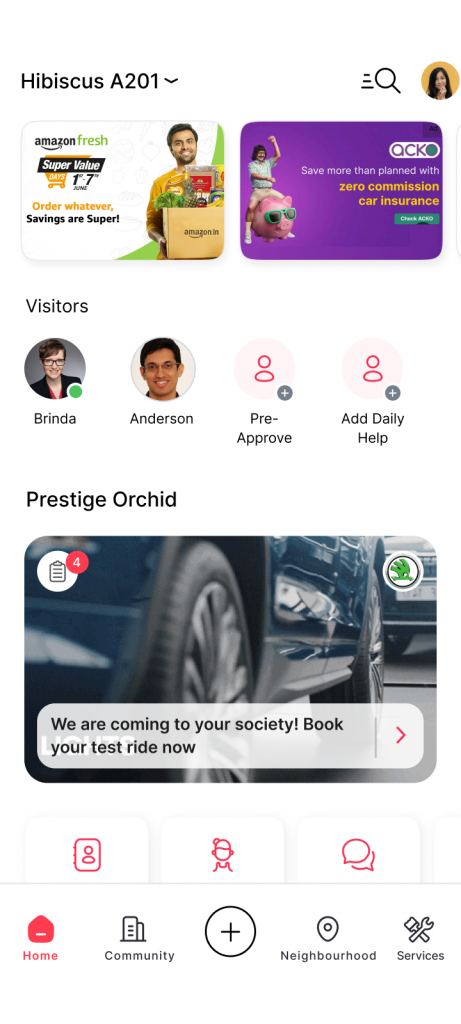
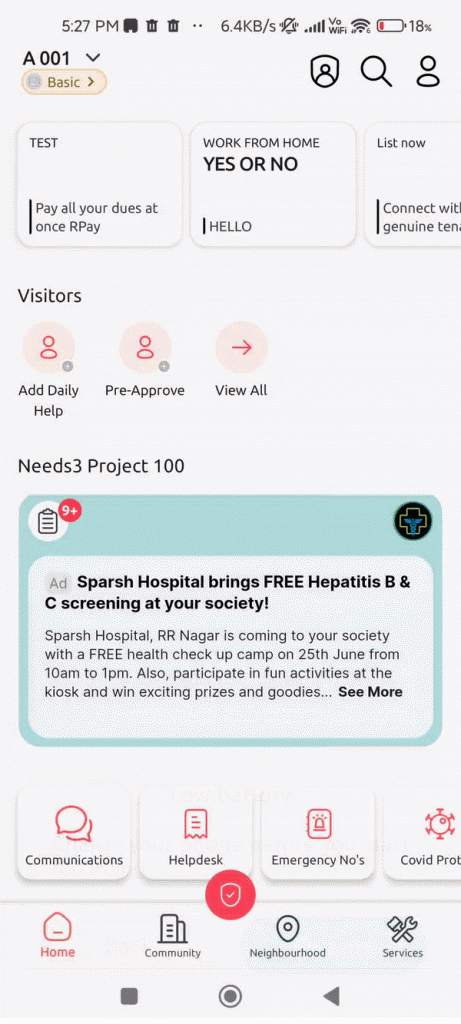
2. Society Notices : The society admin can choose one of the following preloaded templates to ensure their announcements have more character and gain better viewership –

Emergency Notice Alarm
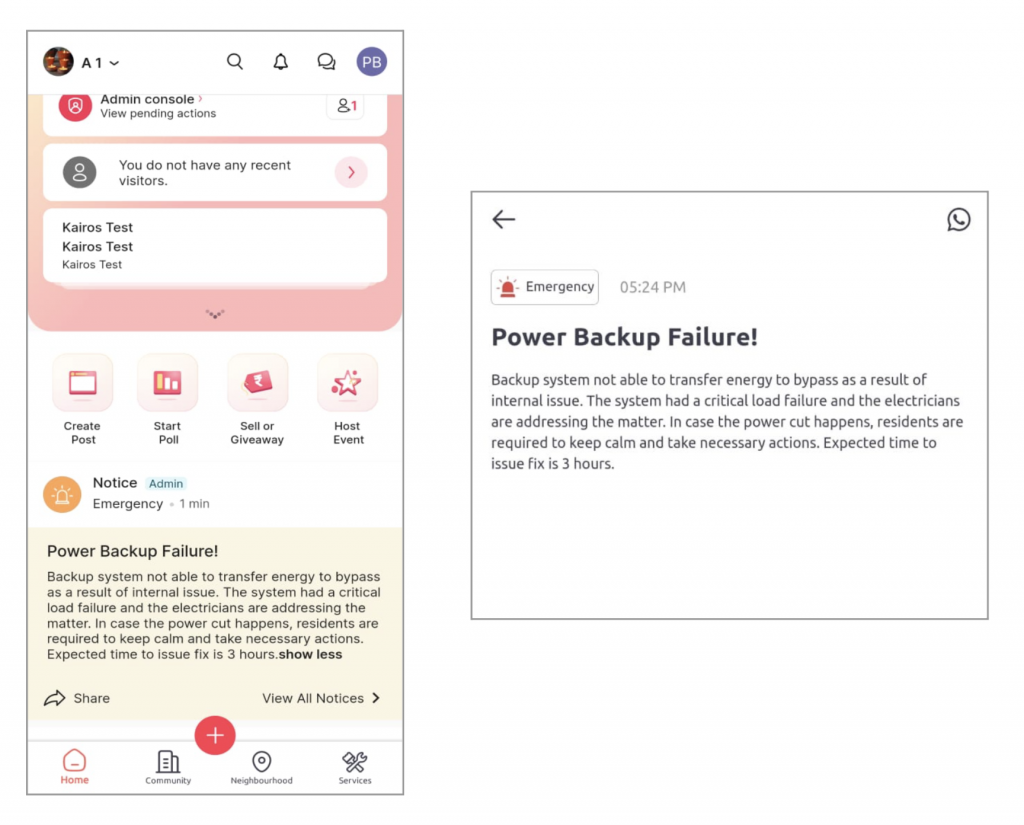
Notices have always been published to the society members with standard push notifications. In favour of a smarter and safer community living, this update introduces a new category called ‘Emergency Notice’. For time sensitive topics such as water supply disruption, unscheduled power cuts, etc or any other situation that requires immediate attention from the residents, this feature would be very useful.
A society admin has to just select the notice type to be ‘Emergency’ while creating the announcement. On the app, it will create the following differentiations –
- The notice will be sent with a label of ‘Emergency’
- The notification will go with an alarm sound (carrying the morse code for SOS) to quickly alert the resident (Alarm Sound)
ERP :
Improvements to Dashboard Search
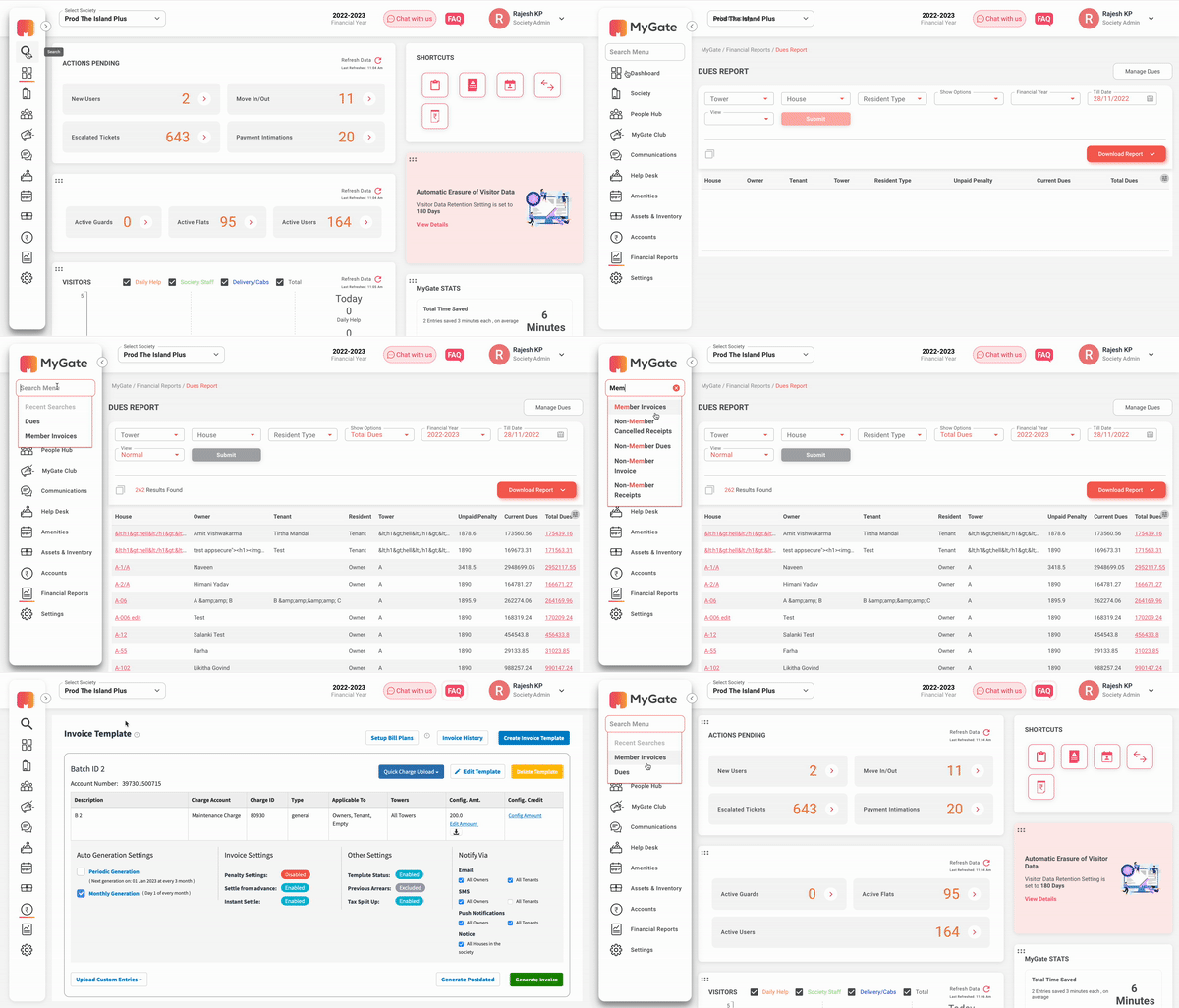
The dashboard search option has traditionally worked on the basis of the user inputting an item from the menu list. With this update, the field of view of this search has been widened by adding an option of tags on the top of the previous functionality. The following provisions have been built
- Tags attached to the menu items can be easily updated to keep the tool relevant
- New menu items added will now automatically fall under the scope of this search
- The roles that do not have access to certain pages on the dashboard will not find those menu items in search results (unlike previously where they landed on an error page)
The dashboard users (especially the new ones) can find the following benefits –
- The tags being added include multiple colloquial terms such as bill or challan for invoices OR raseed for receipts, making it easier for regional admins to operate
- Recent searches are pre-populated when the search box is clicked offering quicker navigation
Dashboard >> Search
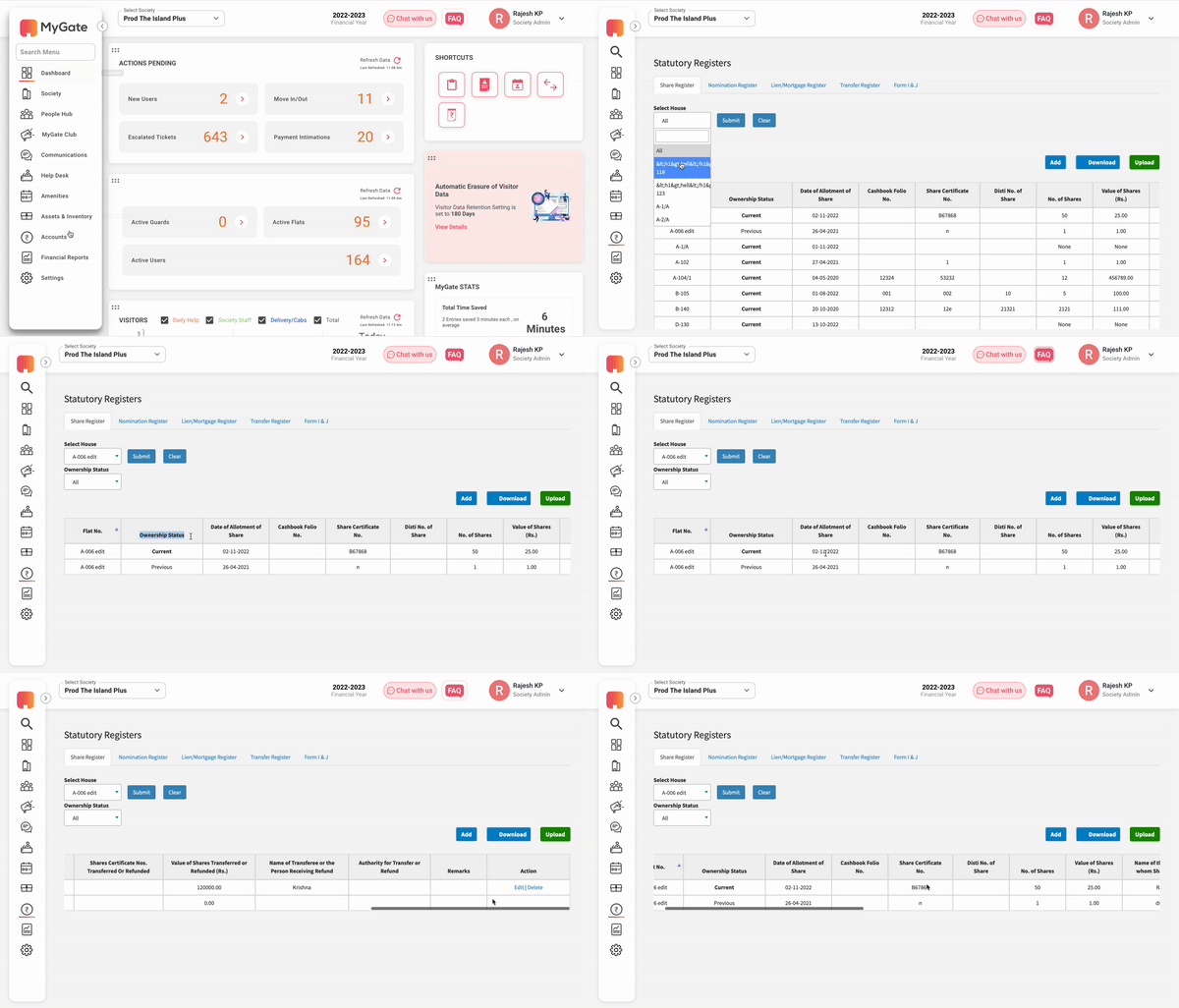
Statutory Registers to retain the previous ownership information
The statutory registers module does not store any previous data added. In case any change is made to stakeholders or a new owner for a house is added, it replaces the old information.
With the current update, the Admin will be able to keep adding new details against a flat. This addition would label the older stakeholder as “Previous” and the newly added one as “Current” –
- Edit or delete actions against the previous owners are barred so that we can prevent loss of data by user’s mistake.
- If an older entry has to be updated, the current one for the flat would have to be removed first.
- Filter for viewing the previous or current list one at a time has been added.
- Downloaded excel file will have the historical records exported as well.
Dashboard >> Accounts >> Statutory registers
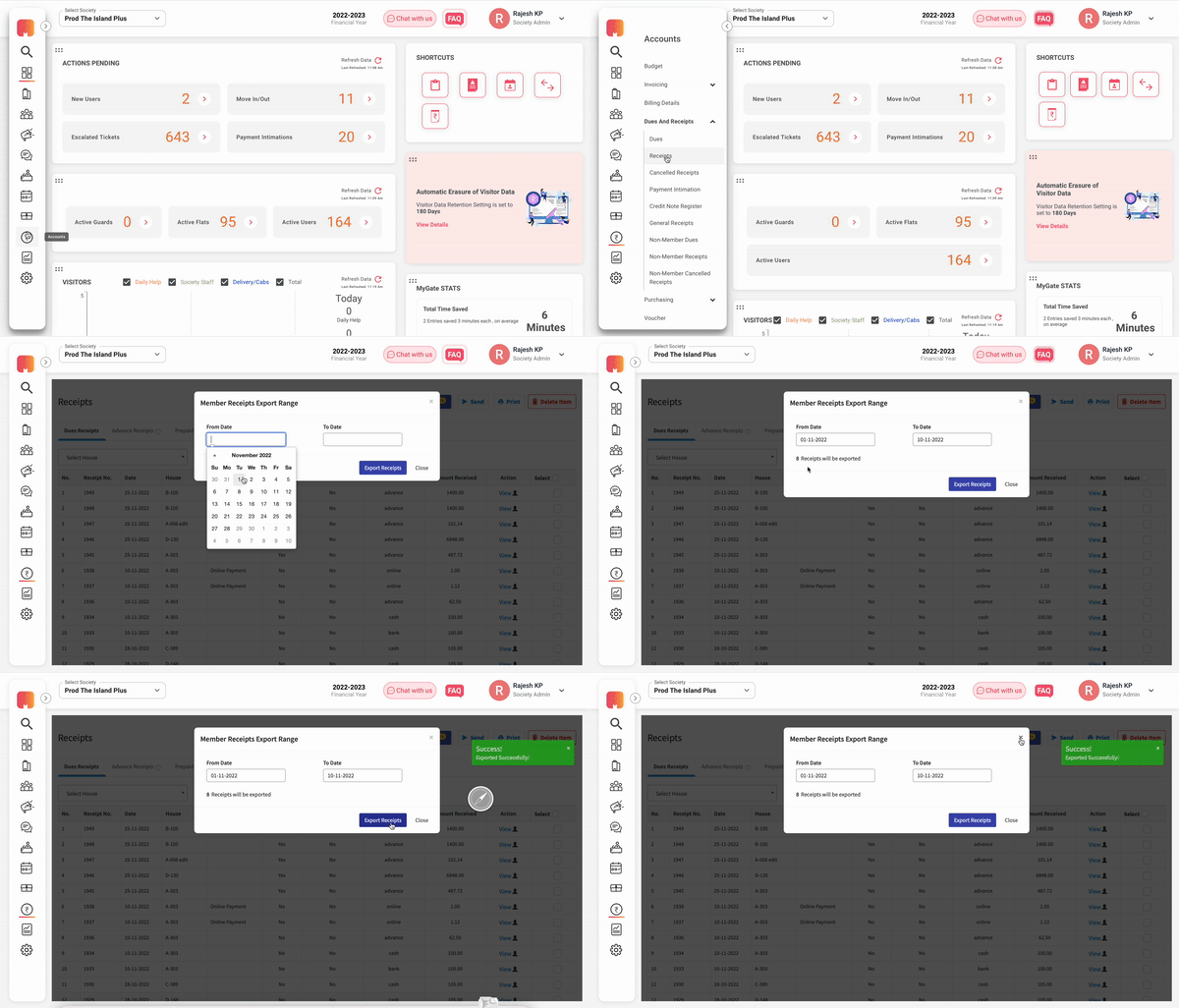
Tally – Bill plan wise receipt export
With the previous release in October, we started supporting the upload of bill plan wise mapping of multiple tally ledgers in MyGate. The updated tool is now being adopted by societies for exporting their multiple bill plan (heads) invoices into tally. The next stage of booking an income i.e. collections were yet to be supported on this new process.
Since it is very common to have one receipt for multiple types of invoices – with this new update, the export system will take bill plan level segregation of the receipt value into account while generating the XML file. The same is achieved using the compound entry feature provided by tally.
Admin/accountant will receive the following benefits –
- There is no bifurcation of receipts involved and hence multiple vouchers are not created in tally for a single receipt in MyGate. A one to one reconciliation is hence possible.
- This upgrade serves as the foundation for adjustments and credit notes for such societies as well. This is slated to be worked upon and released in the next quarter.
Dashboard >> Accounts >> Dues and receipts >> Receipts >> Export receipts to tally
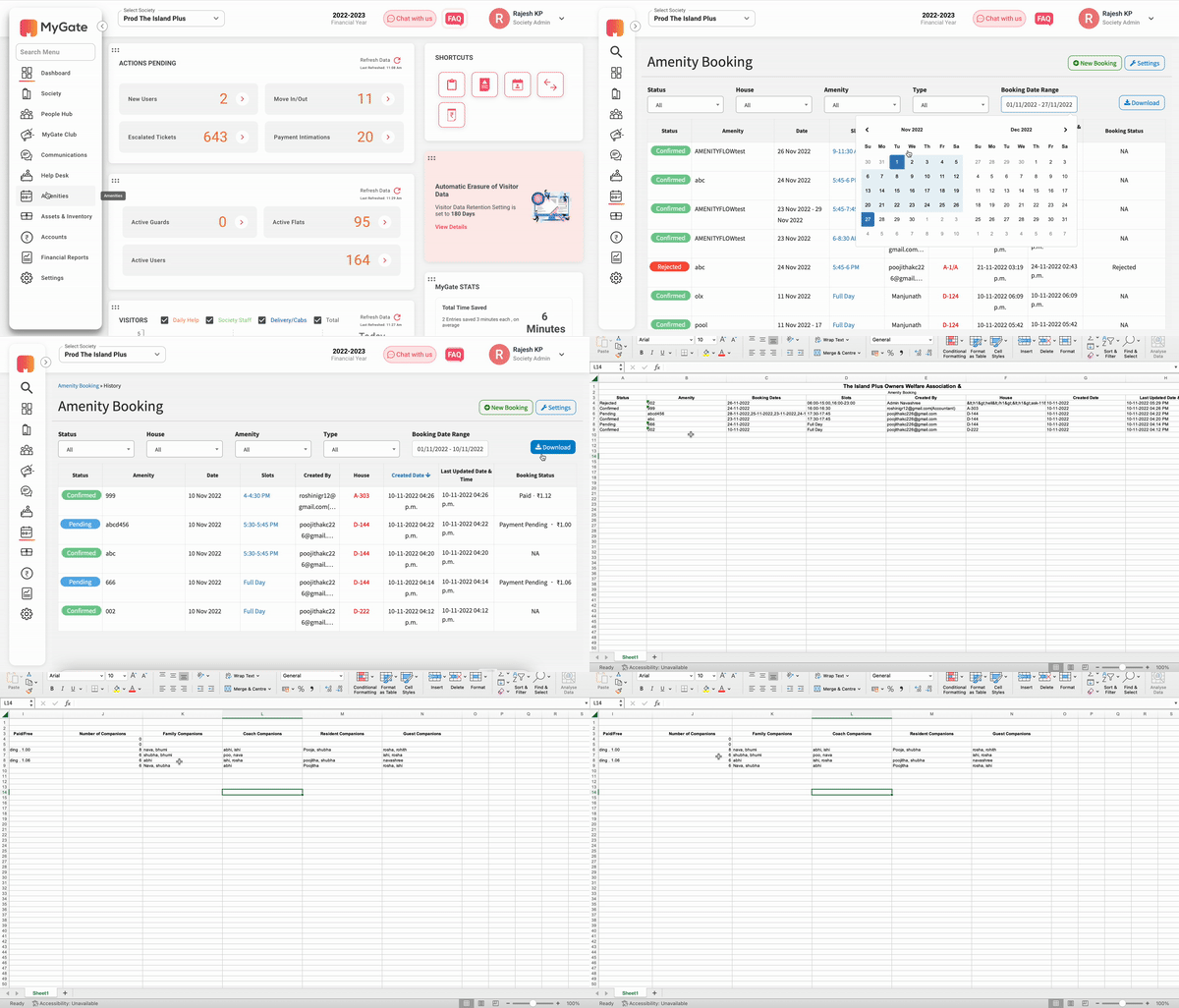
Amenity – Companion name and their relationship in report
The amenity booking feature supports the following types of companions –
- Family
- Resident
- Guest
- Coach
However, such information collected during amenity booking was not being made available as a report to the Admin. With this update, the admin will be able to get the Number of Companions, Family Companions, Resident Companions, Coach Companions, Guest Companions against each booking. This information can help during the following use cases –
- Finding out the exact details of facility users during a slot in case of harm to property or nuisance
- Monetizing the use of facilities by guests or coaches
Dashboard >> Amenities >> Reports
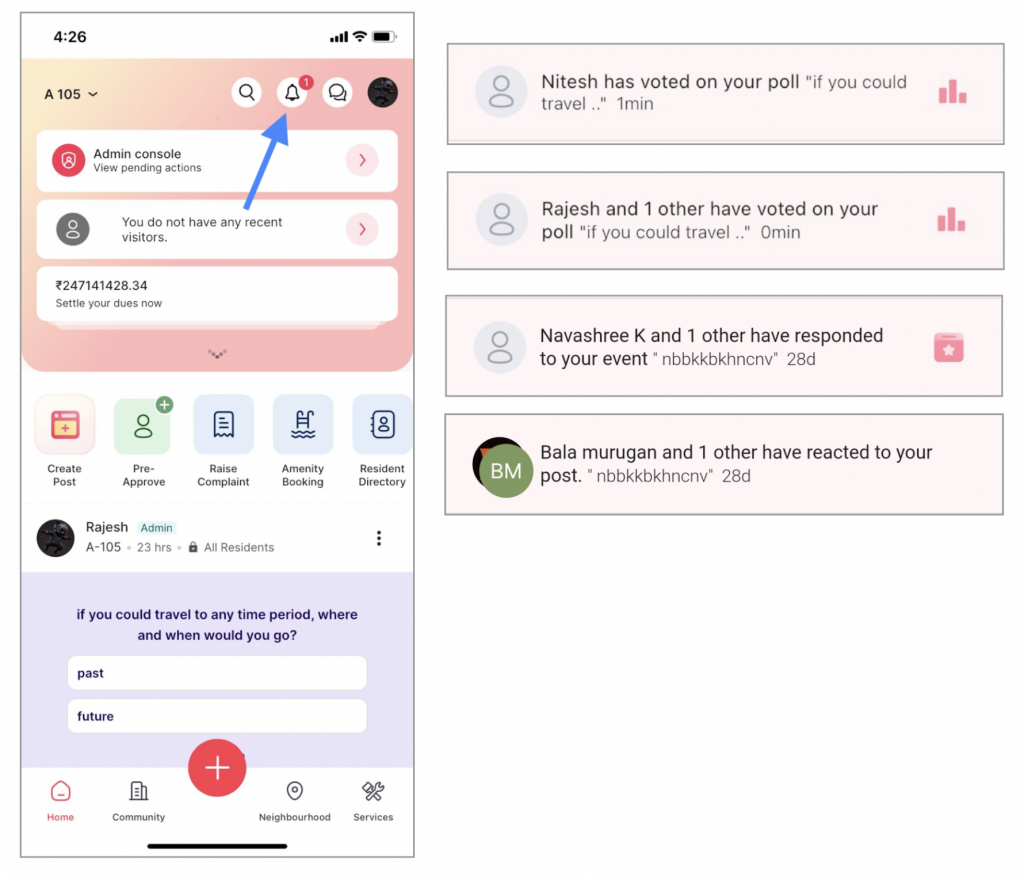
App ‘Notification Center’ to now support Votes & RSVP messages
Votes and responses to a user’s poll and event respectively occur on a very frequent basis. These information points are, therefore, not sent via push notifications to avoid creating nuisance. We have a dedicated notification center on the home page that focuses on listing all user related activities.
With this update, the votes and RSVP counts would now be updated in the notification center listing.
Eg. 1 – Akash Mishra and 7 others have responded to your event.
Eg. 2 – Anlin Assisi and 43 others have voted on your poll.
App >> Notification Center
‘Profile’ page API support on the user app
Post the efforts made on the communications module over the last few months, user profiles are now supported on the MyGate app as well. One can open their own profile page and view all the communication content he or she has previously posted.
App >> My Profile
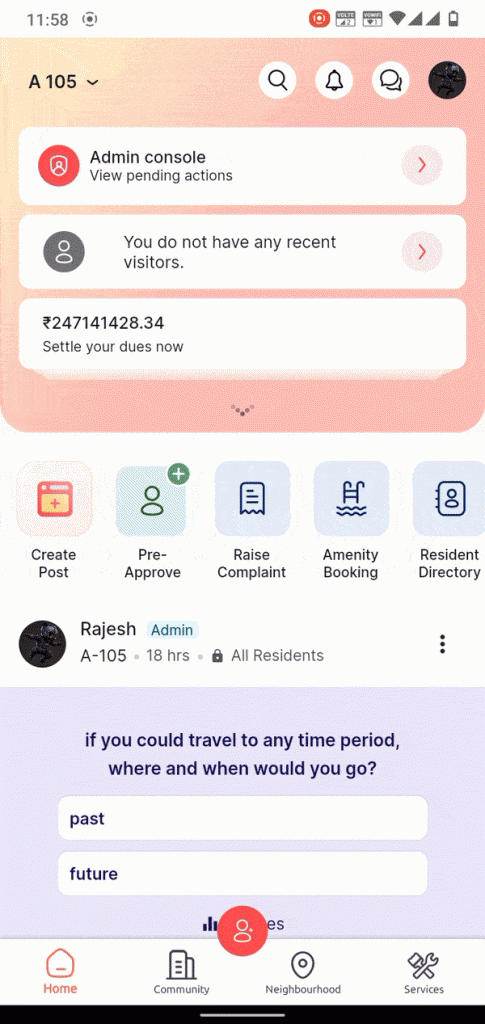
Same as the above, an API level support has been created for viewing another user’s content on their profile pages. It makes it simpler to find and engage with posts made by a popular creator within the society.
Migration – Automated mapping of Bill Plans during invoice upload
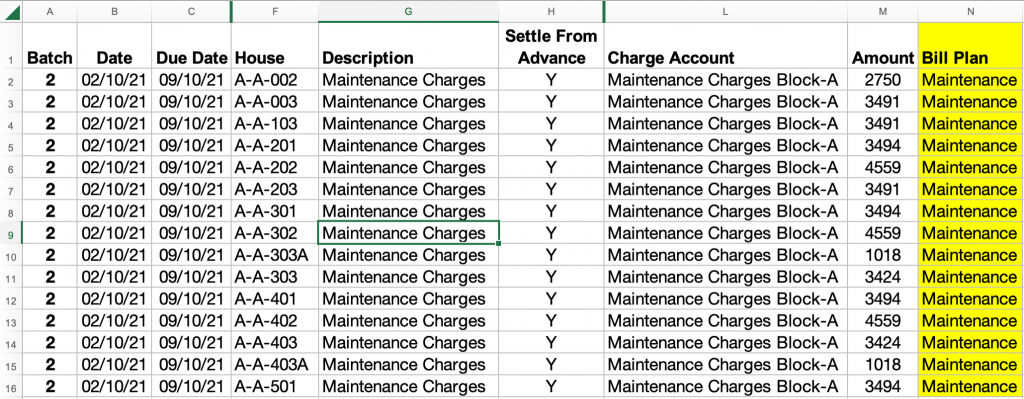
One of the most tedious efforts during migration of accounting data is to manually map all the invoice batches uploaded into their respective bill plans. Given that there are multiple years involved, hundreds of batches may be required to be identified and worked upon individually.
Through the addition of a ‘bill plan’ name column in the invoice upload file, the above process can now be automatically completed at the time the batches are being uploaded. This ensures the following –
- Batches are not wrongly mapped leading to an error in migration
- Almost 2 days of effort can be saved per year of migration, in case multiple bill plans are in play
UL Dashboard >> Upload & Downloads >> Upload Member Data >> Upload Invoices
Security :
New ‘Admin Console’ on the app
In order to increase engagement and enhance discovery of relevant information for our admin users, we have revamped the app admin console. The core functionalities are kept intact and additional details used by the admin in day to day operation across the gate and ERP modules have been included. The intent is to allow admins to take necessary actions quickly for smooth functioning of the society.
The revamp of the app admin console is planned in a phased manner. In the current iteration, we have redesigned the Admin Chat and Helpdesk widgets. Also, a new Income widget has been added to the console.
*Note : The new admin console will not have the old process of society selection on an intermediate page. Whichever society is actively being viewed by the admin, the app would open the console for the same.
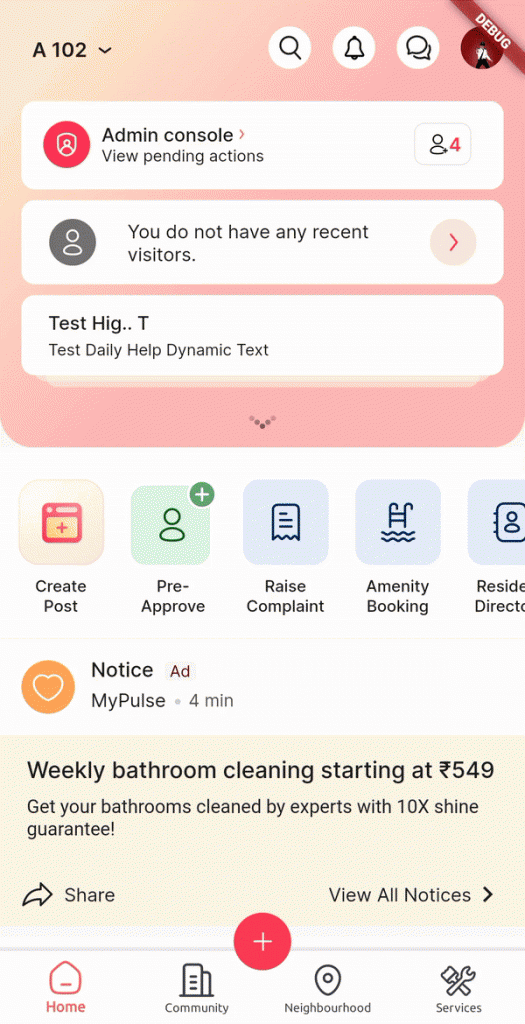
Admins can access the console from the card on the home page as well as the traditional admin button in the header of the community page.
ADMIN CHAT
Chat Support or Admin Chat has been renamed to “Chat with Us” and has been placed in the top right corner of the admin console which will also show the total number of unread messages as a nudge. The icon when clicked will redirect to the Admin Chat page.

HELPDESK
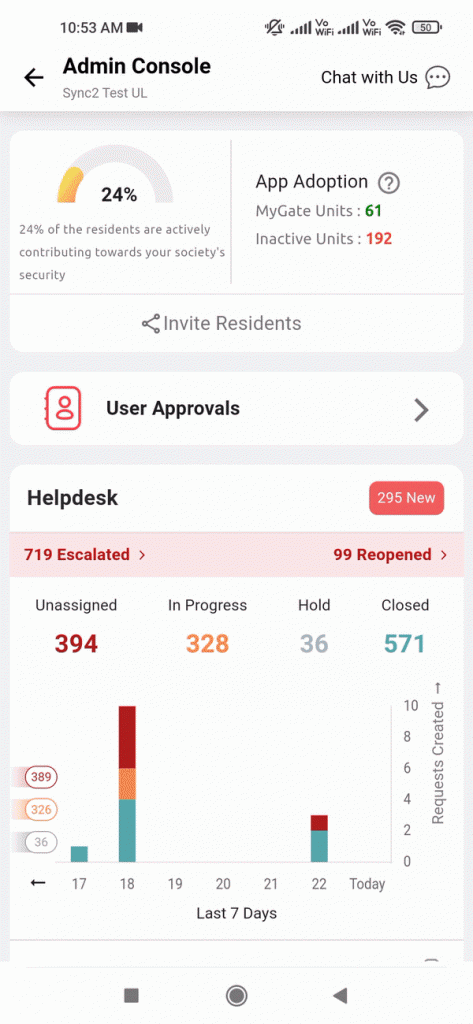
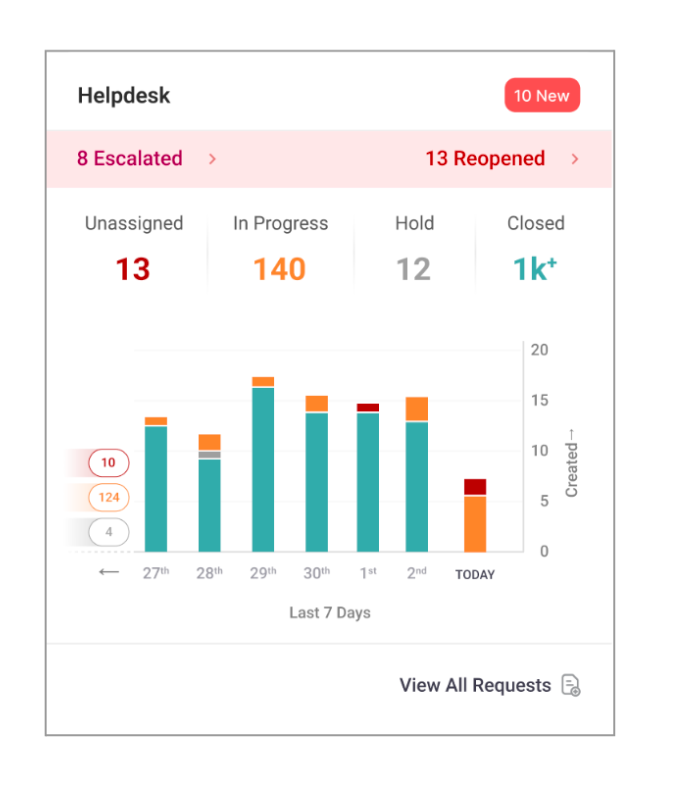
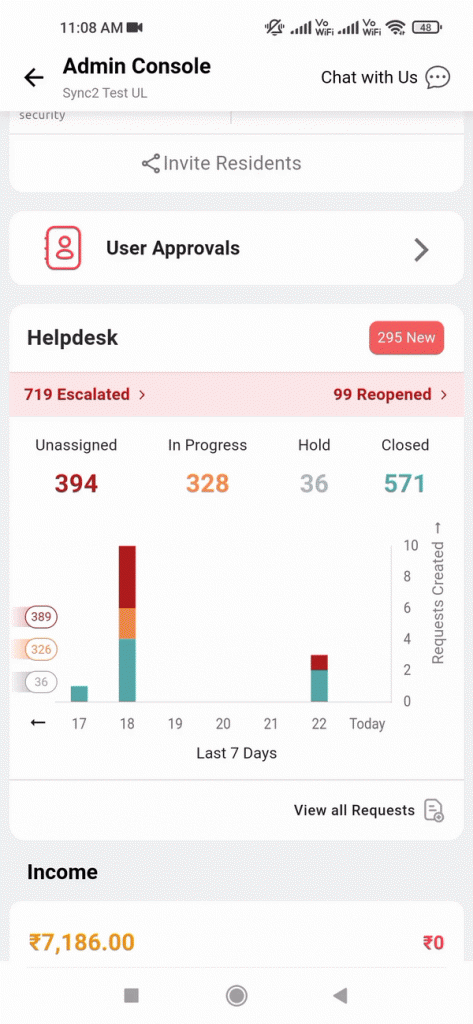
Helpdesk used to be a tile on the old admin console. With the new UI, the admin will now be able to view :
- A lifetime status overview of all tickets raised within the community.
- The count of unattended, escalated and reopened tickets are highlight in RED
- A day-wise bar graph of the current status of tickets created in the last 7 days.
The widget, when clicked, will redirect to the helpdesk admin view of the ticket listing page in the app.
INCOME
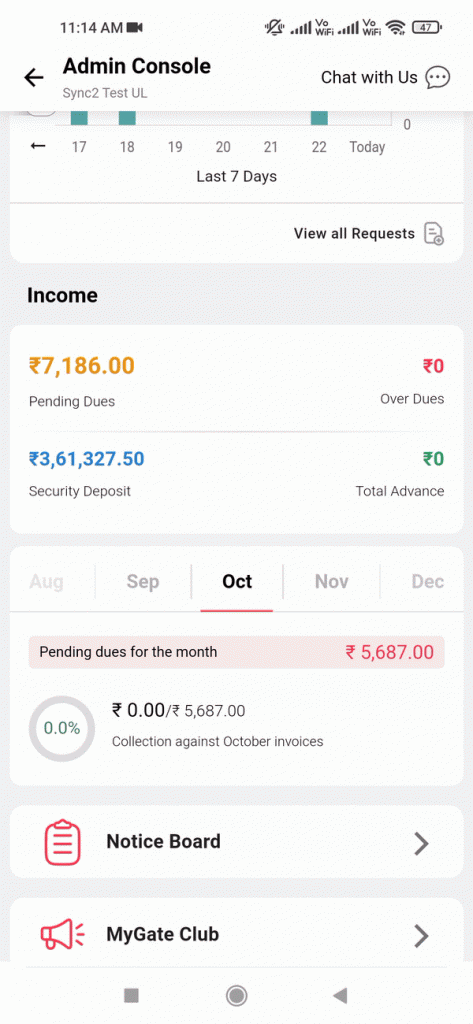
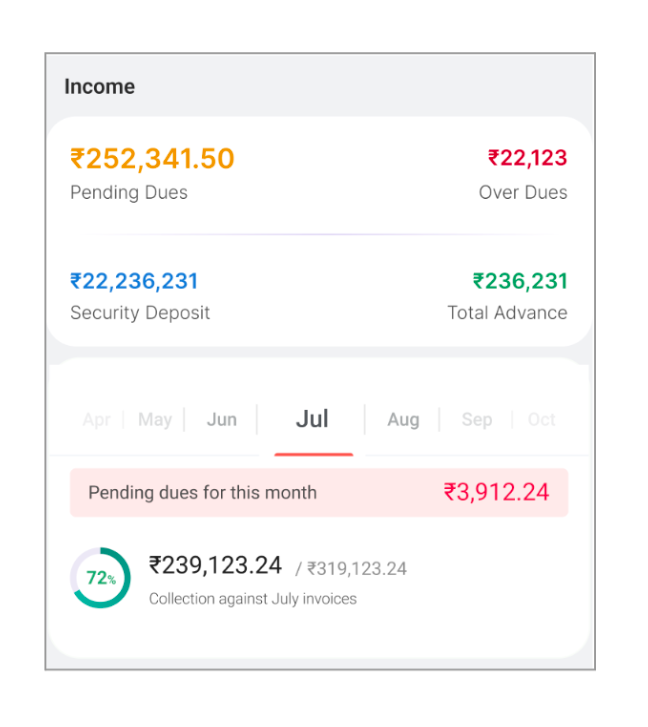
Income is a newly introduced widget which will help the admins of societies active with the accounting module. The widget covers the following :
- The current overview of the top of the line figures such as total dues, total overdues, security deposit and advance.
- The current collection against any month’s total billing can be viewed as a pie chart. The values are represented both as absolute figures and percentages.
Previously only the Society Admin had access to all the widgets in the app admin dashboard. The Society Manager and Helpdesk Manager had access only to the admin level Helpdesk features in the app. With the new admin console, we have introduced the following :
- Module access is extended to all twelve default admin roles of MyGate (custom roles are to be handled in the next iterations)
- Permission for viewing and interacting with any widget has been defined for each role to ensure that only relevant data is present to a customer
Currently, the new admin console on the app is controlled by a society setting “Enable New Admin Console UI” and has been enabled only for a few selected test societies. The access to the setting is reserved to the following roles – Administrator, super admin and customer support.
The module will go through a phase wise scale up and achieve 100% coverage by the end of December. We would like to invite everyone to participate in the transition plan and provide feedback in order to keep improving the console.
What’s next?
- Widgets for viewing app adoption and visitor activity in the society.
- Gray widgets for inactive modules in the society to nudge the admins to onboard all features offered by MyGate.
- Performance improvement for a quick loading experience, especially for large societies
- Feedback implementation and exploration into what an admin would like to view and control via his MyGate application!
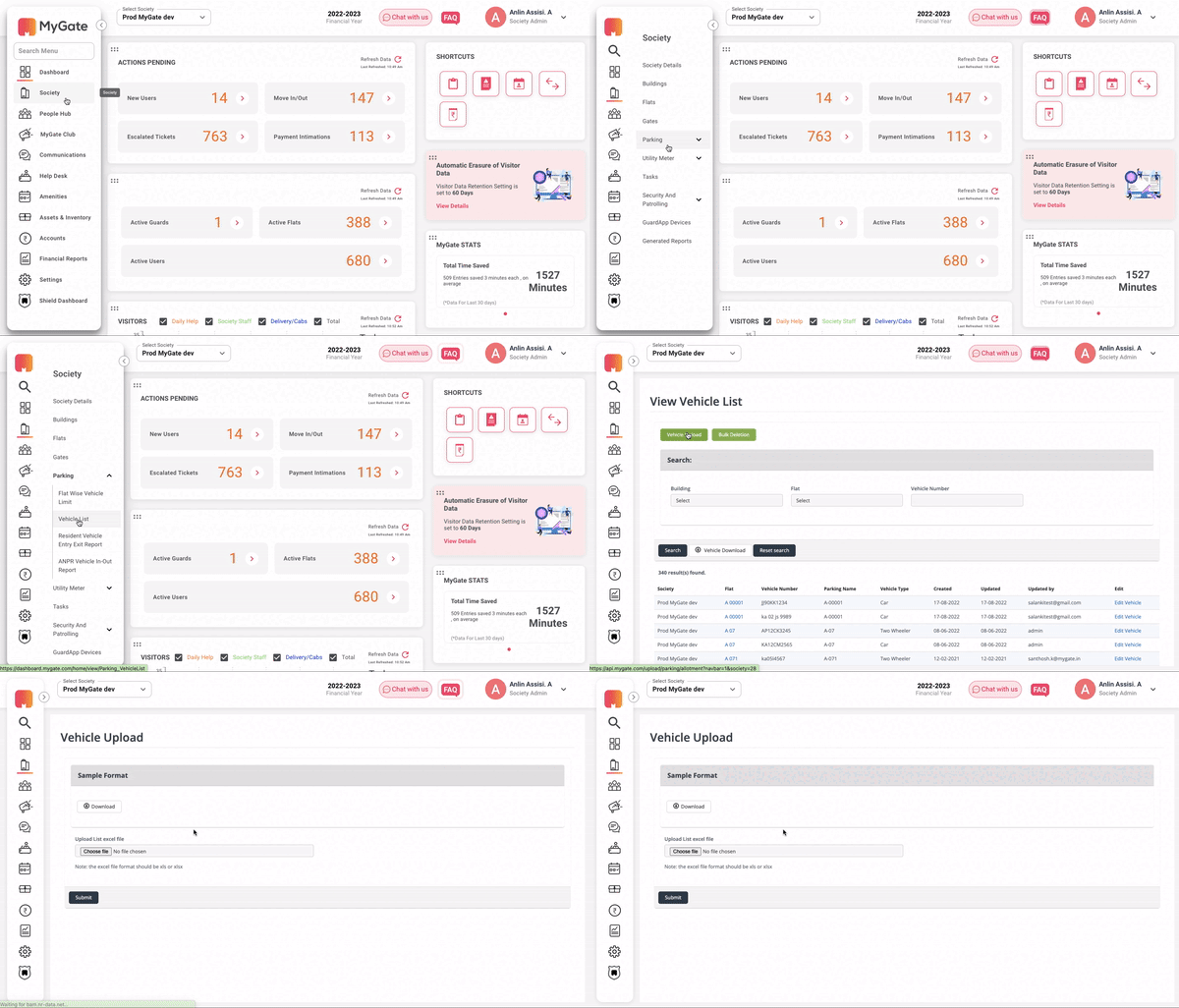
Vehicle Bulk Upload option for Society Admins
The admins had to reach out to the internal teams in order to add the vehicle data to the system. This created a dependency on the internal teams and reduced their bandwidth. The change brings the following benefits for the admins –
- Instead of adding vehicles one at a time, the admin will now be able to upload the vehicle data for their society at once.
- In case the admin does not want to share their data via email due to privacy concerns, the improvement removes the dependency on the MyGate team.
Note : Option to bulk delete vehicle information has already been extended to admins in a previous update.
Society >> Parking >> Vehicle List >> Vehicle Upload >> Upload the file >> Submit
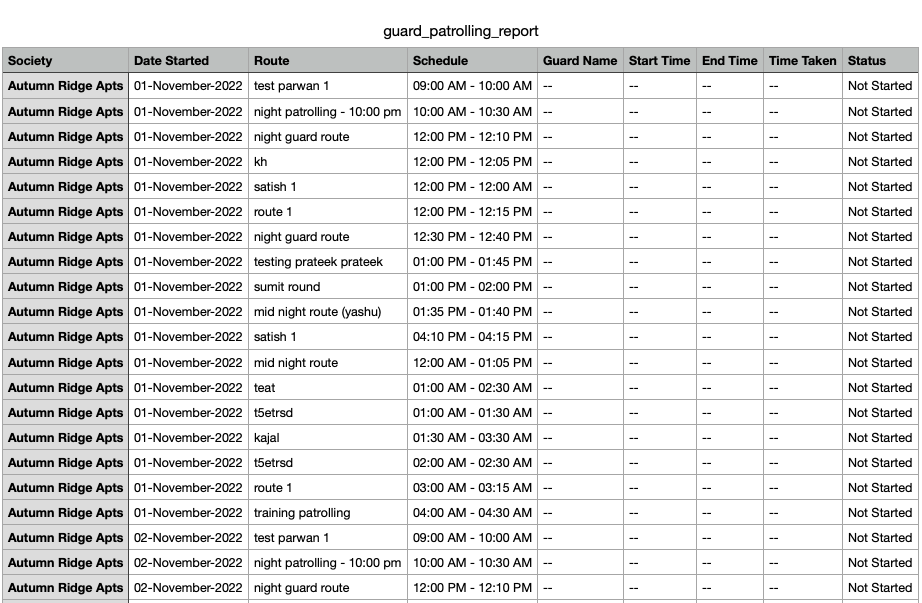
Guard Patrolling Download now sorted by date
The guard patrolling data, when viewed on the admin dashboard, has always been sorted on the basis of date (for all routes). However, when the data was downloaded it used to sort on the basis of routes, making it difficult for the admins to get a complete picture of a day at one glance.
We have made feedback based improvement to the excel exported by the report. The sorting logic in download has been replicated from the dashboard view (reference image below).
Society >> Security and Patrolling >> Guard Patrolling Report >> Download Patrolling Report
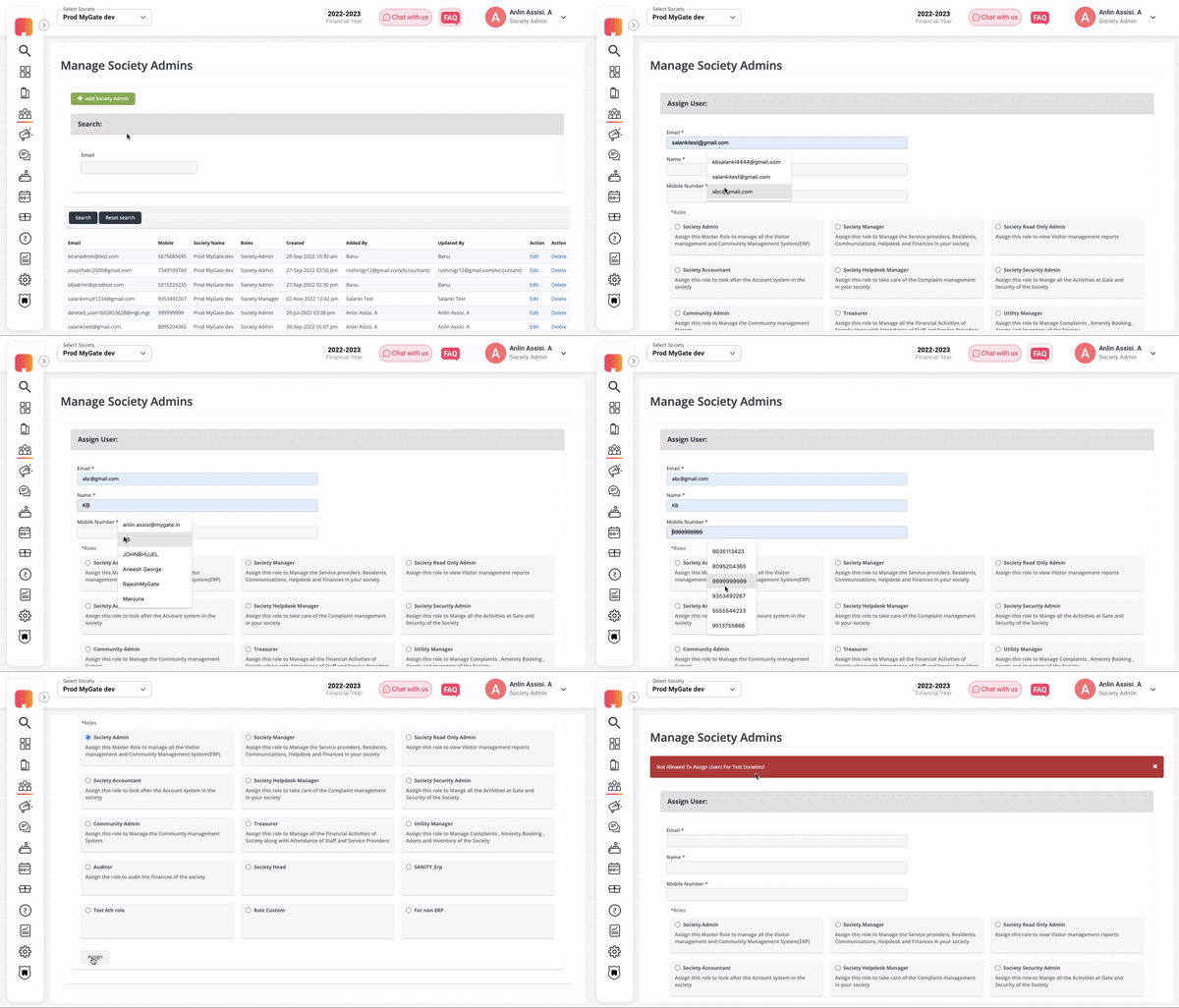
Test society access restrictions
The test societies currently existing in the system do not have an SOP around approval and removal of admin level users. Historically, the creation of test societies has been random and unrecorded – we now have around 250 of them out of which only 10 or so are active. The exit employees still have access to such societies, which can be a potential data threat.
- We have restricted creation of new admins for these test societies and also disabled the option to add a family member or tenant from the app for these test societies.
- The access to create a new society admin in these test societies will be only with the user management and administrator roles.
This change will also allow business & excellence teams to enforce test society access policy for smooth creation or exits of employees. Limiting the number of test societies further would ease identification of red flags in the system and effective timely action.
People Hub >> Admin User List >> Manage Admins >> Add Society Admin >> Enter the Details >> Assign
Additional Notes :
- Retaining user details in the audit log even after the user is deleted
- Disable Society Management Option for City Head Role
- Smart Eye Society Setting API call changes
- Bulk upload access permission to add external roles from Administrator and User Management Roles
- Increased facility access list page limit from 50 to 500 in the API and Unified Dashboards.
That’s all folks!!
Everyone who owns or is looking to own property in India should be aware of the adverse possession law. After all, when you spend years or even decades saving for or paying for a property, you cannot risk losing it over an outdated technicality in the law. Owners are always wary when purchasing property. From scams to disputes, the real estate market can be a minefield to maneuver. The adversse possession of land is one example of what can go seriously wrong for a landowner.
Adverse possession of land spells bad news for property owners. Essentially, adverse possession referred to the aquiring of property in an unsolicited manner. The law of adverse property implies that a person who is in possession of a property for 12 years or more is entitled to ownership rights of that property. So tenants who stay on land for 12 years continuously, without any interruption from the owner of the property during that time, obtain owner status for the property.
What is adverse possession in India?
Adverse possession in India means that the law favors a stranger or trespasser who is occupying land continuously and exclusively, without interruption, for a period of time that is usually 12 years or more. The time which the person occupies the space needs to be consecutive years and the time period can vary depending on the classification of ownership.
In simple terms, if a person who has lived on an area of land without a title for 12 years consecutively and has the owner’s consent they can legally claim ownership of that land. So, if an owner fails to remove a trespasser from their property for a specific time period, that owner can lose ownership of their property. The very term ‘Adverse Possession’ was first established by the Supreme Court of India in the case of ‘Amarendra Pratap Singh v. Tej Bahadur Prajapati’. It was initially introduced by British Rulers and was established to help the usage of land. However, it evolved to impact property owners negatively as tenants and squatters began to take advantage of the law and use it as a form of hostile possession, denying the actual owner claim to their property.
What is the adverse possession law?
This law is governed by the principle of The Limitation Law of 1963. According to the adverse possession under limitation act, if over a time period an appeal has not been filed to correct any limitation then the current scenario of titles continues. The terms for the adverse possession period is defined as 12 years.
According to the law in India, when a property owner does not lay claim to their property for 12 years, and the tenant occupies the property for 12 years continously, then the ownership rights are transferred to the tenant. These are the basic principles of adverse possession limitation act in India.
What are the exceptions to the doctrine of adverse possession?
There are some exceptions to the doctrine of adverse possession. These are stated below:
- If the owner of the property is a minor
- If the owner of the property serves in the armed forces
- If the owner of the property is mentally unwell
How to prove adverse possession in India?
Adverse possession is not considered to be ethical but the Indian legal system still follows the principles of adverse possession, allotting property to tenants when the property has been neglected by the owner for 12 years or more. Owners may fall into this trap of losing their land due to a number or reasons and although there are instances when the courts have been on the original owner’s side, going through the legal trail can be a lengthy, time-consuming and exhausting process that takes years.
According to the Supreme Court in 2019, it was stated that ‘By perfection of title on extinguishment of the owner’s title, a person cannot be remediless. In case he has been dispossessed by the owner after having lost the right by adverse possession, he can be evicted by the plaintiff by taking the plea of adverse possession. Similarly, any other person who might have dispossessed the plaintiff having perfected title by way of adverse possession can also be evicted until and unless such other person has perfected title against such a plaintiff by adverse possession. Similarly, under other Articles also in case of infringement of any of his rights, a plaintiff who has perfected the title by adverse possession, can sue and maintain a suit.’
So, in order to prove adverse possession of a property, these instances need to be investigated:
Continuity : A property can be taken through adverse possession if it has been occupied continuously and uninterrupted for a time period of 12 years.
Actual possession : The person claiming possession has to occupy the property through actual possession. This includes fencing the property, constructing a house, having grazing cattle, erecting a shed, etc.
Exclusive possession : The person who is occupying the property should be able to prove they were solely in possession for 12 years regarding the property in question.
Open possession : Possession of the property cannot be done without telling the owner.
The possessor will need to go before the court and prove the following:
- Date of possession
- That the possession was publicly known
- Nature of the possession
- Continuity of the possession
- Duration of the possession
Can a tenant claim adverse possession?
If you are a tenant through a lease agreement or rental agreement it is usually not categorised under the adverse possession law in India. In specific cases, for instance, if the lease is expired or the owner has not met the specifications in the agreement, then some tenants filed for ownership through adverse possession to help leverage their position.
The time period within which the wonder can exercise their rights easily is 12 years. Therefore, if there is a breach of contract, ownders need to try to vacate tenants to stay clear of adverse possession. Once the agreement has been terminated and if the tenant has paid out rent to the owner, they will ot be able to file for ownership through adverse possession.
Disputes and fights regarding property are commonplace in India. That is why it is so important for owners to be aware of the laws that can work in their favour as well as against it. Being aware of the how adverse possession is proved in the court of law can ensure that your property stays rightfully yours.
If you are in the market to purchase a property then there are many new phrases you will learn and laws you have to familiarise yourself with. One such important phrase is ‘encumbrance certificate’. This document ensures that you avoid certain legal and financial obstacles when you purchase the property. The encumbrance certificate can assure you that the property you are keen on buying is not legally bound to a loan or used as collateral against loans from a bank.
You could also require an encumbrance certificate when you are taking a loan from a bank. For example, if you need a loan to buy a property, or if you need a loan against a property that you already own, you will have to present an encumbrance certificate.
In this article, we look into the meaning of an encumbrance certificate, its importance when buying a home or property and how to apply for an encumbrance certificate, online and offline.
What is an encumbrance certificate?
When you are looking to purchase property, you need to find out whether it has any financial or legal entanglements. In order to do this you have to find out about the encumbrance certificate of that property. An encumbrance certificate can legally certify that a property has no financial or legal liabilities.
The encumbrance certificate will also show the details of all the past owners of that property as well as the property status. It will have details regarding all the past transfers of ownership and the mortgage binding details. In case a property is still under a home loan or mortgage, you will not be able to obtain an encumbrance certificate for it.
When applying for a home loan to buy a property, you will have to show the encumbrance certificate document to the bank you are applying to. It is also needed if you are looking to take a loan out against your owned property.
Why is an encumbrance certificate required?
An encumbrance certificate is required to prove that a property is not bound to any financial or legal liabilities. It is used to prove the free title or possession of a property. You need an encumbrance certificate when buying or selling property and banks require it when you apply to them for home loans. It is a document that proves that the property does not belong to any person or financial institute and is free to buy or sell.
The different types of encumbrance certificates
There is not just one type of encumbrance. Broadly, there are four common kinds – namely, easements, deed restrictions, encroachments, and liens.
1. Easement
This type of encumbrance gives someone the right to use a property when they do not own it. For instance, a telecommunications company may get an easement to place cell phone towers on property owned by a landowner. Another example of easement is one that gives permission to the owner of a neighbouring property to utilise the driveway or compound of another property for convenient access.
2. Deed restriction
Also known as restrictive covenant, deed restriction puts a limitation on what changes can be done to a property. For example, the restriction could be not allowing a satellite dish to be placed on the roof or terrace of a property. Or it could be allowing only specific spaces for cars to be parked. It can also put restrictions on what constructions can take place on the land. These restrictions can help set rules for what can and cannot be done on a property, therefore defining what the land can be used for. Most often these limitations are put in place to help protect the value of the property – especially when it comes to older property with historical value.
3. Encroachment
Encroachment refers to when a part of one property goes over onto an adjacent plot or property. For example, if a tree in one property grows up and over to extend over to a neighbouring piece of land. In these cases, the owner of the property whose space was encroached upon would like for that encroachment to be extracted. This is done so that when it is time to sell a property or transfer the property title to a new owner, the process isn’t marred by any issues due to encroachment.
4. Lien
A lien is often placed on a property to get a financial obligation from the person who owns it – for example, a home loan. This is the most common kind of encumbrance there is. A lien will be on the property being mortgaged until the loan has been paid in full. Other examples of this type of encumbrance are tax liens which are placed on a property due to unpaid taxes. A contractor can even get a lien if they have not been financially compensated for work done to a property. When a lien’s stipulations are not met, it could even lead to the foreclosure of the property. Then the money gained from the sale will pay off the owner’s debts.
How to apply for an encumbrance certificate?
You can either apply for an encumbrance certificate online or offline. We outline the two ways to do it.
1. How to apply for an encumbrance certificate offline?
To apply for an encumbrance certificate offline you will have to do it with application number 22 at a sub-registrar. This is the way it is done in most states, working with documents that are handwritten. If you are applying for an encumbrance certificate you will also need to give self-attested copies of address proof, property papers, registration papers and more. All the documents relevant to the property need to be attached.
The fee to process the encumbrance certificate will vary according to what state in India the property is in. An encumbrance certificate is valid for only a specific amount of time and will need to be updated after that time limit is over.
If you miss updating the encumbrance certificate of your property or are applying for an encumbrance certificate for your property, you will need to avail the NEC, Nil encumbrance certificate.
The Nil encumbrance certificate will state the property’s status in the time period between two encumbrance certificates.
2. Process for applying for an encumbrance certificate online?
You can also apply for an encumbrance certificate online in a few states in India. These include Gujarat, Andhra Pradesh, Telangana, Karnataka, Tamil Nadu, Kerala, Odisha and Puducherry. When you want to obtain an encumbrance certificate in these states, you can go to the respective state’s website to begin the application process. Listed below is the application process for getting an encumbrance certificate in Karnataka.
- Go to kaverionline.karnataka.gov.in
- Click on ‘Register as New User’ to make an account
- Fill the registration form with required details
- Click on ‘Register’ to submit the form
- An activation code will be sent to your email address or mobile phone number. Use this to login and click on ‘Activate’
- Once you have logged in, you can change your password
- Now click on ‘Services’ and click on ‘Online EC’
- You will be required to select the registration year of the property (dates after 2003 are available only)
- Add the property details asked and click on ‘Send OTP to View Document’
- You will receive an OTP. Enter it to view and download the document.
If an attested copy of the encumbrance certificate is needed, click on ‘Check to apply for digitally signed EC’ and then on ‘View Document’. Once the PDF is open, you will see a tab saying ‘Proceed’ at the bottom, which you will have to click to download. Then you will need to make a payment. You will receive a payment receipt. Click on ‘Refresh Payment Status’ and your encumbrance certificate online application can be seen in the ‘Pending/Saved Application’ section. After the authorities get your request, it will be digitally signed and accessible to you.
What are the uses of an encumbrance certificate?
Listed below are the different uses of an encumbrance certificate
Encumbrance certificate for purchase : It is needed when buying a home to ascertain that you are negotiating with the right party and the property does not have any liens.
Encumbrance certificate for sale : When a person wants to sell their property, they will need to present the encumbrance certificate with other needed documents to an interested buyer. To get the encumbrance certificate, the person selling the property has to apply for the document and obtain it from government files.
Encumbrance certificate for property mutation : A new owner who has purchased a property has to use property mutation to document the transfer of ownership officially.
Encumbrance certificate for loans: Banks usually need an encumbrance certificate as one of the required documents before they can sanction an application for a home loan.
Encumbrance certificate for the elimination of provident fund (PF) : If you need to use your provident fund (PF) when making a down payment for a property, your employer can ask for the encumbrance certificate.
How to check the status of an encumbrance certificate?
If you want to check the status of an encumbrance certificate online you can log in to the state government website. It takes 30 days to get approved on the upper limit. Once it is approved, you can download the document from the website. In case 30 days have passed and there is no update on the status, contact the helpline provided on the website or email to inquire about the status.
What documents are needed to obtain an encumbrance certificate?
Here is a list of the documents needed in order to obtain an encumbrance certificate
- Encumbrance certificate application form
- Attested copy of address proof
- Copy of previously executed deed of the property (sale deeds, gift deeds, partition deeds, release deeds, etc)
- Details about the property
- The property’s title details
- The registered deed number, date, book number, volume/ CD number, and signature of the applicant
- Time period for which the encumbrance certificate is needed
- Purpose of the encumbrance certificate – reason it has been applied for
- If the application is made by an attorney holder, then a Photocopy of the Power of Attorney is required
- Aadhar card
- Property card (if it is available)
What is the difference Between encumbrance certificate, completion certificate and occupancy certificate?
Understanding the various terms used in the real estate market can be stressful when you are buying a property. The differences between encumbrance certificate, completion certificate and occupancy certificate can be confusing. Here is how to differentiate between the three.
Encumbrance certificate : This document states that a property is legally unencumbered by debts or obligations.
Completion certificate : Completion certificate is a legal document that is obtained when a building is completed and matches the building plan as well as any other specifications.
Occupancy certificate : An occupancy certificate is a legal document that states whether a building is secure to enter. This is usually issued after the completion certificate is obtained.
How to download encumbrance certificate online?
If you are looking to download an encumbrance certificate online, here are the steps:
- Log in to the website.
- Go to the encumbrance certificate section and enter your details.
- If the status of the encumbrance certificate is approved, download the document in the form of a printable pdf
- You will have to attach the printed copy with the records of your property.
- It takes around 15-30 days for the status to be approved.
An encumbrance certificate is one of the most essential legal documents to have when you are planning to buy a property. It reveals the legal and financial status of the property you are interested in and gives you a clear idea of its ownership history, allowing you to make your investment decision with all the necessary information.
Churchgate, currently known as Veer Nariman Street, is a prominent South Mumbai locale. The name Churchgate came from the railway station and St. Thomas Church. Churchgate is home to some of Mumbai’s most famous structures and organisations. Churchgate, home to financial and corporate enterprises and educational institutions, is a must-see when visiting Mumbai. The bustling neighbourhood is surrounded by several iconic landmarks, such as the Bombay Stock Exchange, General Post Office, and High Court, making it a vital historical hub. It is the perfect place to experience the hustle and bustle of the city while learning about its past. Its well-connected train station provides easy access to all city areas, and the nearby Marine Drive is a stunning spot for evening strolls. Churchgate is a vibrant and lively area of the city that provides insight into Mumbai’s past and an opportunity to immerse oneself in its present.
Top gated communities in Church Gate, Mumbai
1. Vishnu Mahal
Vishnu Mahal, located in the centre of Church Gate, is an excellent place to stay. The apartment complex is 1 acre in size, well maintained, and equipped with all required facilities. The area is convenient for several schools and institutions. It is also a short walk from the nearest bus station. Additionally, the apartment complex is surrounded by various shops and eateries that offer an array of cuisines to suit any taste.
Highlights and amenities of Vishnu Mahal
Types of apartments: 2 BHK and 4 BHK apartments
Area per apartment: 1000 sq. ft. to 2000 sq. ft.
Number of apartments: N/A
Address: Vinoo Mankad Road, Churchgate, Mumbai, Maharashtra 400020
2. Churchgate Mansion
Churchgate Mansion is one of Church Gate’s most desirable residential areas. The building is well-kept and has all the facilities its occupants require. There is also 24-hour running water, power backup, security, a garden, and an elevator. The apartment complex is near several bus stops. The residents of Churchgate Mansion enjoy a luxurious lifestyle, with the convenience of modern amenities and the peace of mind that comes from living in a secure environment.
Highlights and amenities of Churchgate Mansion
Types of apartments: 1 BHK, 2 BHK, and 3 BHK apartments
Area per apartment: 650 sq. ft. to 1200 sq. ft.
Number of apartments: N/A
Address: WRMG+FWG, A Rd., Churchgate, Mumbai, Maharashtra 400020
3. NCPA Apartment
The NCPA Apartment at Church Gate is semi-luxurious. It is a well-kept residential complex close to many bus stops and an airport. There is 24-hour security, running water, and security guards. The location is close to several schools, universities, and hospitals. The NCPA Apartment at Church Gate is a perfect choice for those looking for a semi-luxurious, secure, and convenient place to call home.
Highlights and amenities of the NCPA Apartment
Types of apartments: 3 BHK and 4 BHK apartments
Area per apartment: 2680 sq. ft. to 2880 sq. ft.
Number of apartments: N/A
Address: NCPA Residential, Dorabaji Tata Road, Nariman Point, Mumbai, Maharashtra 400021
Things to do in Church Gate, Mumbai

1. Visit the famous landmarks of Church Gate
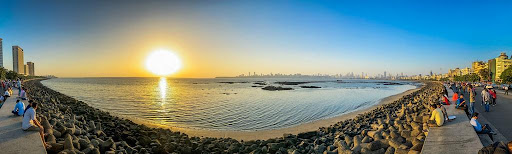
Church Gate has some of the most iconic and prominent landmarks in Mumbai, such as the Marine Drive, Wankhede Stadium, Chhatrapati Shivaji Terminus, Bombay High Court, Rajabai Clock Tower, Nariman Point Sea Face, Churchgate Railway Station. Exploring these places and marvelling at their historical and architectural beauty is a great way to spend the day.
2. Experience the historical Flora Fountain
The Flora Fountain is a relic of the early British Empire in India. Built in the 1860s, the fountain depicts the Roman goddess Flora. Modelled after Victorian-style architecture, the monument has stood the test of time. Despite the changes in Mumbai, the Flora Fountain still stands as a reminder of its colonial past.
3. Visit the ancient Elephanta caves
The Elephanta Caves, also known locally as Gharapurichi Leni, are the remnants of what were formerly brilliantly painted artworks. Situated on an island off the coast of Mumbai, Hindu devotees created these rock-cut temples in the 7th century and are believed to represent Lord Shiva. Today, the Elephanta Caves are a popular tourist attraction and a reminder of Mumbai’s history, offering visitors a chance to experience ancient Indian culture.
4. Fashion galore on Fashion Street
Fashion Street is one of Mumbai’s most popular retail zones. With over 150 stores, Fashion Street promises the eager shopper a lot more variety than any huge mall or trendy store can give. A perfect place to buy fashion items at affordable prices. From traditional Indian clothes to western outfits, accessories, and all kinds of ethnic jewellery, Fashion Street has it all.
5. Visit the impressive Bayview Hotel Marina Plaza
This Mumbai 24-hour restaurant is meant to seem like the inside of a ship, and the menu is as eccentric. Guests can select from gourmet pleasures that appeal to global and local palates. Bayview Hotel Marina Plaza will give you an exceptional and memorable dining experience. Whether you are looking for a romantic night out, a great place to have a business meeting, or simply to relax and enjoy the hotel’s ambience, Bayview Hotel Marina Plaza is an ideal destination.
Places to visit in Church Gate, Mumbai
1. Gaylord
Gaylord is a casual eating establishment that specialises in dessert specialities. A popular restaurant in Churchgate, it is acclaimed for its prompt service and is an excellent place to go if you want to satisfy your appetite with great, sanitary meals at a fair price. Moreover, Gaylord is well known for its delectable desserts such as malpuas, gulab jamun, and kulfi.
Address: Mayfair Building, V N Rd., Churchgate, Mumbai, Maharashtra 400020
2. Gaughan Supreme South Indian
Gughan Supreme South Indian is the place to be for an unforgettable South Indian dining experience. The ambience is very calm and will never fail to relax you. Some popular dishes are Sambhar Rasam, Rasam Vadai, Sweet Pongal, Ghee Idli, Rasam Idli, and Tomato Rasam. All the dishes are expertly prepared and deliciously spiced, ensuring that every bite is as flavorful as possible.
Address: Ground Floor, 91, Shalimar Building, Near Registrar of Companies (RoC G Road, Bhagwandas Todi Marg), Close to Parsee Gymkhana, Marine Dr., Mumbai, Maharashtra 400002
3. The Blowdry Bar
The Blowdry Bar, a unisex concept salon overlooking Marine Drive, has us reconsidering our present salon options. They provide rapid hair and nail solutions. With its luxurious ambience, wide range of services, and expertise in hair styling, the Blowdry Bar is a standout when it comes to getting ready for that special occasion.
Address: Bajaj Arcade, Danda, Pali Hill, Mumbai, Maharashtra, 400052
4. Mockingbird Cafe Bar
Mockingbird Cafe Bar is a must-visit for foodies who appreciate terrific music and ambience. The restaurant not only delivers delicious meals but also offers an extensive range of beverages and mocktails. The service is prompt, and the personnel are courteous and helpful. The cosy and comfortable atmosphere makes it perfect for family outings or romantic dinners. The Mockingbird Cafe Bar has been lauded for its unique decor, combining rustic and modern elements that create a welcoming ambience.
Address: 80, Veer Nariman Road, Churchgate, Mumbai, Maharashtra 400020
5. The Society Restaurant, The Ambassador Hotel
A wonderful setting for crucial meetings or quiet lunches. This restaurant, which serves North Indian, Continental, seafood, and European cuisine, should be on everyone’s list. The atmosphere is captivating, expressive, and lovely. The Society Restaurant offers the perfect atmosphere for any occasion with its plush interior featuring classic decor and stunning views of the nearby gardens.
Address: The Ambassador Hotel Mumbai, Marine Drive, The Ambassador Hotel, Veer Nariman Road, Churchgate, Mumbai, Maharashtra 400020
FAQs about Church Gate, Mumbai
What is the distance from Church Gate to the airport?The Chhatrapati Shivaji International Airport is just 3.1 kilometres away from Church Gate. It takes an average of 15 to 25 minutes to reach the airport, depending on traffic conditions. People may take a taxi, a ride-hailing service, or other public transportation to the airport from Church Gate.
What are the best hospitals in Church Gate?Some of the best hospitals in Church Gate are Shroff Eye Clinic, Saifee Hospital, Sewree Nursing Home, and Family Care Hospitals. These hospitals offer quality medical care for various conditions, from minor ailments to complex surgeries.
What are the best schools in Church Gate?Some of the best schools around Church Gate are St. Xavier’s High School, The Cathedral & John School, and Aditya Birla World Academy. These schools offer a range of educational programs, including general academics, performing arts, athletics, and extracurricular activities to help students develop their skills and talents.
What are the best gyms in Church Gate?Some of the best gyms in Church Gate are UFC Gym, Melt Gym, Body Art, and Studio 23. These gyms provide a range of facilities and classes to cater to people from all walks of life.
Which are the parks in Church Gate?There are numerous parks around the Church Gate neighbourhood. Some of the best ones are Tata Garden, Churchgate Garden, Firdaus View, and Mahatma Gandhi Garden. These parks provide a peaceful environment for people to relax and take a break from the busy hustle of the city.
What is the best place to hang out in Church Gate on weekends?Church Gate has various recreational areas to choose from to spend quality time hanging out with friends and family on weekends. The Mockingbird Cafe Bar is such a place. Located in the heart of Church Gate, the cafe bar has an extensive menu with delicious food and drinks.
Grant Road is an important suburban locality in South Mumbai, Maharashtra. The heart of Mumbai lies in its local train service. And Grant Road East serves as the fourth station, providing the closest proximity to Lamington Road, exclusively famous for affordable electronic articles. The site is a neighbourhood of Khetwadi, Girgaon, Tardeo, etc., and provides smooth connectivity via Sardar Vallabhai Patel Road, Kennedy Bridge, Pathe Bapurao Marg, Javji Dadaji Marg, and MS Ali Road to various parts of the city.
Kumbharvada, nearby Grant Road is the oldest and the largest community in Dharavi and is a shelter for the pottery industry. The site also caters to famous Irani Cafes and Bakeries, like the B’ Merwan. Covered with an abundance stock of amenities, the site provides a plethora of options while selecting schools and medical facilities. Nearby malls and shopping centres complete the area and make Grant Road an ideal location for settlers.
Top gated communities in Grant Road East, Mumbai
1. Grace Heights, Grant Road
Grace Heights, a combination of luxury, comfort, and style is designed by Grace Group of Companies for customer satisfaction. The apartment is under continuous surveillance, with 24Hrs electricity backup and other prominent amenities. It is strategically designed keeping in mind excellent connectivity to public transport.
Highlights and amenities of Grace Heights
Type of apartments: 2 BHK
Area per apartment: 830 sq. ft.
Number of apartments:
Address: 145, Alibhai Premji Rd, Grant Road East, Bharat Nagar, Grant Road, Mumbai, Maharashtra 400007
2. Vijay Chambers, Grant Road
A luxurious road view facing flat. Situated in one of the posh localities it includes all sorts of amenities like 24X7 Security and Medical Facilities. The apartment caters rooms for various entertainment activities for all age groups from Kid’s Playing Areas to Tennis courts, Gymnasium, and much more.
Highlights and amenities of Vijay Chambers
Type of apartments: 2 BHK
Area per apartment: 568 sq. ft.
Number of apartments:
Address: 1140, Tribhuvan Rd, Grant Road East, Shapur Baug, Grant Road, Mumbai, Maharashtra 400004
3. Rubberwala Orion, Grant Road
Spaciously designed 2BHK and 3BHK Apartments with an undisturbed supply of basic amenities such as 24Hrs Electricity, Covered Parking, Landscaped gardens, and a lot more. Also, providing proximity to schools, colleges, hospitals, shopping malls, recreational centres etc. Rubberwala Orion is a perfectly blended destination for settling down with all basic and civic amenities.
Highlights and amenities of Rubberwala Orion
Type of apartments: 2 BHK & 3BHK
Area per apartment: 1020 – 1298 sq. ft.
Number of apartments:
Address: Jalbhai Road, Grant Road East, Mumbai, Maharashtra 400007
4. Adinath Apartment, Grant Road
A well-designed 190 sqft apartment, connected to nearby localities and Grant Road Railway Station. Adinath offers an excellent living experience with Kid’s Play Areas, 24X7 Guarded security, Indoor games, a Lift, etc. A well-furnished apartment is connected to important areas such as Mumbai Central, Churchgate, and Mahim. Prime location for settling down with a comfortable and luxurious stay.
Highlights and amenities of Adinath Apartment
Type of apartments: 1 BHK
Area per apartment: 190 sq. ft.
Number of apartments:
Address: 281, Tardeo Rd, opp. Matru Mandir, Grant Road West, Janata Nagar, Grant Road, Mumbai, Maharashtra 400007
5. Bhaskar Smruti, Grant Road
To fulfil your aspirations, Bhaskar Smruti is a perfect mix of a contemporary and traditional layout. With all the basic amenities like 24X7 security and a Kid’s Play Area, the locality is well connected to the Mumbai City Center, Lamington Road and other roads and highways. The location is fit for settling down with all other civic amenities and adds a layer to people’s living standards.
Highlights and amenities of Bhaskar Smruti
Type of apartments: 1 BHK
Area per apartment: 400 sq. ft.
Number of apartments:
Address: Low Level (South), Nana Chowk, Grant Road (West), Low Level (South), Grant Road, Shapur Baug, Grant Road, Mumbai, Maharashtra 400007
Things to do in Grant Road East, Mumbai

1. Enjoy shopping spree at Chor Bazar
Make your day fun-filled by shopping at the country’s largest flea market, prominently known for its collection of antiques and second-hand items. Name it and you can have it all at just one stop from vintage handcrafts, lamps, antique home décor, posters, musical items, and whatnot. Chor Bazar is ideal for every shopaholic.
2. Peaceful stay at church Mission House
Enjoy an affordable stay at Church Mission House, with exceptional church premises, especially for Christians. A calm place to reside with all basic amenities and deliver church-related activities and nearby attractions offer places like Koh Chang, and Dharavi (home to the pottery industry and Mumbai’s biggest slum area).
3. Satiate your cravings with Different Flavors
At Grant Road East, you can satiate your cravings, your mouth bursting with different cuisines. Perfect to spend your evenings in a serene environment and also enjoy exquisite street food there are many Chowpatty, bars, and restaurants like Girgaon Chowpatty, Café by the Beach, Flute 24Hrs, Baroka Lounge, Jack’s Pizza, etc.
4. Explore more with Namaste City Tour
Mumbai Darshan has always been on every visitor’s bucket list, and Namaste City Tour grants your wish with the utmost ease. The Magical Tour covers a wide range of places from beaches, ancient architecture, famous food joints, and much other eye-catchy sightseeing for soul satisfaction. Namaste City Tour also put forward customizable plans according to one taste and preferences.
5. An in-sight into Parsis culture
To mark the presence at various functions and wedding ceremonies of the Parsis of Mumbai, the locality is marked with 4Fire temples and The Cama Baug. Grant Road is also known for the ancestral roots of the originating Zoroastrians.
Places to visit in Grant Road East, Mumbai

1. Mani Bhavan
A retro-styled, double-storied building, has now been restored as a museum and a research gate centre. Mani Bhavan houses a library, a picture gallery, and memories related to the freedom movement. For a history enthusiast, Mani Bhavan is the place depicting the lifestyles and struggles of Mahatma Gandhi. The place offers a calm and composed environment to spend some time in silence.
Address: 19, Laburnum Rd, near Police Station, Babulnath, Gamdevi, Mumbai, Maharashtra 400007
2. August Kranti Maidan
August Kranti Maidan, formally known as Gowalia Tank, has now been split into 5 smaller grounds for carrying numerous games like cricket, volleyball, etc. The Maidan has been in a discussion because Mahatma Gandhi kick-started his Quit India Speech from here. August Kranti Maidan calls for a pleasant evening outing with friends and family.
Address: 1, Tejpal Rd, Dadi Sheth Wadi, Tardeo, Mumbai, Maharashtra 400007
3. Gol Deval Temple
A round architecture shrine, dedicated to Lord Shiva, is known to be one of the city’s oldest worshipping temples. The name is sought after its structure that the ling is circled in “Gol Deval” and is also known as Round Temple. The Oldest withstand temple is still a famous tourist attraction.
Address: XR5H+67G, Sardar Vallabhbhai Patel Rd, Khetwadi, Bhuleshwar, Mumbai, Maharashtra 400004
4. Jinnah Hall Building
Contemporarily known as P.J. Hall, located near Lamington Road is the biggest market for electronic supplies. This Indo- Saracenic building commemorated the struggles led by Jinnah. The present-day hall caters to national gatherings and is a must-visit stop for many scholars.
Address: XR58+H69, Vithalbhai Patel Rd, Charni Road East, Shapur Baug, Grant Road, Mumbai, Maharashtra 400007
5. Babulnath Mandir
Shadowing the illusion of Mount Kailash, an eternal abode of Lord Shiva, Babulnath is nearly 1000 feet above sea level. The rich heritage temple welcomes thousands of devotees every year, especially during the time of Maha Shivratri.
Address: 16, Babulnath Rd, Charni Road, Babulnath, Dadi Sheth Wadi, Malabar Hill, Mumbai, Maharashtra 400007
FaQs about Grant Road East, Mumbai
What is the distance from Grant Road East to the airport?Chhatrapati Shivaji Maharaj International Airport is a 15km distance from Grant Road connected well via various public transportation facilities.
What are the best hospitals in Grant Road East?Bhatia Hospital, Nicholson Eye Clinic and Hospital, Sir H. N. Reliance Foundation Hospital and Research Centre, and Apollo Spectra Hospitals Tardeo are some of the best hospitals near Grant Road.
What are the best schools in Grant Road East?Our Own High School, Queen Mary School, J.d. Bharda High School, The Universal School, Tardeo, Wilson College, and Hinduja College of Commerce are some of the best schools and colleges in the locality.
What are the best gyms in Grant Road East?The Core Fitness, Maharashtra Fitness Club, Neha NutriFit, Xtreme Fitness Force, etc contribute to the best gyms covering areas around Grant Road East.
What is the best place to hang out in Grant Road on weekends?Hanging Gardens, 36 Downtown, Junction Restaurant and Bar, and ISKCON Chowpatty are major attractions for weekend outings.
What are the best parks in Grant Road East?Plants Nursery, Kabootar Khana, Mahanagar Palika Park, Nana Nani Park, etc are some of the best parks in the locality.