

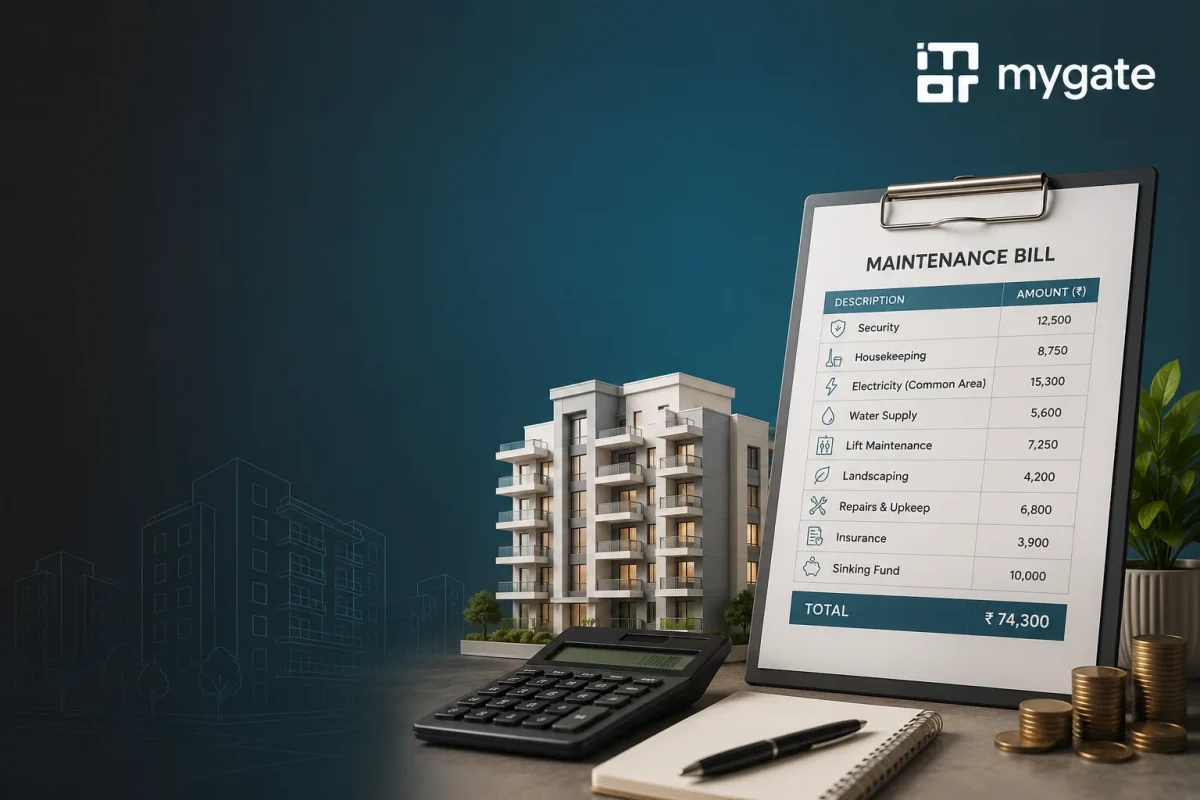
Every apartment complex, regardless of size, runs on maintenance charges. These charges pay for security staff, housekeeping, elevator upkeep, common area electricity, water supply, landscaping, and the dozens of smaller costs that keep a community functioning. Yet maintenance billing is also one of the most misunderstood parts of society management, both for residents who often do not know how their charges are calculated and for committees who sometimes inherit a billing method without fully understanding why it was chosen.
This guide breaks down how apartment maintenance billing software actually works, the different methods societies use to calculate it, what maintenance charges typically cover, and how committees can run the process with less friction and fewer disputes.
What is apartment maintenance billing?
Apartment maintenance billing is the process by which a housing society or resident welfare association calculates, invoices, and collects the recurring charges that fund the upkeep of shared spaces and services. It is separate from a resident’s individual utility bills, such as electricity or water metered directly to their flat, and instead covers costs that benefit the community as a whole.
The amount a resident pays is not arbitrary. It is meant to be derived from the society’s annual budget, divided across flats using a method the committee has adopted, whether that is an equal split, an area based calculation, or a hybrid model. In theory, the total maintenance collected across a year should roughly match the society’s approved operating expenses plus any planned reserve contributions.
In practice, many societies struggle to keep this connection clear, either because the budget was set years ago and never revisited, or because billing and accounting are handled through disconnected spreadsheets that make it hard to see whether collections are actually matching costs.
What maintenance charges typically cover?
Maintenance charges usually fall into a few broad categories, though the exact mix depends on the society’s amenities and staffing.
Staff salaries cover security guards, housekeeping staff, gardeners, and maintenance technicians employed directly or through a facility management vendor.
Utility costs for common areas include electricity for lobbies, staircases, parking, and shared lighting, along with water used for gardens, common washrooms, or shared facilities.
Repairs and upkeep cover routine maintenance of lifts, generators, pumps, fire safety equipment, and general repairs to common infrastructure.
Insurance for the building and common areas is often bundled into maintenance charges, particularly in larger complexes.
Statutory and compliance costs include audit fees, professional tax, and any regulatory filings the society is required to make.
Sinking fund contributions are set aside separately for major, infrequent expenses such as repainting, waterproofing, or structural repairs, and should not be spent on routine operating costs even though residents pay them as part of the same monthly bill.
Understanding this breakdown matters because when residents dispute their maintenance bill, the underlying question is usually not about the total amount but about what exactly that amount is funding. Committees that can clearly show this breakdown tend to face far fewer disputes than those that present maintenance as a single, unexplained number.
Common methods of calculating maintenance
There is no single correct way to calculate maintenance charges, and the right method often depends on how varied the flat sizes are within the society and what local regulations or society bylaws require.
Equal split method
Under this method, every flat pays the same maintenance amount regardless of size. This works well in societies where units are largely uniform, since it keeps calculations simple and easy for residents to understand. It becomes harder to justify in societies with significant variation in flat sizes, since a smaller unit ends up subsidising a larger one.
Per square foot method
Here, maintenance is calculated based on the carpet or built up area of each flat, meaning larger units pay proportionally more. This method is generally seen as more equitable in societies with mixed unit sizes, though it requires accurate, verified area records for every flat, which is not always available in older societies.
Hybrid method
Many societies combine a fixed base charge that covers common services everyone benefits from equally, such as security, with a variable component tied to area or usage, such as parking or amenity access. This tends to balance fairness with simplicity, though it does require slightly more administrative setup.
Usage based charges
Some costs, such as parking for additional vehicles, use of a clubhouse, or access to premium amenities, are billed separately based on actual usage rather than folded into the base maintenance charge. This keeps core maintenance charges lower while still recovering costs from residents who use specific facilities more than others.
Whichever method a society uses, the important part is that it is documented, approved through a general body resolution, and applied consistently. Ad hoc changes to billing methods without proper approval are one of the more common sources of disputes and, in some cases, legal challenges from residents.
The maintenance billing cycle
A typical maintenance billing cycle follows a consistent sequence, whether it is run manually or through software.
It begins with budget approval, usually done annually during the general body meeting, where the committee presents projected expenses for the year and gets resident approval for the corresponding maintenance rates. From there, invoices are generated on a fixed schedule, commonly monthly or quarterly, based on the approved rates and each flat’s applicable charges.
Once invoices go out, the collection phase begins, where residents make payments through whatever channels the society supports, whether that is cheques, bank transfers, or online payment options. As payments come in, they need to be reconciled against invoices so the committee has an accurate, real time view of who has paid and who has not.
Finally, the cycle includes reporting and follow up, where outstanding dues are tracked, reminders are sent to residents who have not paid, and the committee reviews collection efficiency as part of its regular financial oversight. This entire cycle then repeats every billing period, which is exactly why manual handling becomes increasingly difficult as a society grows.
Why do maintenance billing disputes happen?
Most billing disputes in apartment communities do not stem from residents refusing to pay for legitimate services. They usually come from a breakdown in clarity or consistency somewhere in the process.
A common cause is a lack of transparency about how charges are calculated, particularly in societies that switched billing methods at some point without clearly communicating why. Another frequent issue is inconsistent late fee application, where some residents are charged penalties and others are not, which quickly damages trust even if the inconsistency was unintentional.
Errors in area based calculations also cause friction, especially in older societies where flat area records were never properly verified and residents suspect they are being overcharged relative to their neighbours. Delayed or missing receipts add to this, since residents who cannot easily confirm a payment was received tend to raise disputes even when the payment was correctly recorded.
Most of these issues are process problems rather than genuine disagreements about whether maintenance should be paid. Addressing them usually comes down to consistency, documentation, and giving residents easy access to their own billing history rather than making them ask the committee every time a question comes up.
Legal and compliance considerations
Maintenance billing does not exist in a vacuum. It is governed by the society’s registered bylaws, and in many states, by cooperative society acts or apartment ownership acts that set boundaries on how charges can be calculated and enforced.
Societies are generally required to get resident approval for maintenance rates and any changes to the billing method through a general body resolution, rather than the managing committee deciding unilaterally. Late fee structures, if applied, typically also need to be defined and approved in advance rather than applied inconsistently after the fact.
For societies that cross applicable turnover thresholds, GST becomes a relevant consideration on maintenance charges, and getting this wrong, either by not charging it when required or applying it incorrectly, can create compliance problems that surface during an audit. Keeping proper documentation, including approved budgets, billing resolutions, and payment records, is what ultimately protects the committee if a resident challenges a charge or if the society is audited.
Reducing late payments and improving collections
Late maintenance payments are one of the most persistent challenges committees face, and while some delay is inevitable, several practices tend to reduce it meaningfully.
Sending bills consistently on the same date each cycle helps residents build a routine around payment rather than waiting for a reminder. Making it as easy as possible to pay, ideally through an online option that does not require writing a cheque or visiting a bank, removes a common excuse for delay. Applying late fees consistently, once they have been properly approved, signals that the policy is real rather than negotiable on a case by case basis.
Sending automated reminders before a due date, rather than only after a payment is overdue, also tends to catch residents who simply forgot rather than those who are genuinely unable to pay. And critically, giving residents visibility into their own payment history and outstanding balance, without needing to ask the committee, reduces the number of disputes that arise purely from confusion rather than actual non-payment.
Moving from manual billing to a digital system
Many of the challenges described so far become significantly easier to manage once a society moves from manual, spreadsheet based billing to a dedicated system. Automated invoice generation removes the risk of calculation errors. Online payment collection reduces the friction that causes delays. Automated reminders handle follow up without anyone having to send awkward messages. And built in reporting gives the committee real time visibility into collection efficiency and outstanding dues, rather than requiring someone to compile this manually before every committee meeting.
This is also where billing connects to the society’s broader financial management. When maintenance billing operates as part of a larger platform rather than as a standalone tool, the data feeds directly into accounting, compliance tracking, and resident communication instead of needing to be manually transferred between systems. Mygate takes this approach as a society management ERP, combining maintenance billing with accounting, collections, compliance, and communication in one place, alongside its access and security management capabilities. For committees, that means a maintenance bill generated in the system is already connected to the society’s books, its outstanding dues report, and its communication channel with residents, without anyone needing to reconcile the same information across separate tools.
Best practices for committees
A few habits consistently separate societies with smooth billing operations from those with recurring disputes.
Reviewing and approving the annual budget properly, with clear resident communication about how maintenance rates were derived, sets the right foundation before billing even begins. Documenting the billing method and any changes to it, and getting those changes approved through the correct process, prevents disputes about fairness later. Reconciling collections against the books regularly, ideally monthly rather than only at year end, keeps the committee aware of the society’s actual financial position rather than assuming collections are on track. And giving residents self serve access to their billing history and payment status reduces the volume of routine queries the committee has to handle directly.
FAQs
What does apartment maintenance cover?
Maintenance charges typically cover staff salaries, common area utilities, repairs and upkeep of shared infrastructure, insurance, statutory compliance costs, and contributions to the sinking fund for future major repairs.
How is apartment maintenance usually calculated?
The most common methods are equal split billing, where every flat pays the same amount, per square foot billing based on unit area, and hybrid models that combine a fixed base charge with variable, usage based components.
Why do maintenance billing disputes happen?
Most disputes come from a lack of transparency in how charges are calculated, inconsistent application of late fees, errors in area based calculations, or residents not having easy access to their own payment records.
Can a society change its maintenance billing method?
Yes, but it generally needs to be approved through a general body resolution rather than decided unilaterally by the committee, since it directly affects how much individual residents pay.
Does GST apply to apartment maintenance charges?
GST may apply once a society crosses certain turnover and per flat maintenance thresholds, depending on local regulations. Societies close to these thresholds should confirm their specific compliance obligations.
How can societies reduce late maintenance payments?
Consistent billing schedules, easy online payment options, automated reminders before due dates, and clear communication of late fee policies all tend to improve on time collection.
Conclusion
Apartment maintenance billing looks simple on the surface, a fixed amount collected every month, but the process underneath involves budgeting, calculation methods, compliance requirements, and ongoing reconciliation that can quickly become difficult to manage manually as a society grows. Most disputes and inefficiencies trace back not to residents unwilling to pay, but to gaps in transparency, consistency, and access to information.
Societies that treat maintenance billing as part of a connected financial system, rather than an isolated monthly task, tend to spend far less time on firefighting disputes and far more time on actual community management. That shift, from billing as a chore to billing as a well documented, transparent process, is ultimately what makes the difference for both committees and residents.