

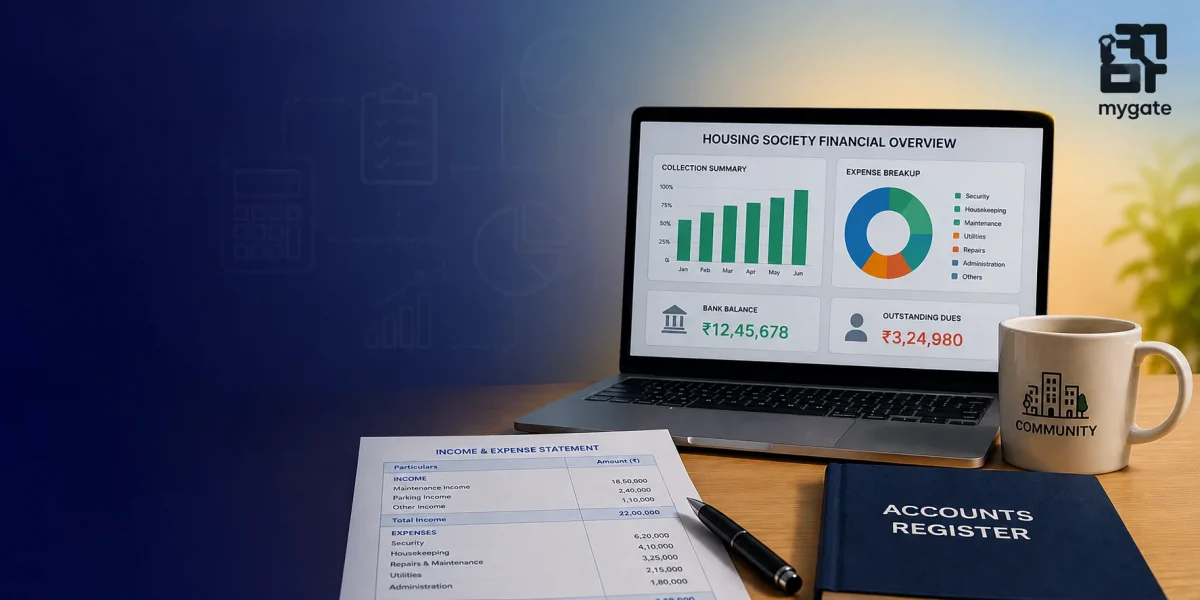
Managing a housing society is not just about lifts, security, or housekeeping. It is equally about how responsibly you handle members’ money, maintain records, and stay compliant with laws. A clear, practical society accounting checklist helps your committee avoid confusion, reduce conflicts, and build long term trust with residents.
For societies using Mygate, this kind of accounting discipline can sit alongside day to day billing and resident communication in a more organised way.
In this guide, you will find a complete, easy to use checklist for day to day accounts, year end work, and statutory compliance. You can adapt it for cooperative housing societies, RWAs, and apartment associations across India.
Why society accounting really matters
Good accounting is the foundation of a healthy housing society. When records are clean, decisions are faster, approvals are smoother, and members feel confident that their money is safe.
Strong society accounting helps you:
- Track maintenance collections and identify defaulters early.
- Plan budgets for repairs, repainting, and future projects.
- Present clear, audited financial statements to members every year.
- Meet tax and regulatory requirements and avoid penalties.
For many societies, the turning point comes when they move from scattered registers and spreadsheets to a structured accounting process with clear roles and timelines.
Core principles of society accounting
Before you build a checklist, it helps to anchor your approach on a few simple principles. These principles work for any size of society.
- Accuracy and completeness: Every transaction should be backed by a receipt, invoice, or voucher and posted to the correct ledger. This protects both the committee and the members.
- Timeliness: Entries for income and expenses should not wait until year end. Updating records weekly or at least monthly keeps your financial picture reliable.
- Transparency: Members should be able to understand what they are billed, what they have paid, and what remains due. Simple reports or a portal can make a big difference.
- Segregation of duties: No single person should control the full flow of money. The treasurer, secretary, and accountant should each have clear, separate responsibilities.
- Compliance first: The society should align with its bye laws, state cooperative rules, and central tax laws where applicable. Compliance is easier when you plan for it from day one.
Society accounting checklist
A practical society accounting checklist can be grouped into six main areas:
- Master records and opening balances
- Income, billing, and collections
- Expenses, approvals, and payments
- Banking, investments, and reconciliation
- Statutory compliance and audits
- Reporting to members and record keeping
You can plug these blocks into a monthly, quarterly, and annual work plan for the treasurer and accountant.
Master records and opening balances
A strong master setup is the backbone of accurate accounting. If your base data is wrong, every report will carry that error forward.
Member and unit master
- Maintain an updated list of all flats or units with owner name, contact details, area, and parking details.
- Assign a unique account code to each flat in your accounting or society management system.
- Update ownership changes promptly with date of transfer and basic documents so billing and voting rights stay mapped correctly.
Chart of accounts
- Create standard income ledgers such as maintenance charges, sinking fund, repair fund, parking income, interest income, and other society charges.
- Create clear expense ledgers for security, housekeeping, electricity for common areas, water, repairs, AMC contracts, audit fees, legal fees, insurance, and administration.
- Maintain separate ledgers for statutory items like tax deducted at source, tax payable, and refunds receivable.
Opening balances
- At the start of each financial year, record opening bank balances, cash balances, member outstanding dues, and vendor payables.
- Carry forward balances of reserve funds such as sinking fund, major repair fund, and corpus fund along with supporting schedules.
- Keep the previous year audited balance sheet and trial balance handy before finalizing the new year opening entries.
Income, billing, and collections checklist
Maintenance billing and collection is the most visible part of accounting for residents. Getting this right builds immediate trust.
Maintenance billing
- Define the basis of maintenance billing, such as per square foot or flat wise, and get it approved in the annual general meeting.
- Set up recurring monthly or quarterly maintenance invoices in your system with clear breakup of components like general maintenance, funds, parking, and any extra charges.
- Apply late fee or interest strictly as per bye laws and resolutions so there is no perception of bias.
- Display all necessary tax related fields on invoices if registration and charging of tax is applicable.
Special charges and funds
- Create separate billing heads for one time collections such as painting fund, lift modernization fund, or emergency repair contribution.
- Post collections from these heads directly into the corresponding reserve ledgers, not into general income.
Receipt management and defaulter tracking
- Issue a receipt for every payment mode including online transfer, cheque, or cash.
- Encourage online and digital payments to reduce cash handling and simplify reconciliation.
- Tag each payment to the correct flat and invoice so that member statements remain accurate.
- Prepare and update a defaulter list at least monthly, showing outstanding amounts and overdue periods.
Income beyond maintenance
- Record income from clubhouse rentals, community hall bookings, mobile towers, advertisement hoardings, and guest parking as separate income heads.
- Reconcile interest earned on savings accounts and fixed deposits with bank statements and interest certificates.
- Capture any tax deducted by banks on interest as receivable so it can be adjusted while filing returns.
Expenses, approvals, and payments checklist
Controlling expenses is as important as collecting income. A basic but firm process protects both the committee and the funds.
Vendor and contract management
- Maintain a vendor master for key services such as security, housekeeping, lift maintenance, generator, gardening, pest control, and plumbing.
- Store vendor details including address, pan, bank account, and registration details where relevant.
- Keep signed copies of annual maintenance contracts and work orders in a shared digital folder that new committees can access.
Expense documentation
- Insist on proper invoices for all regular services and major purchases.
- Use simple petty cash vouchers for small day to day expenses like bulbs, cleaning tools, or small repairs.
- Get petty cash vouchers approved by an office bearer and signed by the payee before recording them.
Payment process
- Link every payment to a specific invoice, voucher, or contract in your accounting system.
- Prefer cheque or online transfers for most payments, keeping cash use to a minimum.
- Define approval levels, for example, payments above a fixed amount need approval from both treasurer and secretary or chairman.
Tax deduction at source on payments
- Identify categories where tax deduction at source is normally required, such as contractor bills, rent, or professional fees.
- Deduct tax at the time of payment and deposit it within the due dates.
- File periodic tax returns related to these deductions and share tax certificates with vendors.
Banking, investments, and reconciliation checklist
Societies often run multiple bank accounts and fixed deposits, so clarity on actual cash position is crucial.
Bank accounts and signatories
- Ensure that bank signatories are updated whenever office bearers change, based on formal resolutions.
- Avoid unnecessary bank accounts that are rarely used and consolidate where practical.
Monthly reconciliation
- Download or collect bank statements for all accounts each month.
- Prepare bank reconciliation statements to track uncleared cheques, deposits in transit, bank charges, and interest entries.
- Investigate and resolve any unexpected debits or credits quickly.
Fixed deposits, reserves, and liquidity
- Maintain a fixed deposit register showing amount, bank, interest rate, start date, and maturity date.
- Map each deposit to a specific reserve or purpose, such as sinking fund, so long term money is not withdrawn casually.
- Review upcoming maturities in advance and decide whether to renew, break, or rebalance based on planned projects and cash flow.
Statutory compliance and audit checklist
A clear compliance routine protects present and past committee members and reduces the risk of future disputes.
Annual financial closure
- Close books for the financial year within a reasonable time after year end.
- Complete all income and expense posting, bank reconciliation, and schedules for major items like member dues and vendor balances.
- Hand over all records to the auditor early enough for a smooth, thorough audit.
Audit and registrar related tasks
- Get the annual accounts audited by an eligible auditor as required in your state.
- Obtain signed financial statements along with audit report and any annexures.
- File required annual returns and forms with the registrar or relevant authority within the specified due dates.
Income tax related responsibilities
- Assess whether the society has any taxable income from interest, non member transactions, or commercial activities.
- Pay advance tax if needed and file income tax returns within the notified deadline.
- Keep all supporting documents like tax deduction certificates and computation working papers safely.
Indirect tax aspects
- Monitor total collections and structure of charges to understand if any indirect tax registration or compliance requirement is triggered under current rules.
- If registered, raise compliant invoices, file returns on time, and reconcile reported figures with books regularly.
- Retain records for the required number of years since notices can relate to older periods.
Local safety and other compliances
- Track renewals of lift inspection certificates, fire safety clearance, and other mandatory safety checks.
- Display or store certificates as required so that they are readily available during inspections or member queries.
Reporting to members and record maintenance
Good accounting becomes truly valuable when it is communicated clearly and records are preserved well.
Simple, regular reporting
- Share a short quarterly financial summary showing collections, expenses, and key balances with members.
- During the annual general meeting, provide audited statements along with a simple explanation of major movements compared to the previous year.
Recording financial decisions
- Document important financial decisions in meeting minutes, including changes in maintenance rates, use of funds, and big project approvals.
- Attach basic cost estimates or justifications to these minutes where possible for better context.
Record retention and handover
- Preserve vouchers, invoices, contracts, bank statements, and statutory filings in an indexed format, both digitally and physically where possible.
- During committee changeover, conduct a formal handover of books, files, logins, and system access to ensure continuity.
Sample calendar based society accounting checklist
The table below converts the concepts above into a simple time based checklist your society can follow.
| Period | Key accounting tasks |
| Every month | Raise maintenance invoices, record collections, update defaulter list, book all expenses, reconcile at least one bank account, pay any taxes due, and review cash and bank balances. |
| Every quarter | Complete full reconciliation for all bank accounts, file tax related returns where applicable, review major vendor payments and contracts, and present a finance update to the committee. |
| Mid year | Review budget versus actuals, assess if maintenance or funds need revision, plan for major projects, and check if any tax thresholds are likely to be crossed. |
| Year end | Close books, prepare schedules, complete audit, conduct the annual general meeting, file annual returns, and review fixed deposits and reserves for the coming year. |
Pros and cons of using a structured society accounting checklist
A structured checklist is powerful, but it does come with a few trade offs. Here is a quick view.
| Aspect | Pros | Cons |
| Clarity | Everyone knows what to do and when, which reduces confusion and missed steps. | Building and maintaining the checklist requires time and discipline. |
| Compliance | Regulatory deadlines and filings are easier to track, cutting the risk of penalties. | If rules change and the checklist is not updated, gaps can still appear. |
| Transparency | Members see clear reports and trails, which improves confidence in the committee. | More visibility can lead to more questions and expectations from members. |
| Continuity | New committees can take over more smoothly because processes are documented. | If records are still scattered or paper based, following the checklist feels heavy at first. |
In practice, once the society adjusts, the checklist usually saves time, reduces stress, and makes transitions between committees smoother.
FAQs on society accounting
Who is responsible for managing society accounts?
Usually, the treasurer oversees accounts, the secretary coordinates documentation and communication, and an external accountant or chartered accountant manages bookkeeping and audit. However, overall responsibility rests with the managing committee as a team.
Do small societies also need an audit?
In many states, registered cooperative housing societies, regardless of size, are expected to get their accounts audited annually by an approved auditor. Even if rules are lighter in some cases, an annual audit is a strong best practice.
When should a society think about tax registration or filings?
Societies should monitor total income, interest on deposits, and non member income like commercial rentals. Once certain thresholds or conditions are met under current laws, registrations and returns can become mandatory. It is safer to consult a qualified tax professional for the latest thresholds and interpretations.
How long should financial records be kept?
Different authorities specify different minimum retention periods, but societies are generally safer if they keep key financial and statutory records for several years. Longer retention makes it easier to respond to old queries, disputes, or inspections.
Is specialized software really necessary?
A small society can technically manage with registers and spreadsheets, but accounting or society management software like Mygate reduces manual effort and errors. It automates billing, reminders, and basic reports, and makes handover between committees far easier.
Conclusion
A society accounting checklist is not just paperwork. It is a simple, living framework that helps your housing society handle money with clarity, control, and accountability. When master data is clean, billing is structured, expenses are documented, banks are reconciled, and compliance is planned, the financial side of community living becomes far less stressful.
Adapt this checklist to your state laws, society bye laws, and ground realities. Review it at least once a year, refine it after each audit, and include it as part of your formal handover pack. With that discipline, you create a culture where every rupee collected from residents is tracked, protected, and used for the long term good of the community.
For societies using Mygate, this checklist works even better when billing, collections, and reporting are kept in a single structured workflow.