

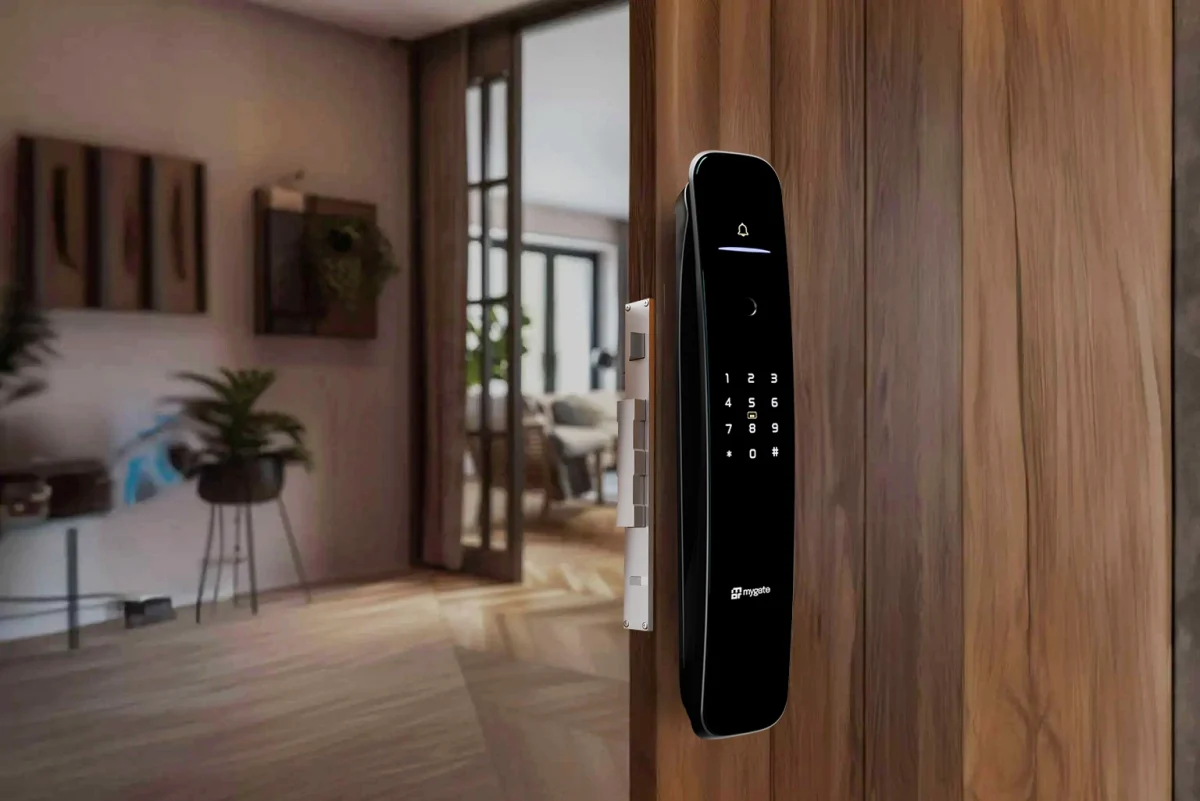
Yes, smart locks remain safe and functional during a power cut, and this is one of the most misunderstood aspects of how they actually work. A smart lock does not run on your home’s mains electricity at all. It runs on its own internal battery, which means a power cut in your building or neighbourhood has no direct effect on the lock itself. The lock keeps working exactly as it did before the power went out, and it stays securely locked throughout.
The confusion here is understandable, since the power cut sounds like it should affect anything electronic in the house. But a smart lock’s actual dependency is on its own battery charge, not on grid electricity, and the two are entirely separate concerns. This guide explains how smart locks are actually powered, what does and does not affect them during an outage, and what genuinely happens in the much rarer scenario where the lock’s own battery runs out.
How smart locks are actually powered?
Nearly all residential smart locks, including the ones commonly installed on Indian home doors, run on internal batteries rather than being wired into a home’s electrical supply. This is a deliberate design choice, not a limitation. A lock wired directly into mains power would stop working entirely during an outage and would also require far more complex, invasive installation involving electrical wiring through the door and frame.
Battery power avoids both problems. The lock operates independently of the building’s electricity supply, and installation stays straightforward since there is no wiring to run. This is why a home’s power cut, whether it is a scheduled outage, a grid failure, or an issue specific to your building’s supply, does not affect whether your smart lock continues to function.
What does a power cut do and does not affect?
It helps to separate what actually depends on mains electricity in a smart home setup from what does not.
The lock itself is unaffected. Fingerprint access, PIN entry, RFID card access, and the mechanical key backup all continue working exactly as normal during a power cut, since none of these depend on your home’s electrical supply.
Your home WiFi router may go down, which affects only WiFi dependent remote features, such as unlocking the door from outside your home network or receiving real time notifications while away. This does not affect the ability to physically unlock the door in person using fingerprint, PIN, or card access, since those functions run on the lock’s own local battery and hardware, not through the internet.
Bluetooth based local access typically continues working, since Bluetooth connectivity between your phone and the lock does not depend on your home’s WiFi or mains power, only on both devices having their own battery charge.
In practical terms, a typical household power cut has essentially no impact on daily use of a smart lock. You can still walk up to your door and unlock it with a fingerprint or PIN exactly as before. The only functions that pause are internet dependent remote features, and only until either the power or your WiFi connection is restored.
What actually matters: The lock’s own battery
The genuine dependency to think about is not your home’s electricity supply, but the smart lock’s own internal battery, which needs to be charged or replaced periodically regardless of whether the mains power at home is working or not.
Quality smart locks are built with battery life measured in months under typical daily use, not days, which means the lock’s own battery running low is a separate, much less frequent event than a household power cut. Most locks also provide a clear low battery warning well before the charge is fully depleted, whether through an audible alert at the keypad, a notification through the companion app, or both, giving you a reasonable window to recharge or replace the battery before it becomes an issue.
What happens if the lock’s own battery fully runs out
This is the scenario people are often actually asking about when they raise concerns about power cuts, even though it is unrelated to household electricity. If a smart lock’s own battery is allowed to run all the way down without being addressed after the low battery warning, most quality locks are still designed with a fallback rather than simply leaving you locked out.
A physical mechanical key backup is included on the large majority of residential smart locks specifically for this scenario, allowing the door to be opened manually regardless of the electronic battery status. This is generally considered a non-negotiable safety feature for any smart lock sold for home use, since a lock that can permanently trap you outside your own home due to a depleted battery would be a serious design flaw.
External emergency power options are also common on many models, allowing a portable power source, such as a 9 volt battery touched to external contact points on the lock, to temporarily power the unit long enough to unlock it electronically and allow you to then replace the internal battery properly. Not every lock includes this feature, so it is worth checking for it specifically if it matters to you, but it is a widely used industry solution precisely for the low battery scenario.
Between the mechanical key backup and, on many models, external emergency power support, a fully depleted battery is an inconvenience to be addressed, not a genuine lockout risk, provided the lock includes these standard fallback options.
Does a power cut make a smart lock less secure?
A reasonable follow up question is whether a power cut, or a lock running low on its own battery, creates any kind of security vulnerability, such as the lock defaulting to an unlocked state.
Quality smart locks are built on what is generally called a fail secure design for residential use, meaning the lock remains locked by default regardless of power status, rather than automatically unlocking if power is lost. This is the opposite of fail safe designs sometimes used in commercial fire safety contexts, where certain doors are required to unlock automatically during a power failure for emergency egress reasons. For a home’s main door, fail secure is the appropriate and standard approach, since you want your door to stay locked during a power interruption, not open itself.
This means a power cut, whether at the household level or even if the lock’s own battery eventually depletes, does not create an unlocking event. The door remains secured, and access still requires an active unlock action through one of the lock’s available methods, whether electronic or the mechanical key backup.
Comparing smart locks to traditional locks during a power cut
It is worth directly comparing how a smart lock behaves during a power cut against a traditional mechanical lock, since this is often the actual concern underlying the question.
A traditional lock is entirely unaffected by any power cut, since it has no electronic component at all, which is sometimes assumed to make it inherently more reliable. In practice, a quality smart lock during a household power cut behaves identically to a traditional lock from a functional standpoint. It remains locked, it can still be opened with a key or, more conveniently, with a fingerprint or PIN that does not depend on mains electricity, and it does not require external power to function normally.
The meaningful difference only appears in the much rarer scenario of the lock’s own internal battery being allowed to fully deplete without any response to the low battery warnings, at which point the mechanical key backup restores exactly the same access a traditional lock always had. In everyday terms, a well designed smart lock does not introduce a new point of failure tied to household power cuts, since its actual power source and the home’s electrical supply are separate systems entirely.
Practical steps to avoid battery related issues
While a smart lock’s own battery running out is a separate concern from household power cuts, a few habits help avoid it becoming an issue at all.
Respond to low battery warnings promptly rather than dismissing them, since most locks provide meaningful advance notice specifically to give you time to act before the battery is fully depleted. Keep spare batteries of the correct type on hand if your lock uses replaceable batteries, so a replacement is immediately available rather than needing an unplanned trip out. If your lock includes external emergency power support, know where the contact points are and keep a compatible battery accessible as a backup option. And periodically check that your mechanical key backup is accessible and that you remember where it is kept, since it is easy to forget about a backup method that is rarely needed until the moment it actually is.
How Mygate approaches this specifically
Mygate smart locks are built with this exact scenario in mind, given how regularly power interruptions occur across Indian households. Its locks run on their own internal battery, independent of home mains electricity, so a typical household power cut has no effect on daily use of fingerprint, PIN, or card access. Battery life is designed for extended use between charges, with a low battery warning provided in advance, and every model includes a mechanical key as a physical backup, ensuring the door can always be opened even in the unlikely event the internal battery is fully depleted without being addressed beforehand. For a country where power reliability varies significantly by region and season, this combination of long battery life, advance warning, and a guaranteed physical fallback is a deliberate design choice rather than an afterthought.
FAQs
Do smart locks stop working during a power cut?
No. Smart locks run on their own internal battery, not on your home’s mains electricity, so a household power cut does not affect the lock’s ability to function normally.
What does a power cut actually affect if not the lock itself?
A power cut can affect your home WiFi router, which limits internet dependent remote features like unlocking from outside your home network. It does not affect local access methods like fingerprint, PIN, or card entry.
What happens if a smart lock’s own battery runs out completely?
Quality smart locks include a mechanical key backup that allows manual entry regardless of battery status, and many models also support temporary external power, such as a 9 volt battery, to restore electronic access long enough to replace the internal battery.
Does a power cut make a smart lock less secure or cause it to unlock automatically?
No. Residential smart locks are built with a fail secure design, meaning they remain locked by default regardless of power status, rather than unlocking automatically during a power interruption.
How is a smart lock different from a traditional lock during a power cut?
Functionally, very little. A quality smart lock behaves the same as a traditional lock during a household power cut, remaining locked and accessible through fingerprint, PIN, card, or the physical key backup, none of which depend on mains electricity.
How can I avoid getting locked out due to a depleted lock battery?
Respond promptly to low battery warnings, keep spare batteries on hand if applicable, and make sure you know where your mechanical key backup is kept at all times.
A power cut at home has essentially no effect on a smart lock’s ability to function, since the lock runs on its own internal battery rather than mains electricity. The genuine consideration is the lock’s own battery charge, which is a separate, far less frequent concern that quality locks address with advance low battery warnings, long battery life, and a mechanical key backup as an ultimate fallback. Understood this way, a well designed smart lock is not a liability during a power cut. It performs exactly as reliably as a traditional lock, with the added convenience of fingerprint and PIN access working throughout.