

Bangaluru
Redevelopment is much more than a construction project; it’s a once-in-a-lifetime opportunity for your housing society to modernize living spaces, upgrade amenities, and add lasting value.
Over the years, policy shifts have made redevelopment more accessible and efficient. From the early changes in 2012 to the recent 2025 rules giving developers only two months to act, the landscape is evolving. But with opportunity comes responsibility: careful planning, informed decisions, and clear communication are essential for success.
Make sure everyone agrees on what matters most
The first step is uniting the society members around a common vision. Redevelopment affects everyone, so knowing what’s non-negotiable, whether it’s maintaining green spaces, ensuring parking adequacy, or safeguarding heritage features, helps avoid misunderstandings later.
When all members agree on their priorities upfront:
- It simplifies discussions with developers and vendors.
- It prevents surprises during project execution.
- It helps focus negotiations on what truly matters.
Skipping this step often leads to delays, disputes, and distrust. Remember, redevelopment isn’t just about buildings; it’s about community.
Focus on building for the future, not just bigger spaces
Redevelopment should envision the society’s future lifestyle, not just add floors or increase flat sizes. Think about:
- Creating green open spaces that encourage outdoor activities and improve air quality.
- Designing safe, step-free pathways and entrances that help senior citizens and differently-abled residents move around easily.
- Planning parking thoughtfully to prevent congestion and protect vehicles.
- Including community halls, play areas, and wellness spaces that support multi-generational living.
This future-focused approach increases society’s attractiveness and ensures the new development remains relevant and comfortable for decades.
Think about the costs that come after the construction is done
A modern building can come with unexpected expenses if long-term costs aren’t considered. Societies should factor in:
- Maintenance of eco-friendly features like solar panels and water recycling systems.
- Regular upkeep of green spaces keeps the environment healthy and appealing.
- Utility costs that might fluctuate due to design choices (for example, air conditioning requirements if ventilation isn’t optimized).
Working with developers who specialize in sustainable and cost-effective building designs can save society money and stress later.
Keep everyone updated at every stage of the process
Redevelopment projects span years and involve many moving parts. Keeping members well-informed reduces anxiety and builds trust. Societies should:
- Hire an independent Project Management Advisor (PMA) to ensure unbiased oversight on timelines, budgets, and quality.
- Consult legal experts early on to protect members’ rights and clarify contractual obligations.
- Provide regular updates and hold open forums for members to ask questions and voice concerns.
Transparent communication fosters a collaborative environment where all stakeholders feel valued and heard.
Look beyond the price when choosing a developer
While financial proposals matter, they shouldn’t be the sole criterion. When selecting a developer, consider:
- Their ability to finance the project fully, avoiding mid-way stalls.
- Track record in delivering projects on time and within budget.
- Reputation for quality, safety, and after-sales service.
- Past client references and feedback from other societies.
Doing thorough due diligence now helps avoid costly issues later.
Treat society funds with care and plan for the long term
Funds like hardship allowances or corpus money are precious resources. Instead of viewing them as easy cash, societies should:
- Use these funds strategically to cover redevelopment expenses and contingencies.
- Maintain meticulous records of expenditures for transparency and accountability.
- Make collective decisions about spending to ensure fairness and prevent misuse.
A disciplined approach to fund management ensures financial stability during and after redevelopment.
Remember, redevelopment is about renewing your community
Ultimately, redevelopment shapes the future of your community. When done thoughtfully, it brings modern comforts, strengthens bonds among residents, and enhances property value. It’s an investment not just in infrastructure but in the social fabric that holds your society together.
Take your time, involve everyone, pick partners carefully, and build a home that welcomes generations to come.
Picture this: It’s 8 PM on a weekday, and residents are returning home from work. The parking area becomes a scene of carefully orchestrated chaos as everyone seeks their designated spots. Now add electric vehicles into the mix, with their charging cables snaking across walkways, and suddenly what seemed like a simple parking allocation has become a complex puzzle requiring Solomon-like wisdom to solve.
This scenario isn’t uncommon in India’s burgeoning residential complexes. With 4.1 million cars sold annually but insufficient parking infrastructure to match, housing societies find themselves at the epicentre of disputes that go far beyond simple space allocation. The rapid adoption of electric vehicles has added another layer of complexity, transforming parking areas into potential battlegrounds where individual rights clash with collective concerns.
Understanding the legal landscape
1. The MOFA framework
Maharashtra has taken the lead with its Ownership Flats Act (MOFA), providing what’s arguably the most comprehensive framework for parking governance in India. Section 78 establishes the first-come, first-served principle for parking allocation, while Section 84 allows societies to implement annual parking fees decided through general body meetings.
The registration requirement under MOFA serves a practical purpose. Every vehicle must be registered with the RWA using RC book copies and application forms. This creates a paper trail that can prevent disputes about who’s entitled to park where. The single vehicle policy per member might seem restrictive, but it’s designed to ensure fair distribution of limited resources.
Other states are taking note. Tamil Nadu’s Apartment Ownership Act includes similar vehicle registration provisions, while Karnataka’s Apartment Ownership Act has provisions for parking allocation that mirror Maharashtra’s approach. Uttar Pradesh and West Bengal are currently revising their housing society regulations, borrowing heavily from Maharashtra’s successful framework.
2. RERA’s game-changing stance across India
The Real Estate Regulatory Authority has fundamentally altered how we think about parking rights across the country. The 2011 Bombay High Court ruling, later upheld by the Supreme Court, established that parking spaces are common amenities, not individual property that builders can sell separately. This precedent has been applied consistently across India, with Delhi, Chennai, and Bangalore high courts referencing this ruling in similar disputes.
The ruling doesn’t retroactively change ownership patterns, but it does establish that parking management is a collective responsibility. The Ministry of Housing and Urban Affairs has codified this through specific requirements: two Equivalent Car Spaces (ECS) per 100 square meters of residential floor area, with variations based on apartment size.
3. Municipal regulations across the country
The Brihanmumbai Municipal Corporation’s requirement that societies reserve a minimum of 5% of parking spaces for visitors has become a model for other urban centers. Pune Municipal Corporation adopted similar guidelines in 2022, while Bengaluru’s BBMP is considering comparable regulations. Chennai Corporation has already implemented visitor parking mandates in new developments.
4. Karnataka’s revolutionary EV charging framework
While most states have been grappling with EV charging disputes on a case-by-case basis, Karnataka has taken a proactive approach that’s already influencing policy discussions across India. The Karnataka Electricity Regulatory Commission (KERC) guidelines represent a paradigm shift in how we approach individual charging rights within collective housing structures.
The KERC directive addresses the fundamental question: Can individual flat owners install charging points, or must everything go through the RWA? The answer is refreshingly clear: individuals have the right to install charging points within their existing sanctioned load or enhance their load under existing tariff categories.
This isn’t a free-for-all, though. The guidelines require compliance with Central Electricity Authority (CEA) safety regulations, creating a framework where individual rights are protected while collective safety concerns are addressed. The provision allowing residents to extend wiring from their metering panels to charging points eliminates one of the most common RWA objections to individual charging installations.
Maharashtra’s electricity regulatory commission is studying Karnataka’s approach for potential adoption. Tamil Nadu has initiated consultations with stakeholders about developing similar guidelines. Delhi’s electricity board has formed a committee to examine how Karnataka’s framework might be adapted for the capital’s unique challenges.
Legitimate areas of RWA authority
RWAs across India have clear authority over common area management, and this extends to parking areas in meaningful ways. Whether you’re in Mumbai, Delhi, Bangalore, or Chennai, RWAs can enforce building safety codes, implement traffic regulations within the complex, and collect maintenance fees, including parking charges approved through proper procedures.
When it comes to electrical infrastructure, RWAs can assess building capacity and require compliance with safety standards. This isn’t about blocking progress; it’s about ensuring that individual actions don’t compromise collective safety. Fire suppression systems, ventilation requirements, and emergency access pathways are all legitimate areas of RWA oversight.
However, RWA authority isn’t unlimited, and courts across India have been consistent in establishing these boundaries. The Delhi High Court’s 2020 ruling on parking rights echoed earlier Maharashtra precedents, while the Madras High Court’s 2021 decision on EV charging restrictions followed similar principles. These cases establish that RWAs cannot arbitrarily revoke legitimate parking rights that were sold or allocated as part of apartment purchases.
Common dispute scenarios and their Resolution
Every housing society faces the challenge of residents who push boundaries, park additional vehicles, occupy visitor spaces, or block access routes. The solution isn’t always punitive action. Sometimes it’s about creating clearer policies and better enforcement mechanisms.
The annual review process for additional space requests serves an important function beyond just managing waiting lists. It creates regular opportunities to reassess space utilization and adjust policies based on changing needs.
The proliferation of multi-car households has forced many RWAs to develop second car policies that balance individual needs with collective resource constraints. Additional fees for second car parking are common, but their legality depends on the original purchase agreements and parking allocation terms.
Waiting lists for additional spaces can work well when managed transparently. The key is establishing clear criteria for allocation and communicating these consistently.
Navigating rights and restrictions for EV Charging
The three most common RWA objections to EV charging installations are safety concerns, electrical infrastructure limitations, and uniformity issues. Modern EV safety systems are sophisticated, with multiple failsafes and automatic shutdown mechanisms. The fire risk from properly installed EV charging equipment is actually lower than many common household appliances.
Electrical infrastructure concerns are more valid, particularly in older buildings. However, individual charging from personal meters typically doesn’t overload common electrical systems. Professional electrical load analysis can determine actual capacity and identify any necessary upgrades.
Many RWAs have opted for third-party charging solutions as a middle ground. These arrangements can address some concerns while creating new ones. Professional installation and maintenance are definite advantages, as are standardised safety protocols and centralised management.
However, residents often end up paying significantly more for third-party charging services compared to using their electrical connections. The convenience of centralised management comes at a cost, both financial and in terms of individual control over charging schedules.
Best practices for sustainable parking management
Effective parking management starts with comprehensive policy development. Written policies covering all parking scenarios, from daily parking to visitor management to EV charging, create clarity and reduce disputes. Regular legal review ensures compliance with evolving regulations and court precedents.
Stakeholder consultation before policy implementation isn’t just good governance, it’s practical dispute prevention. Residents who understand the reasoning behind policies are more likely to comply with them.
Residents who understand their rights and responsibilities are better equipped to navigate parking disputes constructively. Maintaining copies of purchase agreements and parking allocations provides documentation that can be crucial in disputes. Understanding relevant safety norms and building codes helps residents propose compliant solutions rather than simply opposing restrictions.
Constructive engagement through participation in RWA meetings and policy discussions is often more effective than confrontational approaches. Residents who work collaboratively with management committees tend to achieve better outcomes than those who simply oppose restrictions.
Emerging trends and future challenges
Smart parking systems are beginning to appear in premium residential complexes across India’s major cities. Bangalore’s tech corridor has been an early adopter, with several complexes implementing IoT-enabled parking management systems. Mumbai’s luxury developments are following suit, while Delhi’s premium societies are experimenting with app-based parking solutions.
As EV adoption accelerates across India, more states are preparing to follow Karnataka’s lead. Maharashtra’s electricity regulatory commission has formed a task force to study Karnataka’s guidelines, with draft regulations expected by late 2025. Tamil Nadu’s state electricity board is conducting stakeholder consultations that suggest even more resident-friendly guidelines might be in the pipeline.
The Ministry of Housing and Urban Affairs has indicated that future model building bylaws will include comprehensive EV charging provisions. This could accelerate adoption across states that have been hesitant to develop their frameworks.
The evolution of parking regulations and EV charging rights in Indian housing societies reflects broader changes in urban living, technology adoption, and community governance across the country. While disputes are inevitable in any system involving shared resources and individual rights, they can be managed effectively through clear policies, transparent governance, and collaborative problem-solving principles that remain constant whether you’re in Mumbai, Bangalore, Bhubaneswar, or any other city.
Success depends on comprehensive frameworks that address both current needs and future challenges, professional assessment of electrical and safety infrastructure, and building collaborative relationships between RWAs and residents. The goal isn’t to eliminate all disputes but to create systems that can resolve them fairly and efficiently.
Renting out your home is a common way to earn a steady second income. But if you’re a flat owner in a cooperative housing society, there’s one charge you shouldn’t overlook non-occupancy charges.
This is a fee that applies when your flat is not occupied by you or your immediate family, and instead is rented out to tenants. While it’s not a very large charge, it’s important to understand when it’s applicable, how it’s calculated, and what to do if you’re being overcharged.
What are non-occupancy charges?
Non-occupancy charges are levied by housing societies when a flat owner rents out their property to a person who is not a close family member. This fee is collected in addition to your usual monthly maintenance charges.
The purpose of this charge is to ensure that members who are earning rental income from their property also contribute a little extra to the upkeep of common services used by the tenant, such as security, lifts, water, and other shared facilities.
When are non-occupancy charges applicable?
These charges are applicable only if your flat is rented out to someone who is not your immediate family.
You will not be charged non-occupancy fees if:
- You, the owner, are living in the flat.
- The flat is occupied by close family members, such as your parents, spouse, children, siblings, in-laws, or grandchildren.
- The flat is locked, vacant, or unoccupied.
The charge becomes applicable when the flat is used to earn a commercial benefit (i.e., rent) by giving it to non-family members.
In such cases, the society usually requires you to:
- Complete police verification of the tenant (mandatory in many cities).
- Inform them in writing about the tenancy.
- Submit a copy of the lease or leave-and-license agreement.
- Fill out any society-required tenant forms.
How is the non-occupancy charge calculated?
Earlier, societies used to charge a flat amount as a one-time non-occupancy fee. This led to disputes and overcharging in many cases. To address this, the Maharashtra government issued a circular under Section 79A of the Maharashtra Cooperative Societies Act, which clearly states that:
Non-occupancy charges cannot exceed 10% of the service charges paid by the member.
This rule has since been upheld by the Supreme Court and is now followed by most cooperative housing societies, especially in Maharashtra and major metro cities.
Let’s break this down with an example:
- Suppose your total maintenance bill is ₹3,000 per month.
- Out of this, ₹2,000 is considered “service charges” (expenses such as security staff, society staff salaries, electricity for common areas, housekeeping, etc.).
- You will be charged 10% of ₹2,000 = ₹200 as non-occupancy fees.
Important: Service charges do not include sinking fund, repair fund, property tax, or water charges.
What if you are overcharged?
This is unfortunately not uncommon. In many housing societies, members have raised complaints that the management committee has either:
- Charged non-occupancy fees even when the flat is used by a relative
- Charged more than 10% of service charges
- Not provided clarity on the breakup of the charges
In such cases, here’s what you can do:
- Write to the managing committee and request an explanation with supporting calculations.
- If you don’t receive a proper response, escalate the issue to the Registrar of Cooperative Societies in your area.
- You can also approach a Consumer Forum for redressal if the charges are unfair or violate the law.
It’s illegal for societies to charge more than what is permitted under the rules. And it is equally illegal to collect non-occupancy charges when the flat is used by a family member.
Is GST applicable on non-occupancy charges?
Yes. As per recent GST clarifications, if the total maintenance charges (including non-occupancy) exceed ₹7,500 per month per member, then 18% GST is applicable.
However, this GST is not paid by the owner to the government directly. The society is responsible for calculating and collecting the GST and remitting it to the government. Make sure your maintenance bill reflects this clearly, especially if you cross the ₹7,500 threshold.
Do tenants have to pay the charge?
By default, non-occupancy charges are the responsibility of the flat owner, not the tenant.
However, if you want your tenant to cover this cost, you can mention it clearly in the rental agreement. That way, you can legally recover it from them along with rent and other maintenance charges. But societies will only deal with the owner for collecting this charge.
Is this rule the same across India?
The 10% rule originates from the Maharashtra government circular and is strictly enforced in cities like Mumbai, Pune, and Nagpur.
In other states like Karnataka, Telangana, Delhi, and Tamil Nadu, most societies either follow similar rules by internal agreement or choose not to charge non-occupancy fees at all. But unless there is a clear by-law stating otherwise, housing societies cannot arbitrarily fix this charge.
In Bangalore, for example, many RWAs do not charge non-occupancy fees unless it has been included in the society’s registered bye-laws.
Why should committee members understand this?
If you’re part of your RWA’s managing committee, you’re expected to:
- Inform members about non-occupancy charges when they rent out their flat
- Collect it as part of the maintenance bill
- Explain how the amount is calculated
- Ensure the society stays within the legal limits
Many disputes between owners and societies arise due to lack of communication or incorrect billing. Being transparent and following the law helps keep things smooth for everyone.
What if the owner refuses to pay?
If a flat owner does not pay the non-occupancy fee when it is due, the society can:
- Issue a payment reminder notice
- Declare the member as a defaulter for society billing purposes
- Withhold the No Dues Certificate required for property sales or rentals
However, societies must still act within the legal limit and cannot use coercive tactics or harassment.
Non-occupancy charges are legal and necessary but they must be applied fairly, transparently, and within the limits defined by law.
If you’re a homeowner renting out your flat:
- Check your society’s by-laws
- Inform the committee and submit documents
- Verify your monthly bill for correctness
- Know your rights if you’re being charged unfairly
If you’re on the committee:
- Know the rules
- Educate members
- Stay accountable
Understanding non-occupancy charges helps everyone avoid unnecessary conflict and ensures smoother community living.
Fire safety isn’t just some rule to follow, it’s what can save lives when things go wrong. Especially here in Bengaluru, where everything’s so close and packed, a fire can start anywhere and spread fast.
Remember the fire in Whitefield back in 2018? A short circuit in a car parked in the basement led to a tragedy where a mother and her little kid lost their lives. The fire brigade came quickly, but sometimes even that isn’t enough.
That’s why Karnataka insists every society has proper fire extinguishers, smoke alarms, sprinklers, and that everyone keeps checking and practicing fire safety.
➡️ Check out the official Karnataka State Fire & Emergency Services fire safety guidelines, and make sure your building is correctly equipped.
Managing modern residential societies is no longer a job for volunteers alone, it’s complex, demanding, and requires professionals. Society managers are paid experts who handle the daily operations of housing societies, from paperwork and maintenance to finances, resident issues, and legal compliance.
Without a society manager, gated communities often face chaos like delayed maintenance, financial confusion, and overworked committee members. A good manager brings structure, ensures legal compliance, supervises staff, manages vendors, and keeps residents informed.
Introduction
We’ve been working in housing society management for years now, and let me tell you – things have changed a lot. Back in the day, a few volunteers could handle most society work. Not anymore. These residential complexes have gotten huge and complicated. Residents want everything done perfectly and fast. That’s why almost every decent-sized society needs a proper manager these days.
Who is a society manager?
Think of them as the person who runs your building day-to-day.
They’re not volunteers like your RWA committee folks – they’re paid professionals who’ve learned how to handle all this stuff.
Some societies hire their own dedicated manager. Others use companies that send managers to handle multiple buildings.
Why a society manager is crucial
Here’s what happens without proper management – we’ve seen it plenty of times. Complaints pile up. Maintenance takes forever. Vendors show up whenever they feel like it. Nobody knows what’s going on with the money. Your volunteer committee members get burned out trying to handle everything.
A good manager fixes all this. They know the housing laws, deal with municipal authorities, and let your committee focus on making decisions instead of chasing contractors around.
Key responsibilities of a society manager
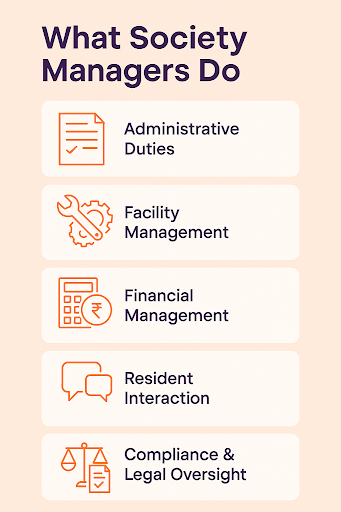
1. Daily operations & administration
Every meeting needs minutes. Every vendor needs a contract. Officials want notices. Someone has to track all this stuff and file it properly. During audits or legal issues, you’ll thank God someone kept proper records.
2. Facility maintenance
Cleaning staff need supervision. Gardens need maintenance. Something’s always breaking and needs fixing. Annual maintenance contracts need monitoring. When your elevator stops working or the generator fails, residents call the manager – not you.
3. Financial management
Budgets need planning. Maintenance fees need collecting. People who don’t pay need reminding (politely but firmly). Vendors need paying on time. Accountants need help during tax season. Without proper financial management, societies go broke fast.
4. Resident interaction
Residents complain about everything – noise, parking, maintenance, neighbors. New people move in and need orientation. Others move out and want deposits returned. Everyone wants updates on what’s happening. Managing all these personalities and expectations is honestly the hardest part.
5. Compliance & legal oversight
Fire safety inspections can’t be ignored. Structural audits are mandatory. Sewage treatment needs checking. Society registration must stay current. Labor laws apply to your staff. One missed compliance and you’re in serious trouble.
Tools and software society managers use

Most managers use apps now for communicating with residents. Visitor management systems track who comes and goes. Service requests get logged digitally instead of random phone calls.
Accounting software keeps financial records straight and generates reports automatically. Digital notice boards replace those paper notices that always fell down. Complaint tracking systems ensure nothing gets forgotten.
Put it all together and you get proper management systems instead of chaos.
Common challenges faced
- Residents expect different things. Some want immediate fixes, others complain about costs. During monsoons or festivals, everyone gets extra demanding.
- Collecting overdue payments without creating enemies requires serious diplomatic skills.
- Committee members often interfere or have unrealistic expectations.
- Vendors sometimes don’t show up or do shoddy work.
- Emergency situations – floods, power failures, medical emergencies happen at the worst possible times and need immediate handling.
Skills required to be an effective society manager
- Communication skills matter more than anything else. You’re constantly talking to residents, vendors, committee members, and officials. Poor communicators fail quickly in this job.
- Problem-solving under pressure separates good managers from mediocre ones. When three things break simultaneously during a festival weekend, panic doesn’t help – creative solutions do.
- Technology skills are becoming essential. You can’t avoid computers, smartphones, and management software anymore. Basic knowledge of housing laws and regulations prevents expensive mistakes.
Qualifications and hiring tips for RWAs
Most societies want college graduates, preferably with relevant diplomas in property management or business administration. Professional certifications help but aren’t always necessary.
Background verification is crucial – they’ll handle money and have building access. During interviews, give them real scenarios. How would they handle a major water leak? What if residents refuse to pay maintenance? How do they deal with difficult people?
Decide whether you want your own dedicated manager or prefer outsourcing to a management company. Your own manager gives personal attention but costs more. Management companies provide backup support and standard procedures.
FAQs
Is hiring a manager legally required?
No, but practically necessary for anything over 50-100 units. Volunteer committees simply can’t handle the workload effectively beyond that size.
What do they typically earn?
Salaries range from ₹25,000 to ₹60,000 monthly, depending on location, society size, and experience. Mumbai and Delhi pay more than smaller cities.
Can residents become managers?
Yes, but they must quit any committee positions first. Otherwise, conflicts of interest become inevitable.
How do facility managers differ?
Facility managers focus mainly on building maintenance and infrastructure. Society managers handle broader responsibilities including finances, resident relations, and administration.
What if the manager doesn’t perform?
Submit written complaints to your managing committee. If problems persist, contact your state’s society registrar or housing authority.
Conclusion
Good society management makes everyone’s life easier. Residents get better service, committee members avoid daily headaches, and property values stay stable. The investment usually pays for itself through smoother operations and fewer conflicts.
Most importantly, professional management prevents small problems from becoming major crises. Prevention costs less than fixing disasters later.
Drainage problems often start with small puddles but can quickly escalate into basement floods, foundation damage, mold, and costly repairs. Common causes include poor grading, clogged gutters, failed French drains, and heavy clay soil. Fixing grading, upgrading gutter systems, installing proper French drains or sump pumps, and improving soil are proven solutions. Regular maintenance and professional help (when needed) are essential to prevent disasters and protect your home’s value.
Drainage issues start small. Maybe you notice a puddle that doesn’t dry up after rain. Then your basement smells musty. Before you know it, you’re dealing with foundation cracks and mold problems that cost serious money to fix.
Introduction
Last month, my neighbor’s basement flooded again. Third time this year. She keeps mopping up water and hoping it’ll stop, but the real problem is outside – water has nowhere to go. We’ve seen this story play out dozens of times in our neighborhood.
Drainage issues start small. Maybe you notice a puddle that doesn’t dry up after rain. Then your basement smells musty. Before you know it, you’re dealing with foundation cracks and mold problems that cost serious money to fix.
Why proper drainage matters in residential areas
Your home’s drainage system isn’t just about avoiding puddles. Good drainage keeps your property value up. Houses with water problems sell for less – buyers can smell trouble from a mile away. Plus, standing water breeds mosquitoes and creates perfect conditions for mold growth. Nobody wants their kids playing in a yard that turns into a swamp after every storm.
Then there’s the legal side. More cities are cracking down on stormwater runoff. Your drainage problems can become your neighbor’s drainage problems, and that leads to disputes nobody wants.
Top residential drainage system problems
1. Poor grading around the house
Walk around after a good rain and you’ll spot the trouble areas. Water sitting against your house foundation? That’s bad news waiting to happen. This happens usually because whoever did the original grading didn’t think it through, or the ground has settled over time.
2. Clogged or broken gutters and downspouts
Overflowing gutters are like having no gutters at all. Water cascades down your walls, stains the paint, and dumps right where you don’t want it. Most of the time it’s leaves and debris, but sometimes the gutters are just too small for heavy storms.
3. French drain failure
These underground drainage systems work great when they’re new. Five years later? Roots grow into the pipes, debris clogs everything up, and suddenly your “fixed” drainage problem is back worse than before.
4. Basement water seepage
That musty smell isn’t just unpleasant – it’s expensive. Water finds its way through foundation walls when the soil outside gets saturated. You’ll see white chalky deposits on your basement walls, rust on metal fixtures, and eventually actual puddles on your floor.
5. Soil saturation and yard flooding
Some properties just don’t drain naturally. Heavy clay soil holds onto water like a sponge. Low spots collect runoff from higher areas. Your grass dies, your landscaping suffers, and your yard becomes unusable for days after storms.
Warning signs of drainage issues
- Water stains on foundation walls tell a story. Even if they fade during dry weather, they’re warning signs of bigger problems coming. I always tell people to take pictures of these stains so they can track whether things are getting worse.
- Cracks in walls or floors that keep getting bigger usually mean your foundation is moving. Water damage causes this kind of structural shifting, and it doesn’t fix itself.
- Mold and mildew smells in basements are dead giveaways. Once you’ve got moisture problems, mold follows quickly. This stuff affects your family’s health and makes your house basically unsellable.
- Mosquitoes breeding around your property means you’ve got standing water somewhere. Even tiny amounts in hidden spots can support huge mosquito populations.
- Dead patches in your lawn despite regular watering and fertilizing usually indicate drainage problems underground. Waterlogged roots can’t get oxygen and die off.
Best solutions for common drainage problems
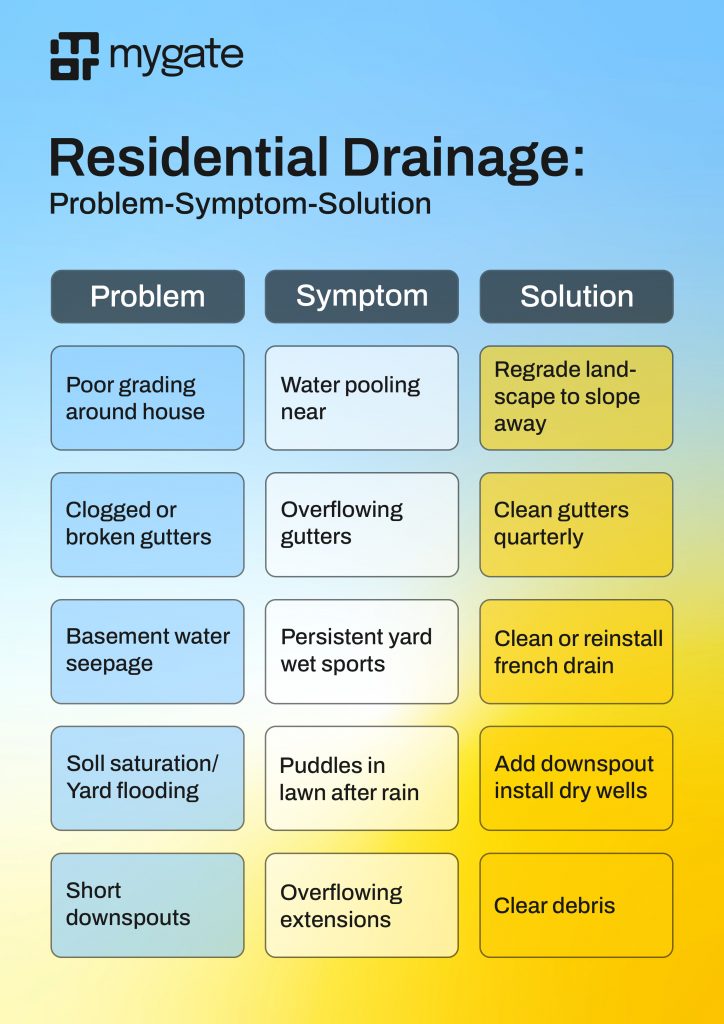
1. Fix your grading first
Your ground needs to slope away from your house – at least 6 inches over the first 10 feet. Sounds simple, but it requires bringing in the right kind of soil and shaping everything properly. Investing in proper grading now can prevent thousands in future repairs. Proper grading prevents way more expensive problems later. I’ve seen people spend hundreds on grading to avoid thousands in foundation repairs.
2. Upgrade your gutter system
Standard residential gutters often fail during today’s increasingly intense rainstorms. Go bigger if you’re replacing them. Add leaf guards to reduce maintenance headaches. Most importantly, make sure your downspouts dump water at least 6 feet from your foundation.It is always recommend getting your gutters professionally installed with the right slope toward downspouts. DIY gutter work often creates more problems than it solves.
3. French drain installation or repair
When installed correctly, French drains work for decades. The key is proper depth – usually 18-24 inches and using the right materials. Filter fabric prevents soil from clogging the system while still allowing water flow. Most failures come from cutting corners during installation. Proper pipe sizing, adequate gravel, and correct slope make all the difference.
4. Sump pump installation
If your basement floods regularly, you need a sump pump with battery backup. Power outages often happen during storms when you need pumps most. Get this professionally installed. Proper pit sizing and electrical work aren’t DIY projects. Regular maintenance includes testing the pump and keeping discharge pipes clear.
5. Soil aeration and dry wells
Clay-heavy soil causes drainage problems by holding onto water. Core aeration helps by creating channels for water and air movement. It’s not glamorous work, but it makes a real difference. Dry wells work in some situations, they collect stormwater and release it slowly into surrounding soil. These need adequate space away from your foundation and septic systems.
When to call a professional
- Some warning signs mean stop messing around and call experts immediately. Foundation shifts, new wall cracks, or doors and windows that suddenly don’t close properly indicate serious structural problems.
- Large areas of standing water that persist for days after storms usually require systematic solutions beyond DIY capabilities. I’ve watched homeowners throw money at temporary fixes while ignoring the real underlying issues.
- If you’ve tried multiple solutions and problems keep getting worse, professional assessment becomes essential. Experienced contractors spot root causes that aren’t obvious to homeowners.
Preventive maintenance tips
- Clean your gutters every three months, more often if you have lots of trees. This simple maintenance prevents most overflow problems.
- Check your grading annually, especially after heavy rain seasons or major landscaping work. Look for areas where soil has settled or erosion has changed drainage patterns.
- Make sure downspouts stay extended away from your house. These extensions get moved during lawn maintenance and forgotten.
- Rain barrels help reduce system burden during heavy storms while giving you water for dry periods. Native plants that tolerate wet conditions absorb excess water while looking good.
FAQs
How do I know if my drainage is bad?
Water pooling near your foundation, basement moisture, overflowing gutters, soggy yard areas, foundation cracks, and musty basement odors are clear warning signs.
Simple stuff like cleaning gutters, extending downspouts, and minor grading work are fine for DIY. Complex problems involving foundations, major regrading, or French drain installation need professional expertise.
When’s the best time to fix drainage problems?
Late spring and early summer provide ideal conditions for drainage work before heavy rainfall seasons. Emergency repairs should be addressed immediately regardless of timing.
Conclusion
Taking care of drainage problems before they become disasters saves enormous amounts of money and stress. Prevention costs way less than repairs after water damage occurs.
Regular attention and occasional updates keep drainage systems working as your landscaping matures and weather patterns change. When problems exceed your capabilities, getting professional help quickly prevents thousands in future repair costs.