


Any seasoned real estate agent or a property dealer knows that selling a home is often a longer and more complicated affair than buying a home where various factors decide the profit-loss equation. Location, condition of the property, market, transportation, among others. But what are the right signs to sell your home? Let’s find out.
1. When you’re emotionally ready
The time when you believe you have enough savings, investment, and equity tucked away neatly and have a strong, consistent and adequate source of income, you just might be ready to sell your home to look for greener pastures. It also makes sense to clear off any impending debts/loans/ credit card bills to keep your credit ratings high. You might also have to decide whether to hire a professional real estate agent and consider their commission. Your planning should be meticulous so that selling the house should not affect your financial situation negatively.
2. When you have a concrete future plan
Once the house is sold, you’d need to move to another property. Some sellers do a near-simultaneous transaction, selling the old and buying a new home, while some take the advantage of a good deal and move to a rented space temporarily after the sale. Either way, you’d have to figure out definitive next steps as well as plan for moving arrangements. Additionally, you’d have to set aside time and money to spruce up, furnish or decorate the new home. You might have to declutter, get rid of old furniture and appliances, and enlist professional help, like movers and packers, real estate agents, online portals, etc., to plan the shift.
3. When your property has something to offer
You must first evaluate the value of your property and see where it stands with respect to similar ones in the neighborhood. You’ll have to keep your property in the best of condition, spread word of mouth, market your home on different platforms, and list agents to help push the sale. You’ll have to factor in the reasons that your house may not appeal to buyers, e.g. open landfills nearby, illegal slums, distance from public transportation, age of the building, etc., and figure out possible workarounds and solutions.
4. When you’re truly ready for an upgrade/downsizing
If you’re expecting a life-changing event, such as weddings, the birth of a child, or general cohabitation, you’d need to expand. If you’re dissatisfied with single units and want to move to a bustling gated community with multi-family values, or conversely, if you’ve had a bigger space and want to retire to a smaller residence, need to sell to reduce commute hours or any other pressing need, you can consider selling your current residence. Use home appreciation calculators to check the market value and consult the RBI House Price Index.
5. When you’re compliant with home loan policies
You should have generated enough personal equity. If the current property that you’re wanting to sell is purchased on a loan, you’d have to check the legal requirements for selling the house, for instance, some lenders may apply a penalty for selling the house before five years. Besides, there may be extensive paperwork, NOC, and other legalities to prepare for.
6. When you’ve researched local markets
Look for telltale signs of a good or an unfavorable sale in your own area. For instance, did the neighbor’s house sell at a price lower and higher than your asking price, if so, why? Visit nearby properties on sale and get a pulse on what the buyers are currently looking for. It may not be the wisest idea to wait till the market is peaking as per your expectations. Consult a real estate agent for the best strategy, as home appreciation rates may not always be high and could be unlikely to go high in the future. It’s also not pragmatic to sell at a lower price out of fear. The trick is to gather expert opinions from professional sources, forums, and listings while focusing on local market movements.
7. Bonus reason a marketable property
If you know you could get way more than the purchase price of your home owing to an attractive community built features and added amenities like in-house waste management facility, state of the art clubhouse/fitness centre, you’d have more to lure in the buyers. One such asset that adds tremendous value is MyGate, the leading gated community app in India that provides end-to-end communication, payments, and security for gated communities. Buyers can be made aware of benefits like:
1. passcode-based gatekeeping
2. digital payments through multiple gateways
3. safe package delivery
4. online amenities booking
5. domestic help tracking
6. discounted services at home (groceries, medicine, etc.)
7. virtual noticeboard
8. automatic maintenance billing with reminders
9. child safety measures…..to name a few.
Selling a house can be a challenging and exhausting process mentally and emotionally. It has to be made easier by combining thorough research, careful planning, and evidence-based decisions.
Your house rent is probably one of the biggest spends you make in a month. You may not have the liberty to skip paying the amount since it’s essential to make timely rent payments. This is why Mygate has introduced RentPay on the app. You can now pay your house rent via credit card on a monthly basis and get exciting credit card rewards!
Why pay your rent using Mygate?
Earn exciting credit card rewards Free up cash and get a 45 to 60-day interest-free credit period Enjoy the lowest transaction charges on payments via credit cards Make UPI payments at INR 4 transaction cost Set reminders so you never miss a due date Manage all your household payments in one place Download rent receipts to claim maximum HRA tax benefits
Here’s how you can get started….
- Click on the Rent Payment widget on the app
- Click on ‘Pay Rent’
- Add the Landlord’s name, the property address, the Landlord’s Bank account details and click on ‘Next’
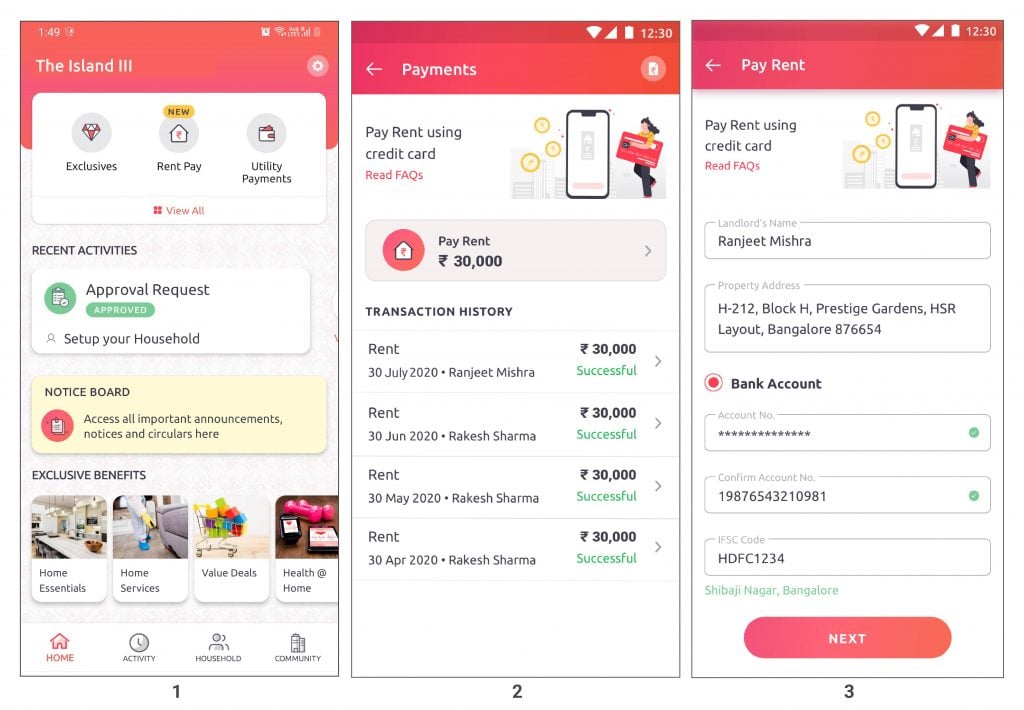
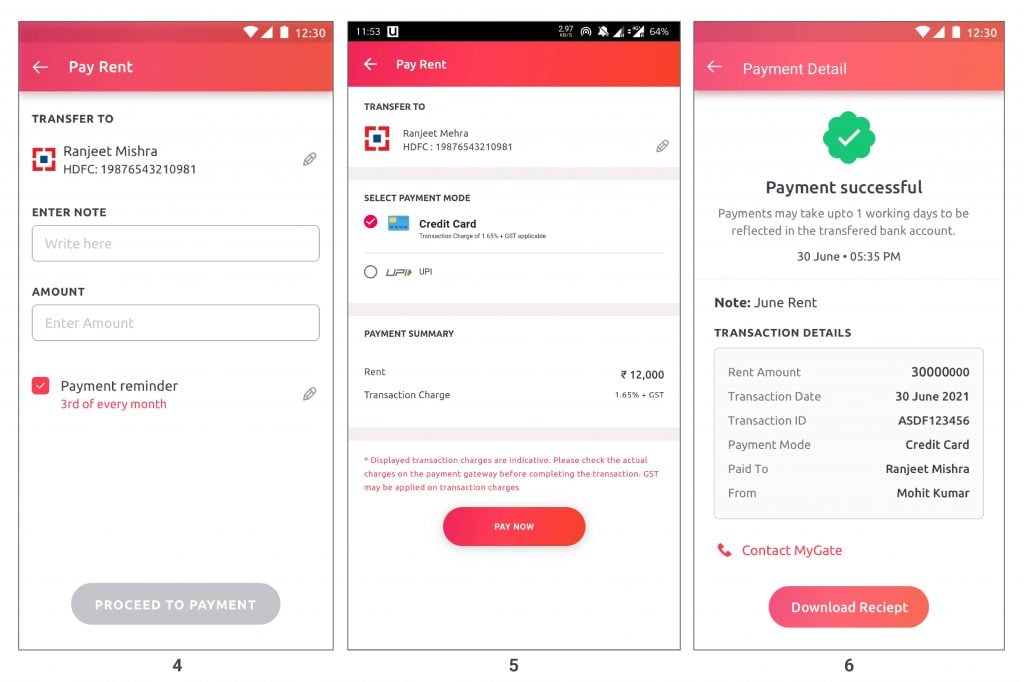
4. Add a note, enter the amount that has to be paid. You can check ‘Payment reminder’ and edit the date. Click on ‘Proceed to Payment’
5. Select the payment mode and click on ‘Pay now’
– For UPI, enter the UPI ID
– For Debit/Credit Card, enter the card details
6. View the payment status and download the receipt
For more details please contact your management committee.
Check the guidelines for RWAs during COVID-19
MyGateWritten by Shailesh Sridhar, Associate Data Scientist at MyGate
Introduction
Here’s a quick exercise.
The two sentences below mean “The coffee smells good”. One of them is in Chinese and the other one is in German.
- Der kaffee riecht gut.
- Kafei wen qilai hen xiang.
Can you guess which one is in which language?
If you guessed that the first sentence is in German and the second is in Chinese then you are right.
If you are like most people, you are not confident about the meaning of even one of the words in those two sentences.
So how did you know?
Language Identification in the real world
Language Identification is the task of identifying the language which a certain text belongs to.
It can act as an important first step in several text processing operations. Especially for operations such as search and text analytics, figuring out the language of text and applying language specific processing is generally a lot more efficient than applying generic processing.
Let us look at the example of a complex of guest houses for an academic institution. Many people enter the complex and visit the guest rooms. A data entry person sits at the gate and is responsible for noting down their purpose of visit. His english is not very good and he tends to make mistakes.
The following are entries made by people in similar situations. Can you guess what the correct spelling of each is?
Entries
1.Oobar
2.POLEMBAR
3.GEZER
4.WHATRPHITR
. . .
Correct Spellings
1.Uber
2.Plumber
3.Geyser
4.Water Filter
Such misspellings make it quite a difficult task to map entries to their corresponding categories.
At MyGate, The data cleanse system is responsible for carrying out this mapping and uses phonetics based algorithms along with normal text based methods in the process. Application of Levenshtein distance technique to identify the most likely candidates to replace the incorrect word and Elastic Search for representative storage are two essential components of the system.
The real problem arises when text from other languages is mixed into the entries.
Here are a few such examples:
—————-
newspaper ka check dena hai
Room bearing 702 dekhna
DELIVERY NAM TO BATATE JAO YAAR
————-
Mapping such entries becomes a nightmare as not only do spelling mistakes have to be dealt with for english words, but for other languages as well. How do you know if a misspelled word belongs to english or Hindi? Adding to the complexity is words such as ‘TO’, which can be a valid word in both Hindi and english.
If there was a way to at least identify, within an entry, which language each word belonged to, things would be a lot easier. This is where language identification comes into the picture.
Word level language identification refers to the task of identifying the language in text, one word at a time. It is a popular research topic, attracting even big names such as Microsoft Research.
Several approaches exist for solving this problem. However one aspect most have in common is that they rely on surrounding context. Given the words around the word in consideration, it is possible to predict which language a word belongs to.
“DELIVERY NAM TO BATATE JAO YAAR”
Here the word TO is flanked on either side by NAM and BATATE, which both belong to the Hindi dictionary and hence highly likely to be a Hindi word.
This approach works very well for texts that are many words long. However, for our use case this is clearly not something that is guaranteed. We can not depend on the context. Find the below plot of the entries made.

Figure 1
Most entries are 1-2 words long and lack useful context. How do you figure out the language of an unseen word without context?
The Feel of a Word
Let us go back to the sentences we encountered at the beginning of the post.
1.Der kaffee riecht gut
2.Kafei wen qilai hen xiang
Why does the second sentence ‘sound’ more chinese? Let us say you only had one word from each sentence.
1.Riecht
2.Xiang
Most people would still identify 2 as chinese and 1 as german. “Xiang” can be broken up like so:
Xi – A – ng
Intuitively, these parts of the word feel chinese. Using the hundreds of chinese words we have heard from places we may not ever have consciously considered (eg. Beijing, Li Xingping, Jackie Chan etc.), our brain subconsciously identifies ‘Xiang’ as a highly probable chinese candidate. The word ‘feels’ chinese.
To some extent we can actually teach this ‘feeling’ to a computer.
NGrams
Let’s take two 5 letter words and split them into pairs of adjacent letters.
xiang -> [xi,ia,an,ng] (list 1)
hello -> [ he,el,ll,lo] (list 2)
If we have a dictionary of all possible 2 letter sequences possible and, the number of times they are seen in all words of a particular language, we will probably see that the sequences seen in list 1 are much more common in chinese than in english.
Each such sequence of adjacent characters is called a bigram.
A sequence of ‘n’ adjacent characters is called a character level ngram. Ngrams play a very important role in Natural Language Processing (NLP). While ‘word level’ ngrams (a sentence is decomposed into sequences of words) are more popular, ‘character level’ ngrams, which we use here, can be very useful in their own right.
Let’s take a look at two more familiar languages, English and Hindi. It is very easy to think of words in Hindi which contain the bigram ‘kh’. Khana. Khargosh. Aankh. Khel.
Now try doing the same for english.
The stark difference becomes clearer when we plot the number of words in each language containing the ‘kh’ bigram.

Figure 2
All languages have their own unique flow and NGram frequencies. Programming a computer to decompose a word into NGrams and analyzing their frequencies to predict the language it belongs to seems like a viable option.
The reason ngrams is such a powerful concept, is that spelling errors will only consist of a few characters. Most of the characters remain unaffected. Hence while a few ngrams may get affected by spelling errors, a majority of them is likely to remain untouched.
Not only that, spelling errors tend to follow patterns themselves and these patterns also may follow a trend based on language. If we have enough examples of spelling errors in a language we can probably identify ngram patterns for that particular language.
Let us see how well an implementation of this idea performs.
An Implementation
Let us limit the problem to, given a word, identify whether it belongs to English or Hindi.
In order to understand the important NGram based features a language possesses, we can either try to hand code certain rules which is an incredibly difficult task, or depend on good old machine learning to identify rules on its own from thousands and thousands of training examples.
So first , we create a large dictionary of English and Hindi words, decompose each word into its corresponding ngrams. We can try out various values of ‘n’ and identify which value seems to produce the best result. We also add every single ngram we encounter into a huge dictionary of ngrams.
Now that we know the ngrams that belong to each word and the language which the word belongs to, we can begin training a classifier to figure out patterns that make a word English or Hindi. Here we use Naive Bayes, a simple yet powerful algorithm which probably deserves a post of its own. The basic idea of Naive Bayes is that based on frequency of occurrence of ngrams in a particular language, we can identify the probability of a word belonging to a language based on each of its ngrams.
By training a Naive Bayes model on a large number of examples, the model learns which ngrams are important to classify a word as Hindi or English. Now when an unseen word, even one with a spelling mistake, is encountered it is decomposed into its ngrams and the probability of the word being Hindi or English is calculated, based on the probabilities corresponding to each of its ngrams.
A model was trained using a dataset of 8000 english words and 8000 Hindi Words, with both 3-grams and 4-grams. The model predicted the probability of a word belonging to Hindi and English. If the calculated probability was less than 0.6 for both Hindi and English, then the words’ label was marked as ‘unknown’.
This allows us to get very informative results.
| English Precision | English Recall | Hindi Precision | Hindi Recall | |
| n=3,TrainData=90%,TestingData=10% | 0.9388 | 0.9136 | 0.9158 | 0.9403 |
| n=3,TrainData=10%,TestingData=90% | 0.9235 | 0.8908 | 0.8946 | 0.9262 |
| n=4TrainData=90%,TestingData=10% | 0.9444 | 0.9205 | 0.9224 | 0.9457 |
| n=4TrainData=10%,TestingData=90% | 0.9156 | 0.8815 | 0.8859 | 0.9186 |
Table 3
The model seems to perform quite well, reinforcing our idea that n-grams can be very useful in language identification of text. The hypothesis that ngrams can capture the feel of a language worked out well.
We can now take a breath of relief, knowing that the person who said the words:
“DELIVERY NAM TO BATATE JAO YAAR”
is one step closer to having his pain understood.
References
[1] Chanda, A., Das, D., & Mazumdar, C. (2016b). Unraveling the English-Bengali Code- Mixing Phenomenon.
In Proceedings of the Second Workshop on Computational Approaches to Code Switching, pp. 80–89, Austin, TX, USA.
[2]Tommi Jauhiainen, Marco Lui, Marcos Zampieri, Timothy Baldwin, and Krister Linden. 2018d. Automatic language identification in texts: A survey. arXiv preprint arXiv:1804.08186.
[3] Char n-gram based model to detect language of sentences out of 6 possible choices
https://github.com/dinkarjuyal/language-identification
[4]Vatanen, T., Väyrynen, J. J., & Virpioja, S. (2010). Language Identification of Short Text Segments with N-gram Models.
In Proceedings of the 7th International Conference onLanguage Resources and Evaluation (LREC 2010), pp. 3423–3430, Valletta, Malta
Each year, several shocking and heartbreaking deaths are caused due to accidental falls from balconies. 5% of accidental deaths in India were caused due to ‘falls’ in 2019. Most recently, the tragic death of a toddler was reported in Thane where the child opened the sliding approach door to the balcony and fell from the balcony of the seventh floor. Balcony safety is not a trivial matter, especially if you have children or young adults in the family.
To prevent any deaths, accidents, or injuries, residents must exercise precautions in
- inspecting the sturdiness of the balcony’s existing railings, and
- establishing safety installations over and above the basic balcony structure.
Balcony construction
Ensure that your balcony is constructed in compliance with the National Building Code which states that, “Parapet walls and handrails provided on the edges of roof terraces, balcony, veranda, etc. shall not be less than 1.0 m and not more than 1.2 m in height from the finished floor level.” It means handrails should be 3.44 feet and not less or else it poses a safety issue.
The code also states that any balcony at a height of 2 meters or more from the ground, should have safety railings. Guidelines state that “Every slab or balcony overlooking any exterior or interior open space which is 2 meters or more above ground level shall be provided with parapet walls or guard rails of height not less than 1.20 meters and such guard rails shall be firmly fixed to the walls and slabs and shall be of blank walls, metal grills or a combination of both.” Usually, full concrete railings are safer but if they are made of metal, the gap between the metal grills shouldn’t be too wide for little children to fit through (not more than 10 cm). There shouldn’t be any horizontal grills or foot-supporting enclosures to step up so that kids (or adults) don’t climb up top of the railings. Guard railing should not be made of glass or any material that is not reinforced. The ledge should be such that it’s impossible to sit on so that no one is tempted to sit on it for leisure or shenanigans. As an extra step, you can install spindles between railings bars to prevent any mishaps.
It’s been found that builders who might want to cut corners don’t adhere to guidelines during construction. Some disregard the building code to make the balconies and facades look more aesthetic and attractive. Such non-compliance could play a big role in causing accidental falls and in many cases, even death. If such is the case in your residential building, do bring it to the managing committee’s attention so that further safety measures can be used. Landlords should inspect the conditions of their balconies before they let tenants move in.
Safety precautions for residents
Even if the construction of the balcony is as per specifications, there’s always the danger of accidental falls and injuries. Follow these balcony rules for apartment buildings, to guarantee safe balconies:
- If you’re living in an older building, make sure you get an expert to check the structural integrity of the balcony and the railings.
- Balcony furniture should be placed away from the railings. It should be heavy so that kids don’t drag it over to the railings to play with or use it to climb up and stick their necks out.
- Balcony doors should have a keyed lock and be placed higher so that toddlers and kids can’t reach up to open it. Never leave kids or pets unsupervised in balconies (whether it’s a high-rise balcony or not).
- Winds are strong in high-rise balconies. Don’t hang loosely fitted decorative items made of glass or other sharp objects in ways that it can harm anyone. Furniture in balconies should ideally be bolted in to protect against rains and storms and so that it can’t be dragged around towards the railings.
Balcony safety installations
You have several options to reinforce your balcony structure to ensure high-rise balcony safety. Here are some of them:
1. Grills
You can choose from regular metal, wrought iron, stainless steel grills, or go for Invisible Grille that won’t block the view while maintaining sturdy security. If the approaching door to balconies is made of sliding windows, you can install lockable grills there as well.
2. Plexiglass
Toughened plexiglass is a great way to cover and shield the area in between and above the railings. It won’t spoil the view and provide additional security. You can have sliding plexiglass windows with locks as well so that air circulation isn’t blocked.
3. Wire mesh
Protection wire and metal mesh are the most commonly used balcony safety solutions in residential societies.
4. Balcony gate
As an additional measure that is aesthetic as well, you can simply install a child-proof balcony gate that adults can attach/detach or keep locked unless adults are around for supervision.
Make a list of dos and don’ts for all members of the family and domestic help with respect to balcony safety. Children should be thoroughly educated on the dangers of playing carelessly around the railings or leaning over them. Ensure that if there are any psychologically disturbed friends, colleagues or family members at risk of suicide, you keep them away from balconies and don’t leave them unsupervised.

Rajanee Balaram has been a resident of TATA Housing Rasina Residency in New Delhi for the past three years, and also the Vice President of its 8-member Management Committee. We spoke to Rajanee to get insight into the everyday challenges as a member of the committee and how MyGate is helping her keep these challenges at bay.
What made Rasina Residency feel the need for a solution like MyGate?
After the committee was formed, within the first few weeks we noticed there were a lot of gaps in how people were let into the society. People walk in and out randomly and it was very difficult to keep a tab on the overall activity. And, of course, the society communications happened in silos. There was a Whatsapp group, and there was a Google group. But again, everyone was not on the Whatsapp group so there was a separate Telegram group as well. Thus, it was all mixed up.
Complaint Management was another pressing challenge. Residents would raise complaints, and we, as a committee, would maintain excel spreadsheets. The information was manually imported as there was no automated workflow. We could barely make sense out of the data to derive any sort of analysis.
Thus, we knew we wanted to introduce a society management app and decided to outline our options after a bit of research. That’s how we shortlisted about 3 to 4 companies and spoke to them over two weekends. After thorough consideration, we opted for MyGate.
What was your residents’ response to MyGate’s installation?
The residents were extremely enthusiastic, quite literally, as we told them we are using MyGate. They immediately downloaded the app. I already started getting messages from people saying that they have downloaded the app, now what? This was before I’d even got the dashboard access.
We also spoke to the residents to inform them why we chose MyGate – because of the simple interface and for the unified solution that it is critical for visitor and society management. We wrapped up very, very quickly and today, nearly 90% of the residents are onboarded.
How did your guards react to this new way of enhancing security in your gated community?
Our guards were quite receptive of the idea and picked up really well. We never felt any reluctance from their end. Initially, there were a couple of areas where they were doing the wrong thing or they were not realising the importance of doing something right. However, they kept learning every day and we have now managed to eliminate all of the initial hiccups. Right now, I think we are quite tight in terms of managing visitor entries.
One of the other things that is really good about MyGate is, the message to the guard. I keep telling residents that if you have any issues, for example, cab entries, just text back to the guard. That way, we can just download the report. It saves a lot of time and effort.
Could you highlight a few features that have helped you simplify your daily responsibilities?
Actually a bunch of them. To begin with, I think the management of daily help who come in and go out has become so much better. We know that everybody who is coming in is registered and verified.
In terms of complaint management, it’s very simple to raise a complaint as it sits in the correct category. We are not required to choose a category for each complaint.
And I think in terms of notifications, it is a breeze. Communicating with the residents has become so easy. There was this time when our lift got stuck and the technician had been called. The maintenance went on for four hours, so a message went out to all the residents and there was not one complaint on the residents’ group because they were all informed.
MyGate