

Maintaining a car in an apartment complex can be relatively more difficult than an independent home with a garage simply because there are many people handling common spaces like parking spaces, which can lead to negligence and scratches. As a rule of thumb, always keep your car covered to avoid accidental damages. However, you’d have to do more than that. Make sure you protect your car from any unforeseen events while taking care of its routine maintenance. Here’s how:
1. Beware the pitfalls of open parking
Parking spaces are often limited in urban societies. Not every apartment parking lot is covered and it’s common for residents to park their cars in the open premises of the society. This can pose some dangers like scratches, dents, and swirls on the exterior over and above intense weather conditions. Residents can implement a system of rotational parking so that there remains no monopoly in case of covered parking shortage. MC can also circulate a list of dos and don’ts around cars (e.g. not letting children play near parked cars, no random parking of two-wheelers next to cars, etc.)
To tackle the problem of parking spaces in open space, societies can grow trees around the designated open spots to provide natural shade to cars. Buy weatherproof car covers and make it a habit to use them daily.
2. Steer clear of theft/vandalism
Motor vehicle vandalism and theft are the least solved crime in the country, especially if the car is parked inside safe gated premises. It’s entirely possible that if you leave your car unlocked, valuable belongings inside can go missing or the vehicle itself can be vulnerable to occasional hooliganism. Always park under a light and have extra CCTV cameras installed in the parking spaces whether on the ground floor, basement, or open parking. Buy removable car stereo systems and don’t leave items of value in the car. Another measure is to install boom barriers and invest in app-based gatekeeping and security technology like MyGate to automate vehicle and visitor movement.
3. Prevention from rodents, birds, and pests
The maintenance staff and security guards should be trained to keep the parking space, clean, disinfected, and decluttered daily. Instruct them to use rat/pest repellents at the earliest sign of rodent and pest activity. Cover any structural areas that could become bird nests with wire mesh or other materials as well as repair and seal any cracks in the parking space walls and ceilings to prevent termite or ant colonies. To deal with bird poop, always keep specially made exterior detailer spray and clean as soon as spotted since bird droppings can damage the polish of your car. Keep your car clean of wrappers, food leftovers and get it fumigated regularly. Trash containers should be kept at a distance from parked cars.
4. Daily wash facts
It’s a common practice in gated societies to get their vehicles washed and cleaned every morning for which car cleaners are hired. Due to the abrasive nature of the low-quality cleaning sprays and soap water they use, the exterior surface of your car might suffer from slow deterioration especially if the cleaners contain hydrofluoric acid. Some societies might practice greywater reuse which might not be properly filtered at times, in which case make sure you insist on treating it properly.
Buy microfiber cloth for daily cleaning and instruct the guard to make sure that the cleaner doesn’t use any dirty rags to clean your car even as a second layer of cleaning. The suspended dirt from regular cloth can leave swirls on the car. A waterless wash is a good option. Microfiber cloth (or car dusters) can dry easily, are odor-free, and especially effective when used with a good quality car wax, general-use car soap, or spray. Cloth can be washed and rinsed in regular soap water. Car owners usually get a good car wash once a month and get it serviced every 12 months. But it’s wise to do routine inspections like checking fluid levels, tyre pressure, etc. In case of cold starts (when the car won’t start) in the winter, you can invest in an engine heater that connects to your radiator.
Car detailing which is cosmetic car care should be performed once every year or two years depending on the condition. It should include basic wash and wax, interior cleaning, and surface polishing, buffing, and deodorising the car.
5. Safeguarding against climatic conditions
Come monsoon, society storm drains may flood over, basement flooding can create havoc on your vehicles. Underground parking should be equipped with sump pumps and rainproofing to keep out excess water. Clean out the storm drains of snags and trash before the rains hit. If the water logging is a permanent problem due to heavy monsoons in your area, invest in a mini car lift so that even in stilt or open parking, the lower parts of your car can remain undamaged by floods. In open parking, you can use a detachable car tent or car canopy to protect your car from rain and sun.
A little foresight and vigilance can help keep your car running in the best of condition even amidst a bustling gated complex.

Our cities haven’t been safe havens if numbers are to be believed, aside from numerous horror stories that surface about assaults against women.
According to a UN survey, 95% of women in Delhi feel unsafe in public spaces.
There is an average of 87 cases of rape daily and in 2019, crime against women increased by 7%.
Bangalore is not unfamiliar with its own maladies of attacks on women, from the horrifying mass molestation case to the caught-on-camera-attack on a woman walking alone on a narrow lane.
Safety of women is a problem that can be especially tricky to solve when women are employed in night shifts or may have to work late or perhaps even travel often to the airport owing to work flights. The infamous case of Pratibha Srikanth Murthy, a 28-year-old BPO employee assaulted and killed by the perpetrator who posed as a driver is a gruesome reminder of how unsafe conditions can be for women working late nights.
With respect to women working during the night, the Karnataka state government issued an amendment on October 19, 2020, to The Karnataka Shops And Commercial Establishments Act, 1961. The law came into being to remove the prohibition on women from gaining employment at night as it hampered their economic opportunities.
Highlights of the amendments made in Karnataka Shops And Commercial Establishments 2020
- Women working in night shifts (between 7 pm and 6 am)should write a letter of consent stating they’re willing to work at night.
- Companies should provide adequate security and transportation to such women free of cost with GPS tracking and monitoring of vehicles with a travel monitoring desk/station.
- Not less than ⅓ of the supervisor shift in charge or other supervisory staff shall be women during night shift.
- Appropriate medical facilities, rest rooms, canteen and necessary hygiene should be provided.
- Drivers employed by the companies are required to be screened prior to appointment with full bio data.
- The routes should be picked in a way that no woman employee should be picked up first or dropped last.
- The company should perform random checks on the vehicles on route.
- Such companies, factories and establishments should also have CCTVs with proper lighting in and around the establishment.
The law makes it mandatory for companies/factories and any other establishments to ensure protection and penalties against sexual harassment, lack of proper facilities and hygiene.
The law also states that there should be a consecutive 12 hour rest between two shifts so that there’s enough rest. Even though this order came into being mainly for women employed in factories, it now uniformly applies to IT/ITES and all other sectors. The law also suggests for companies to create their own mobile applications to ensure that the women employees can contact someone for help when in distress.
How should societies ensure safety for women residents who may work late nights or in night shifts?
- Any society has a number of single women, students, young working women living alone or with families, over and above the women tenants. The number of women who work night shifts per society may not always be excessively high but it’s paramount to ensure their safety by following strict protocols.
- When it comes to being compliant with the law and to ensure women’s safety, a residential society can take the following measures:
- Women working in night shifts should carry a rape whistle, pepper spray or a personal safety app available on the internet. Even if you don’t take the company transport and commute in your own vehicle, it’s a logical first step to ensure you have some help in case of any unwanted advances.
- The security guards should have a list of women residents who work night shifts and a list of designated drivers with their phone numbers and addresses. They should also be given a flashlight, whistle, baton, pepper spray and an emergency first aid box.
- If the vehicle cannot drop a woman resident all the way to the gate, the guard (or driver) should accompany her till she has safely entered the premises.
- Keep security around entry and exit gates extra tight with flood lights and have motion detection CCTV cameras and lights installed in the main gates at least. This can alert the guards to any unauthorised entry or tailgating in the context of women residents entering or leaving the premises at late hours of the night.
- Instruct the guards to be on the lookout for any suspicious or unsavory behaviour from any regular or new drivers and to intervene when necessary.
- The security guards should be made to keep their mobiles charged at all times, in case if any women residents need emergency help. Woman can also use MyGate, a security and community management app that ensures instant help at the time of emergency. This feature allows create a single directory of all emergency contacts
- If women residents are returning home late at night from the office and travelling in a rental cab and not the company car, they can call the guard in advance and let him know the estimated time to arrive. The guard should be made to understand that he should follow up with a call if the resident hasn’t arrived at around the expected time.
- Security patrol should be done outside the premises especially before and around the time of return of women working late at night so that anyone lurking around can be questioned or apprehended.
- An intelligent society management app can be the perfect solution to women’s (and general) safety since it uses a secure passcode-based verification procedure for automated gatekeeping.
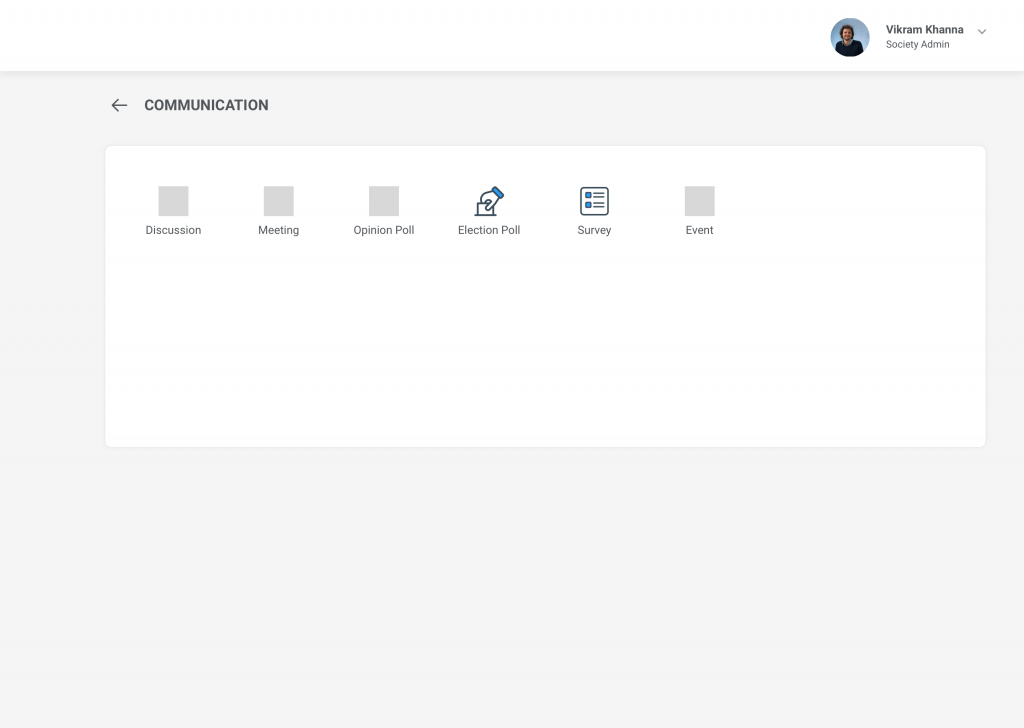
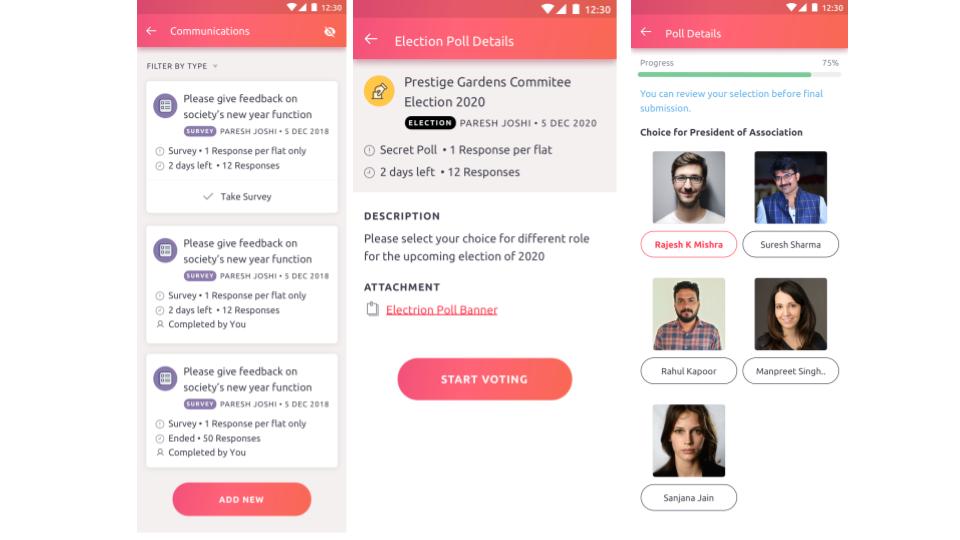
- Log in to dashboard.mygate.com
- Go to Communication and select Survey
- Click on Create
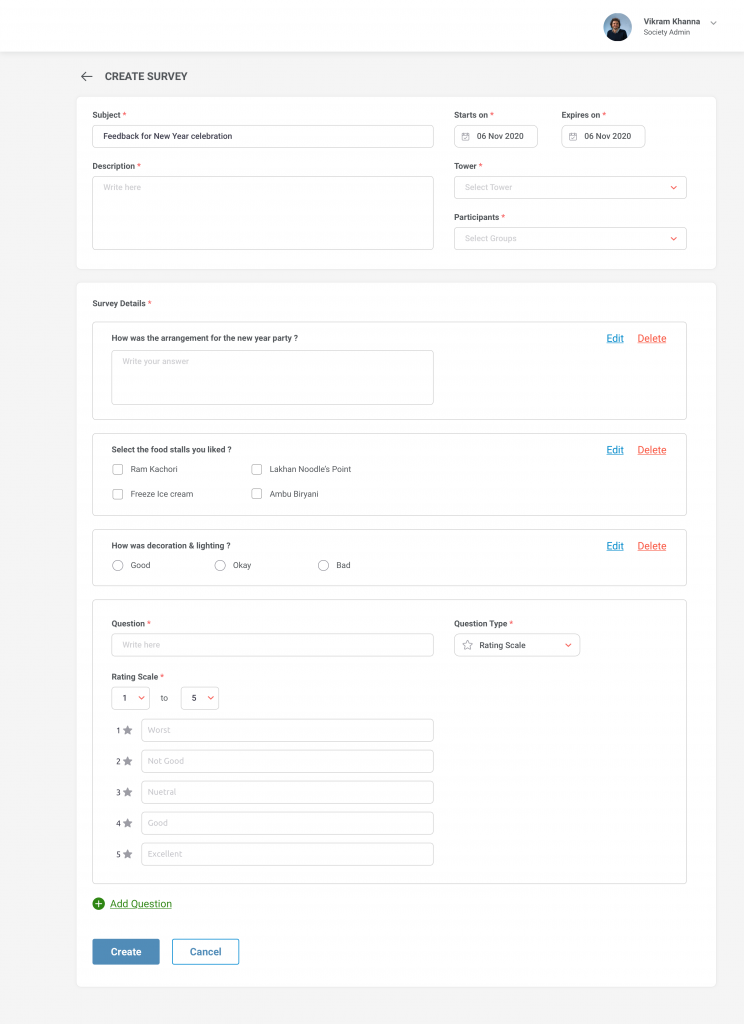
- Admin will set the Subject, Description, Questions Participants, One Response per flat, Survey start, and Expiry date.
- Admin can set up to 10 questions of different types such as Short Answer, Rating Scale, Single choice, and Multiple choice.
- Admin can start the Survey instantly or schedule the survey for selected “Start Time”
- The resident can give the response only once
- The resident will is not able to make changes once the response is submitted
- The result will not be published to residents
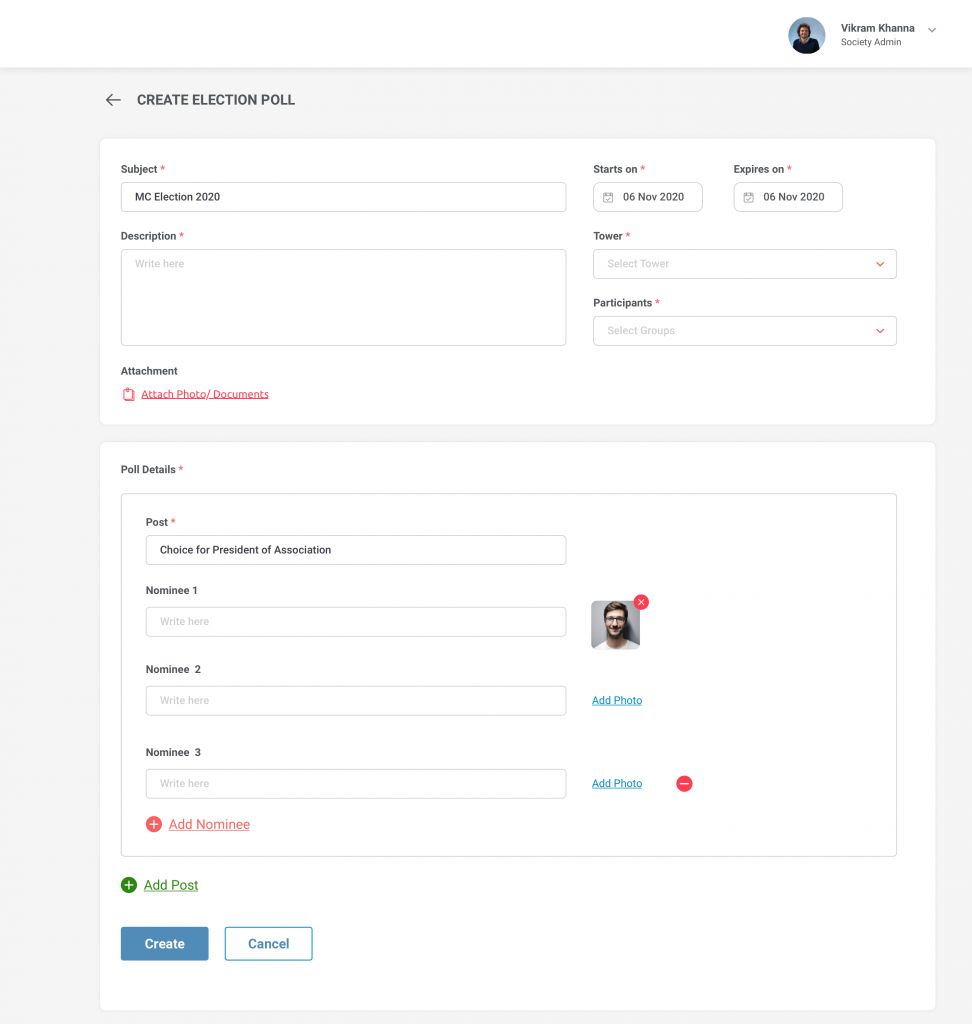
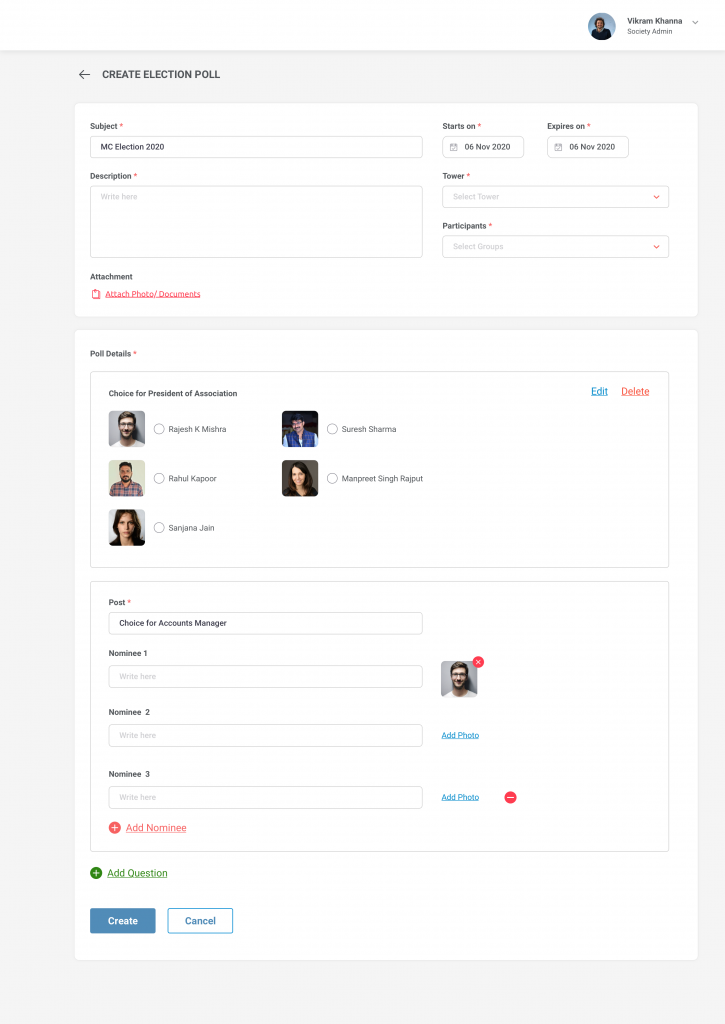
- The resident can vote for one nominee in a post
- The resident will not be able to make changes once the poll is submitted
- The result will not be published to residents
- While voting, the Progress Bar will change based on the number of questions voted
With the exponential surge in COVID-19 cases across the city, there is a serious shortage of live-saving plasma. If you’ve fully recovered from COVID-19, then, with just one plasma donation, you can save two or more lives.
MyGate has partnered with Covid India Campaign, which is connecting potential plasma donors in Bangalore with Covid patients in need. If you’re interested in donating, please sign up by filling the form below.
Do note the following:
- You can donate plasma 28-30 days after recovering from COVID-19
- You cannot donate plasma for 28 days after COVID-19 vaccination
- Women who have ever been pregnant cannot donate COVID-19 plasma
You can learn more about plasma therapy via these FAQs. Please call the COVID India Campaign helpline number +91 804 804 00 00 for more information.
COVID
Indian real estate market has not entirely tapped into the concept of open house hosting but it does have a bright future. An open house is a scheduled time in which a house or any real estate property is showcased to potential buyers. In the context of Indian real estate, the open house concept is not exactly as prevalent as in the west, but takes on a more practical form, as in virtual listings and pre-booked physical viewings.
Open house features
- You almost always never meet the owner since the open house is hosted by the real estate agent. (It’s not a rule).
- You’ll get all the necessary information about the house and the neighborhood while exchanging your own information.
- You may get to meet other potential house hunters and get a chance to get real estate information and other interesting leads.
- In most cases, photographs of the property or a virtual tour are already available online. Some luxury listings may be shown in only open house settings. It depends on the type of property (e.g. high-end and luxury properties) and the will of the seller.
Advantages of an open house
- Reliable marketing tool – Hosting an open house is one of the best ways to create buzz and publicity around your house. If it is organized professionally, it can bring forth multiple offers and even start a bidding war. Organizers of open houses use a variety of promotional strategies to market the property, such as social media posts/ads, digital marketing, offline networking circles, real estate portals, and other modes of advertisement. Eventually, this creates a steady stream of leads and an influx of walk-ins that you would not otherwise get with regular property listings. Open houses give you an edge and exposure in a competitive market as they shine a spotlight on your property.
- Free for all – Anyone can visit an open house and inspect every corner of the property to their satisfaction and get a prolonged visit. Visitors can assess the amenities and fixtures, take photographs and get all their questions answered by the estate agent in charge. There’s a slight pressure to wrap up the visit at a personal visit but not in an open house.
- Staging of an open house – Some staging ideas can help make your property on sale look even more attractive and welcoming. The pre-staging may include a virtual tour to interested buyers. Some staging tips used by open house organizers are
- Well maintained lawns and gardens
- Bright flowers, freshly painted walls
- Fresh linen, aromatic scents
- Finger snacks, refreshments, and beverages
In addition to that, a home with the latest appliances, security systems, and upgraded furniture is a plus point for an open house. On a side note, if a society has futuristic amenities like MyGate, intelligent end-to-end security, communication, and financial management app for gated societies, that makes a great selling point.
Disadvantages of hosting an open house
It involves some amount of financial investment depending on varying budgets. Open houses are not supposed to be empty, so you’d have to furnish your property and make it appealing to the lifestyle of the types of buyers you’re attracting. If you’re hiring a real estate agent to handle the sale, it means their commission has to be considered.
- Relocation woes
Many, if not most owners live in the house they want to currently sell. The traditional way is to set up a viewing based on leads and phone calls received from interested viewers while the owners (and family) are usually present at home. This is not the case with an open house.
There are two ways to handle the occupancy of the property if you want an open house.
- You’d have to vacate the property on designated days of the open house if you’re already living in the home.
- You’d have to move to another property and let the house be unoccupied until it’s sold (if that’s an option you have).
This may be challenging for homeowners who don’t want to be inconvenienced by temporary or permanent relocation.
- Lookers-on – There is always the possibility of casual home hunters or just curious browsers who may not actually be interested in a serious deal. Although the idea is that everyone is welcome in an open house, you’d have to be prepared to answer a lot of questions even though you know that the visitor will not buy the house.
- Security – Another issue is that of security. There may be trouble makers, vandals, or robbers who could be on the prowl. It’s ideal to have a guard/bouncer or at least not have unsupervised valuable items on display that can be stolen.
- Lack of personal attention – Sometimes serious buyers may not get the necessary amount of time and attention from the host if the footfall is too high. Some may wait it out, but others could just leave without having a chance to speak to the realtor if the viewing is too crowded and busy with other competing offers. It’s only natural that buyers prefer a personalized and instant approach that’s available during a private viewing.
Whether to host an open house or not depends on how much traction you want to build on generating interest in your property and if it’s feasible financially in terms of promotional expenses.
Freshwater is a rare commodity in the world. Out of 70% of all the world’s water, only about 2.5% is freshwater. The rest has to be treated by scientific technology. But not every household in India has access to fully treated or purified water available directly off the tap. What flows through our faucets is hard water with varying levels of chemical content.
What is hard water? How to identify it?
Hard water is water that contains salts, high mineral content, calcium, magnesium, bicarbonates, sulfates, and other impurities. It has the following indicators that you may find commonly:
- Dry scum on utensils/glassware even after washing them
- Scaling on pipes, plumbing fixtures, the surface of the toilet, and faucets
- Dry and itchy skin
- Blurry spots on appliances and objects cleaned with hard water
Such water is not fit for consumption by humans without proper treatment as the residue can cause health problems like kidney problems, cardiovascular or neural diseases. Indian domestic water supply is notoriously famous for its hardness, it corrodes pipes, water heaters and needs extra detergents/cleaners to get things cleaned.
Due to the shortage of treated water in India, many housing societies have to hire services of water tankers that provide water directly from the borewell, the quality of which is questionable. The soap doesn’t lather well, and hair becomes brittle and dry. What should the residents do to resolve this problem?
How to soften hard water
1. Industrial RO installation
One of the ways to ensure that all of the water that gets supplied remains harmless is to get a Reverse Osmosis water treatment plant which can drastically bring down the hardness of potable water. The term used to describe it scientifically is TDS (Total Dissolved Solids) which is the total amount of inorganic matter and minerals in the water. Studies suggest that the acceptable amounts of TDS in drinking water should be between 50-300 and anything above 500 is not fit for drinking. RO units have been known to reduce the number of TDS by 80% to 90% if the brand is BIS approved and reliable.
Housing societies can consider investing in one depending upon their society size and requirements. They can cost anywhere between Rs 20,000 to Rs 1.5 lakh.
2. Home remedies for hard water problem
Another safeguarding measure against hard water is to apply some tried and tested home remedies, although it may be stated that these are short-term solutions and need to be used again and again. You can boil hard water at home before drinking. When it comes to cleaning faucets, utensils, and appliances to ensure no spots remain, you could use some hot water mixed with all-natural/distilled white vinegar. Yet another hack is to use washing soda while doing your laundry. Some people also like to invest in a domestic water softener, which is used for softening bathing and cleaning water. It could cost anywhere between Rs 1500 to Rs 10,000. An individual whole-house water filtration system could cost up to Rs 20,000.
3. Water purifier
A healthy household must invest in a good water purifier for drinking water despite using any of the above measures.
Here’s what to look for when choosing a reliable water purifier
The three commonly used filtration technologies are RO, Ultraviolet filtration (UV), and Ultrafiltration. The first step to check the TDS levels of your housing society water supply in order to decide which one is the best for you. This can be done by buying a TDS meter online (Rs 150-Rs 4000).
After finding out the TDS levels, shortlist the water purifiers on the basis of the range of TDS mentioned on the specifications of the water purifier brand. If the brand doesn’t provide the type of purification technology and TDS recommendations, do not buy it, no matter how economical.
If the TDS level found in your water is above 500 ppm, you can choose an RO water purifier.
If it is below 200 ppm, you could go for a UV or a UF filter. To be doubly sure (or if the TDS levels are above 1000 ppm), you could also get a water purifier system that combines both technologies.
Keep in mind that RO systems consume a lot of electricity and pose a challenge of wasted water. It’s ideal if you explore systems that offer a water storage tank for sifted water that can be later used for cleaning purposes.
Last but not least, you could also consider a gravity-based water purifier that cleans drinking water equally well without needing electricity and is quite affordable but may not last as long as RO/UV systems and require more maintenance. As a rule of thumb, visit the brand’s website and check online reviews as well.