

Activation of E-Invoicing marks the movement of society towards a serious billing flow. Since the invoices are declared to the GST authorities in real time, it becomes crucial to curate all the details before actual billing. To help our customers, we publish error messages and block the invoicing process in case of insufficient data.
Here are messages you might see while generating e-invoices. And the reason why you’re seeing them.
1. Mandatory HSN Submission
The following two conditions – Template Creation & Penalty Setting – are validated along with the mandatory buyer and seller details before allowing you to go forward with the billing process. HSN submission is mandatory for both of them.
2. Count of B2B Houses
The count of B2B houses configured with the amount within the template is displayed during the generation process to remind the user about the E-Invoices being generated.

3. E-Invoice Label
The E-Invoice label appears alongside the batch ID number in case the batch contains a house that is GST registered. The E-Invoice Alert label appears alongside the batch ID number in case the batch has not been completed or failed with an IRN generation.

4. Aggregate Counts
The aggregate count of the B2B houses and IRN numbers generated is displayed on the details page of the batch ID.

5. B2B Labels
The GST-registered houses are denoted with a B2B label alongside their names.

6. IRN Entries Tracker
With an IRN entries tracker, you can easily track and monitor the status and movement of e-invoices vis-a-vis IRN numbers. This enables better visibility into the invoice lifecycle, including invoice generation, submission, acceptance, and retrials in case of failure. It helps you stay organized and maintain control over your invoicing processes by offering various filters of flat, status, request & document types, etc.
In the latest development of the government’s initiative to shift to an e-invoicing model, the Finance Ministry has issued a notification dated May 10, 2023, stating that any GST-registered entity having turnover of more than Rs. 5 Crore in any financial year from 2017-18 will be required to comply with the e-invoice provisions with effect from 01st August 2023 i.e., they will be required to generate IRN/e-invoice against all B2B transactions.
How to activate the E-invoice system?
Given the fact that B2B invoices should preferably be declared to the GST authorities on a real-time basis, you must ensure that all details surrounding the parties and invoice items are correctly updated on the dashboard. Here MyGate dashboard is functioning as the Application Services Provider (ASP) to build a direct link between your society and the GST Suvidha Portal.
Step 1: API User Registration
For the MyGate dashboard to be used for e-Invoicing, you must register the society onto your GST portal as an API user. Once registered you’ll be provided with an API ID and password against your GSTIN that should be shared with MyGate to allow linkage with the GST portal.
Download the booklet to read more on how to register as an API user
Step 2: Feed in your details
As a society admin, it is mandatory for you to submit the following details under the Maintenance & Account Settings section:
- Society GSTIN
- Society Registered Name
- Society Address
- Society Pincode
- Society Location (city associated with the mentioned pincode)

Step 3: Ask Buyers to feed in the required information
The following details are mandatory for all the GST-registered houses and other debtors to submit under the Billing Details section:
- Debtor GSTIN
- Debtor Registered Owner Name
- Debtor Billing Address
- Debtor Pincode
- Debtor Location (city associated with the above pincode)
- Debtor Place of Supply for Goods or Services (to decide between CGST/IGST billing)

To ensure data sanctity for all B2B buyers, the following alert message will be displayed in case of any information discrepancy.

Step 4: Submit the Invoicing and Penalty Details
While the rates and quantities for the invoice items along with their GST rates and values are handled by the invoicing system directly – it is mandatory for you to provide the HSN/SAC codes. The latter should also be updated to the individual penalty settings associated with the billing templates.
Step 5: Activation of the E-Invoice system
The API User Id and password are essential for the activation of the E-invoice system. Entering these credentials into MyGate’s invoicing system is deemed as explicit consent to the ERP software to be able to raise E-Invoices for the seller.
We perform a test authentication call to the GST portal to verify the credentials before turning on the switch for E-Invoicing. Society must either be on a provisional penalty system or a subsequent invoice penalty system.
How to generate E-Invoices?
MyGate offers various entry points to generate member/non-member invoices to cater to the different use cases –
- If the society wants to generate invoices for multiple houses/non-members at once then the Group Invoice feature can be availed.
- If the society wants to generate an invoice for a particular house/non-member then the “Add Charge” feature is preferred. (Do not use this if the society works on bill plans or if there are multiple items on the concerned invoice)
- Societies levying provisional penalties onto their defaulting houses/non-members would find the ‘provision to tax conversion’ happening either automatically or through a tool on the dues summary page on the dashboard.
Group Invoice
Most of the billing occurs through the group invoicing section. Post configuration of a template, it can be used as a draft any number of times. The society can even enable automated periodic generation settings on a template to enable monthly/quarterly invoicing without any manual interference.
As billing flow has not changed in any way, society just has to be wary of adding any incorrect supporting information for the B2B houses involved in the generation process. For example, the non-GST items in the template have to have their proper HSN/SAC codes, given that each value is properly validated by the GST portal.
If there is incorrect information for a B2B house, the IRN and QR generation for that specific bill would fail. That one bill should be canceled and a fresh invoice must be generated for the house after data correction.

Add Charge
This is a quick invoicing tool presented on the dues page of all the houses/debtors. Due to its restricted nature, it is able to generate a single-item invoice whenever necessary.
Again, the usual billing flow has not changed in any way. Data-related cautiousness needs to be maintained.
Provisional Penalty Conversion
Receipt-based automatic conversion: The provisional penalty system in MyGate does not book income and attract GST liability until the penalty value is paid by the debtor. Upon payment, the penalty tax invoice is generated automatically alongside the receipt, and an IRN call is triggered by the software.
Bulk manual conversion: If a society deliberately wants to show the impact of the penalty on income, this is ideally done once a month or at the end of the financial year to keep simpler records. A conversion tool to address the same is offered on the dues summary page. This single-click operation can convert provisional entries of penalty into tax entries in bulk.

Validations to be kept in mind before generating any E-Invoice
- Ensure all B2B houses have their GST numbers configured along with address, pin code, location, POS, and registered owner names.
- GST number cannot be a dummy or incorrect value
- Pincode should belong to the same state as the GST number
- The location should be in plain text and match the pin code provided
- POS should exactly match the state code for service/goods supply
- The address cannot be more than 100 characters in length
- Ensure the seller has their GST number configured along with address, Pincode, location, and registered owner names. The other details mentioned in pt 1 apply here as well.
- If the seller and the buyer belong to the same state, an IGST invoice CANNOT be pushed and vice versa.
- HSN CANNOT be missing within any invoice item (whether the item attracts GST or not) or the penalty settings
- While dealing with the IGST houses or non-members, the society would need to create a separate template from the GST and non-GST registered parties.

Cancellation of E-Invoices
The GST authority mandates that the cancellation of a B2B E-Invoice/credit note must happen within 24 hours of its generation. Hence, we fetch the exact IRN generation time from the Suvidha Portal and allow cancellation until 23 hours 58 minutes to accommodate for safety.
Secondly, the ‘Delete’ button that appears on the latest batch generated also becomes non-functional in case the concerned batch contains an E-Invoice. This fail-safe ensures that no declared documents are accidentally hard-deleted and lost.
All invoices generated through group invoicing (whether manual or automated) sit under the group-generated charges in the invoice history. A ‘Cancel’ button is provided with each invoice batch that can be used to trigger the cancellation of the IRNs generated within that particular batch.

All invoices generated through add charge within the house/non-member dues page sit under the other charges in the invoice history. A ‘Cancel’ button is associated with each invoice that can be used to trigger the cancellation of the IRNs generated within the batch.

Reversal of E-Invoices using Credit Notes
When a transaction needs to be reversed, such as due to order cancellations, returns, or adjustments, you can reverse the original e-invoice using a credit note. The credit notes are required to be linked to the original e-invoice through its unique Invoice Reference Number(IRN). MyGate dashboard ensures this efficient linkage for the reversal to be properly connected to the original transaction for reconciliation purposes.

IRN Entries Tracker
With an IRN entries tracker, you can easily track and monitor the status and movement of e-invoices vis-a-vis IRN numbers. This enables better visibility into the invoice lifecycle, including invoice generation, submission, acceptance, and retrials in case of failure. It helps you stay organized and maintain control over your invoicing processes by offering various filters of flat, status, request & document types, etc.

Deactivation of the E-Invoicing System
You can reach out to the MyGate team for the deactivation of the E-Invoicing system. To ensure clarity around the previous IRN generations –
- The batch IDs will continue to carry the E-Invoice and generation pending labels.
- The aggregate counts of B2B houses and IRN generations would still be presented in the batch detail on the page.
- The invoices for the GST-registered houses would continue to display the IRN and QR codes.
The B2B label on the GST-registered house’s dues page will be disabled along with the various validations we do for any type of invoice generation.
The Indian government has been shifting to the e-invoicing model to prevent tax evasion and improve the transparency of the taxation system. In the latest implementation of the same policy, The Finance Ministry has issued a notification dated May 10, 2023, stating that all GST-registered entities with a turnover of ₹5 crore or more will be required to adopt e-invoicing for all B2B transactions from August 1, whereas the current threshold stands at ₹10 crores. Societies that fail to comply with the regulations after August 1, 2023, will be penalized with 100% of the tax due or 10,000 Indian rupee, whichever is higher.
Does your society qualify for E-invoicing?
Any society registered under the GST regime and having turnover of more than Rs. 5 Crore in any financial year from 2017-18 will be required to comply with the e-invoice provisions with effect from 01st August 2023 i.e., they will be required to generate IRN/e-invoice against followings: –
- Each tax invoice, debit note & credit note is issued to the registered person.
- Export Transactions
Kindly note that for any society, all maintenance services are offered by the seller which in your case could either be an RWA, a builder, or an FM company with the possibility of their annual turnover being 5 Crores.
What is B2B E-invoicing?
E-invoicing is a system of electronically capturing and validating the invoice details between the seller and the buyer. The objective of E-invoicing is to streamline the invoicing process, reduce errors, enhance transparency, and facilitate the seamless flow of information among societies and tax authorities. It helps prevent tax evasion, as the invoice data is directly reported to the GST portal, enabling real-time monitoring and validation.
It aims to improve the efficiency and transparency of the tax administration as well as reduce errors and fraud. Hence, a B2B Invoice, in your context, is a document for proof of sales that a GST-registered society shares with a GST-registered house/debtor in exchange for the services or products provided.
How does invoice reporting work?
As with many other countries adopting the system, adherence to the laws and correctly formatting the invoice is essential. Understanding how the electronic invoicing system works is the first step to avoiding common mistakes during the e-invoicing process.
Invoice Generation: The seller generates the invoice using any accounting or billing software that is integrated with the GST portal. The invoice is assigned a unique Invoice Reference Number (IRN) and a QR code.
Validation and Authentication: The generated invoice details are sent to the Invoice Registration Portal (IRP) for validation. The IRP validates the invoice and provides a digitally signed QR code, also known as the Quick Response (QR) code.
Invoice Sharing: The seller shares the e-invoice with the buyer, either by providing a copy or by uploading it to the buyer’s accounting system.
Reporting to the GST Portal: The details of the e-invoice are reported to the GST portal, which enables the automatic generation of the buyer’s tax return and allows reconciliation of the input tax credit.
How is E-invoicing distinct from normal invoices?
So far societies have been generating invoices or credit notes for all houses and declaring their income to GST authorities the next month with the R1 fling. The same process has to continue for the GST-unregistered houses.
However, for the GST-registered ones, the income declaration must happen along with or preferably within two days of the invoice generation. In response to this, the GST authorities will provide a Unique Invoice Reference Number (IRN) for each bill or a credit note against a bill. The IRN along with its associated QR code MUST be printed on the invoice/credit note PDF for it to be qualified as an e-Invoice document.
Benefits of having an E-invoicing system
Generating an e-invoice is usually the responsibility of a taxpayer who reports to the IRP in GST. Next, the IRP will generate a unique IRN and an OR code (optional). The taxpayer will be able to scan this GR code, extract the IRN, and fetch invoice deals.
Here are some benefits of e-invoicing for societies:
- E-invoicing helps you with data reconciliation and accuracy
- during manual data entry.
- It allows interoperability across societies.
- Real-Time E-invoice Tracking
- The e-invoice details will be auto-populated on tax return forms
- and e-way bills, making the tax return process easy.
- All transaction details will be available online at all times. This.
- would eliminate the need for frequent audits and surveys.
- Differences in data can be caught by comparing input credit and
- output tax.
- This initiative will also build efficiency within the tax administration by
- helping to identify fake invoices.
How will e-invoice help in controlling tax fraud?
The e-invoicing system will curb tax fraud in the following ways:
- With the implementation of e-invoicing, tax authorities will have access to all their transactions as they have to be uploaded on the GST portal.
- Manipulating invoices will not be easy as they will have to be generated before the transaction takes place. The system will allow you to spot fake invoices easily by matching the input tax credit with the output tax details on the GSTN portal.
At Mygate we are committed to ensuring that your safety is never compromised. That’s why we want you to know that your visitor management system never goes to sleep even in the face of network disruptions guaranteeing uninterrupted security.
What is Always On Mode?
The Always On Mode ensures that key security features, such as access control and visitor management, continue to operate seamlessly during network disruptions. Our system is designed to detect the availability of network and system failures & automatically move the operations to the offline mode. This allows for recording of the visitor data on the guard device itself i.e. residents, staff, guests & non-invitees can enter and exit your premises smoothly as usual.
Benefits of Always On Mode
- Uninterrupted Security: Visitors will experience a consistent and secure check-in process, irrespective of any temporary disruptions in network connectivity.
- Data Integrity: All data collected during offline mode on the guard app is securely stored and synchronized once the network connectivity stabilizes. This guarantees that your records are accurate and available on both the admin dashboard and the resident app.
- Always Prepared: With the impressive 6 hours of offline operation capacity, we ensure that your community remains safe and connected even during extended periods of network downtime.
- Reliable Documentation: Records both passcode & non-invite entries without any lapses & eliminates the need for guards to return to manual record-keeping during outage hours.
- Seamless Security experience: No matter the circumstances, your society’s security operations will remain active and vigilant.
Stay connected, stay secure, and enjoy the peace of mind that comes with Mygate’s Always On Mode. Should you have any questions or require assistance, our dedicated support team is always ready to help.
Efficiently managing amenities within a residential society is no small feat but with the help of Mygate’s comprehensive suite of unique features, society admins can effortlessly streamline the management of amenities and thereby optimize resident experiences. From restrictions on booking frequency to enforcing penalties on misuse, Mygate equips admins with all the tools they need to create a harmonious and seamless amenities management system.
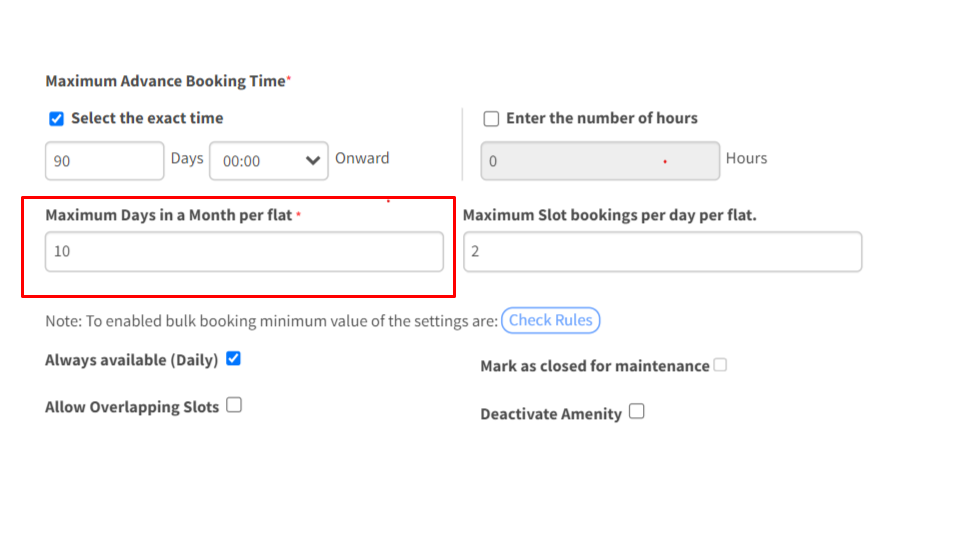
Maximum days in a month per flat
Limit monthly amenity bookings per house
Did you know that Mygate allows you to set a cap on the number of days a house can book an amenity within a month? This helps distribute access equitably, ensuring a level playing field for all your residents.
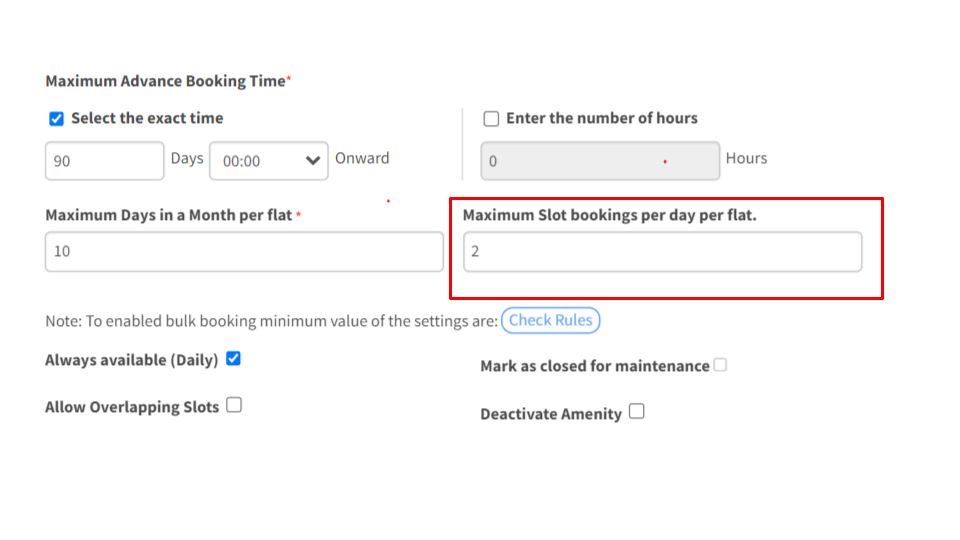
Maximum slot bookings per day per flat
Enforce daily slot limits per house
You can also set limits on the number of slots a house can book for a particular amenity per day preventing a single household from hogging the slots & ensuring a fair chance for all to access without any undue advantage.
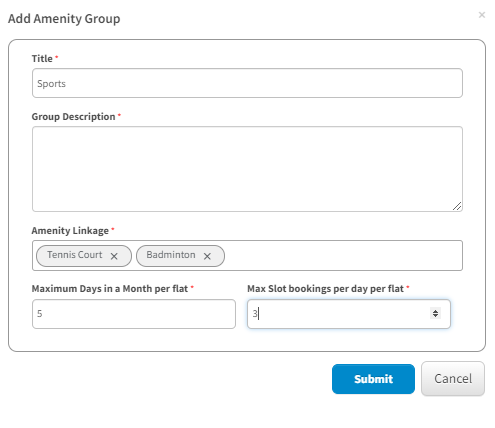
Add amenity group
Group similar amenities to discourage amenity hogging
And that’s not all, Thanks to Mygate’s intelligent grouping feature, you can group similar amenities to discourage one house from hogging multiple amenities simultaneously ensuring everyone gets a chance to experience different offerings.
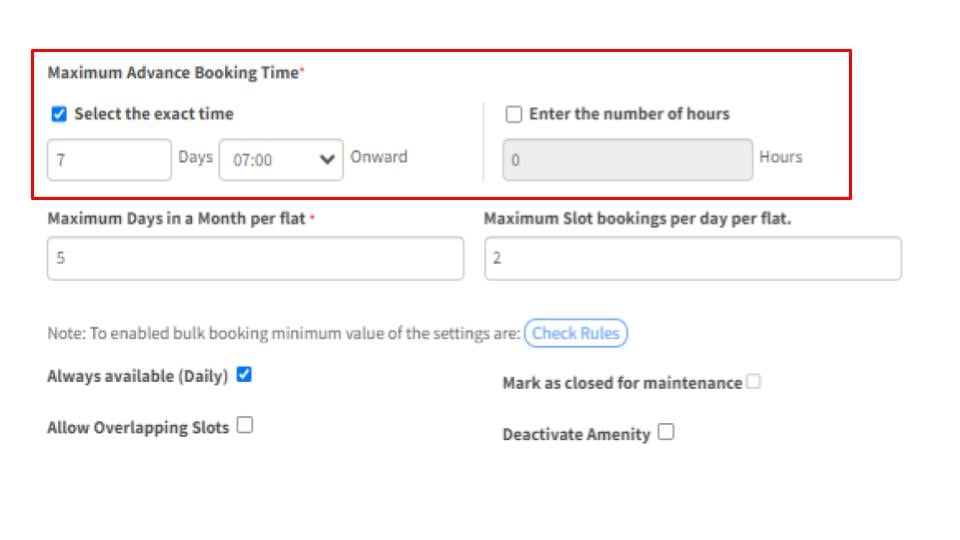
Maximum advance booking time
Set a specific time-frame for advance bookings
What’s More? Prevent unnecessary or far too advanced bookings by placing restrictions on how many days or hours in advance residents can book amenities. This will prevent undue hoarding of slots & ensure a smooth and conflict-free experience for all.
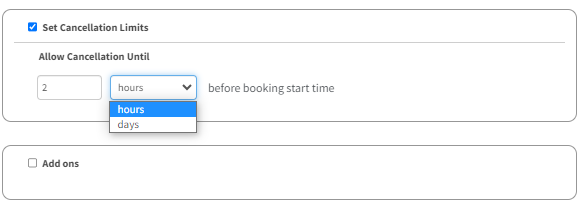
Set cancellation limits
Implement a non-cancellation period before a slot begins
There’s more good news! Enforce a stringent non-cancellation period prior to fixed slot in order to avert last-minute cancellations, ensuring residents only make reservations they intend to honor, enhancing efficiency and fairness in amenities management.
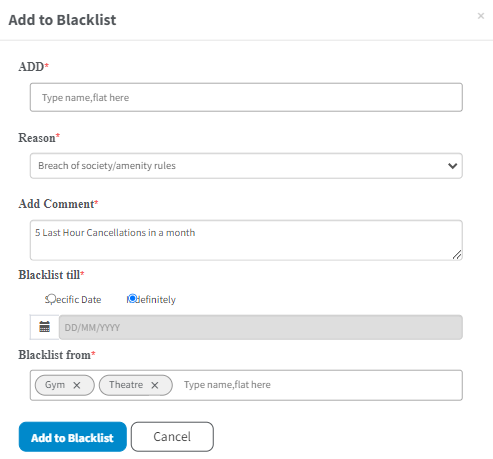
Add to blacklist
Debar residents for misuse or no-shows
But here’s the real game changer, instill accountability & block residents from future bookings as a penalty for misuse or no-shows ensuring that everyone respects the amenity booking system & utilizes the amenities responsibly.
Up-and-coming Ahmedabad has no dearth of neighbourhoods that offer housing that is both premium as well as affordable. Its ever-growing IT and corporate sectors have made it one of India’s top metropolitan cities. Its rich history and cultural importance draws tourists from India and all over the world to its magnificent sites. This makes Ahmedabad the perfect blend of old-world charm and modern conveniences, attracting the attention of homebuyers looking to build their lives in a thriving city.
If you are looking to buy or rent a home in Ahmedabad, you can choose from beautiful, bungalow-style individual houses to modern high-rise buildings with luxury amenities such as swimming pools, gyms and sports courts. You may be wondering which are the best locations to purchase property or rent. In fact, one of the key factors of being happy in your city depends on liking where you live.
Here are some of the best and posh areas in Ahmedabad to live in.
1. Thaltej
For those looking for a peaceful and quiet neighbourhood at a distance from the hustle and bustle of the main city, Thaltej is a great place to explore. Filled with trees and greenery, nature lovers will especially appreciate the tranquillity of this residential haven. Even though it is situated outside the city, its proximity to SP Ring Road and SG Highway make it easy to commute daily.
In Thaltej you will have great healthcare facilities such as CIMS Hospital and Sterling Hospital. There are malls to shop at, including Gulmohar Park Mall, Ahmedabad One Mall and Iscon Mega Mall, which have a host of entertainment options. When it comes to property options, your choices include standalone independent houses or bungalows, multi-storey apartments and even modern villas. The cost of buying in Thaltej is around Rs. 7,500 to Rs. 12,300 per a square foot.
2. Satellite City
With a host of business parks (Navratna Business Park, Parshwanath Business Park, Pinnacle Business Park), shopping malls (Ahmedabad One Mall, R3 The Mall, Grand Mall) and hospitals (Devi Hospital, Shanti Multi-Specialty Hospital, RushabhMedi-Surge Hospital PVT LTD), Satellite City guarantees you all the comforts and luxuries that city life offers.
It is a well-developed area which has many completed as well as ongoing prestigious residential projects. The cost of buying residential property in Satellite City is around Rs. 6,800 to Rs. 10,700 per a square foot.
Being well-connected to the city makes travelling from Satellite City to work or school during everyday commutes a breeze, even through longer distances.
3. SG Highway
Due to its connectivity, there has been a sharp rise in development, both commercial and residential along the SG Highway, over the last few years. An integral road in the western part of Ahmedabad, the SG Highway (Sarkhej- Gandhinagar Highway) connects south Ahmedabad’s Sarkhej and Gandhinagar, which lies in the north of Ahmedabad.
Staying along SG Highway offers many benefits. It is just 22kms distance from Sardar Vallabhai Airport – a relatively short drive at around 30 minutes.
Entertainment and shopping options are available through malls and centres such as Acropolis, Iscon Mega Mall and One Center.
There are good educational institutes if you have school-age children – JG International School, Cosmos Castle International school, Hiramani, SGVP international and Adani Vidya Mandir, among others. If you happen to work at one of the many IT or business parks it is extremely beneficial to be located close by. Business parks in and around the area include Westgate Business Bay, Pinnacle Business Park, Times Square and JB towers.
As a potential resident, you can choose from villas or bungalows or multistoried apartments in standalone buildings or complexes.
4. CG Road, Navrangpura
CG Road is one of Ahmedabad’s most exclusive and expensive neighbourhoods that is booming with commercial and residential real-estate potential. The cost of buying here is very affordable at around Rs. 3,300 to Rs. 5,000 per a square foot.
Here you will find fast food chains like Dominos, Pizza Hut, Mcdonalds and KFC, high-end restaurants like Tinello and Sale and Pepe, plus everything in between. For entertainment, there are plenty of nightclubs as well as shopping malls like One Mall, CG Square Mall and Ahmedabad Central.
Navrangpura is home to good educational institutions such as St. Joseph Convent School, Ahmedabad University and Gujarat University. There are a few major business parks located in the area – Westgate Business Bay, Navratna Business Park – which makes living here a boon if you happen to work there.
5. Jagatpur
Jagatpur is an up and coming residential neighbourhood located in the northern district of Ahmedabad that is popular for its affordable housing and convenient location to business parks such as Parshwanath Business Park and Navratna Business Park.
It is easy to commute to several key areas in Ahmedabad from Jagatpur such as Chandkheda, Devnagar, Adalaj, Khodiyar and Motera. There has been a sharp increase in interest from homebuyers in this area and many reputed developers, such as Godrej Properties, have projects here. In Jagatpur, you can find premium 2 and 3 BHK apartments in modern residential complexes, as well as flats in multi storeyed buildings and standalone houses.The cost of buying in here is around Rs. 3,900 to Rs. 5,500 per a square foot.
Healthcare options are adequate with hospitals such as Satyam Hospital, Parth Children Hospital and Lifeline Multispeciality Hospital all in the vicinity. Navratna Business Park and Parshwanath Business Park are located nearby and there are a few good malls as well, such as Ahmedabad One Mall, Iscon Mega Mall and Shreeji Mall.
6. Sindhu Bhavan Marg
Another popular residential area that is posh and modern in western Ahmedabad is Sundhu Bhavan Marg. Here you will find a wide range of good residential options as well as businesses and MNCs housed in big corporate buildings. Here you can choose to live in independent houses or villas, buy plots of land to build on or opt for the convenience of an apartment in a building or complex. There are many well-known residential projects in this area, including Shaligram Flora, Aayansh, Shreeya Antilia and Shaligram Plush.
It is located close to popular areas such as Friends Colony, Rajiv Nagar, PRL Colony, Bodakdev and Thaltej. A short distance, at just 2km away, is Ambli Road Railway Station, which can be travelled to via Nandigram Road. To reach Vastrapur Railway Station, which is 10Km away, you will need to get on to National Highway-147 from Sindhu Bhavan Marg.
If you work at one of the nearby business parks – Navratna Business Park (1Km), Mondeal Business Park (3Km) and Westgate Business Bay (9Km) – living in Sindhu Bhavan Marg makes a lot of sense. There is also good connectivity to other business areas such as Sanand (18Km) and Naroda (34Km) via the National Highway-147.
Schools in and around the area include international schools such as Ahmedabad International School, The New Tulip International School, JG International School – Ahmedabad and Cosmos Castle International School. And for shopping and recreation, you can head to Iscon Mega Mall, Gulmohar Park Mall and Ahmedabad One Mall, which are all close by (within a 5Km radius) of Sindhu Bhavan Marg.
7. Science City Road
If you are looking for a good mix of affluence and affordability, Science City Road could give you the best of both worlds. There are plenty of residentials options available for rent or sale in this area with an average cost of Rs. 5179 per a square foot. If you are looking to buy an apartment, expect to spend around Rs. 60 lakh to Rs. 6 crore for 3BHK, depending on location and size of the home. Rents for a 3BHK range between Rs. 18,000 to 68,000.
The Science City Road has good connectivity as it is close to good neighbourhoods such as Bodakdev, Thaltej and Vastrapur (IIM). There are many good hospitals (Sterling Hospital, CIMS Hospital, Sanjivani Hospital) and schools (JG International School, Shayona International School, Shanti Juniors School) within the locality so meeting healthcare and education needs should not be a problem.
City Center 2, Coral Complex Shukan and Mall Cross Road are nearby for shopping and entertainment as are also a couple of big business parks such as Pinnacle Business Park and Navratna Business Park.
8. Ambli
Ambli is an area that is expanding and growing fast in Ahmedabad. Located near Sardar Patel Ring Road, Ambli has great connectivity to many popular localities in Ahmedabad. National Highway-147 and Ambli-Bopal Road offer added connectivity.
Some popular neighbourhoods to stay in are Shilaj, Mumatpura, Bopal, Bodakdev and Vastrapur. Here you can find several residential projects to choose from, whether you are moving to rent or to buy a home. There are plots, independent houses and high-rise building apartments to choose from. Popular residential projects include Synthesis Spacelinks, Arista Lifespace, Shree Radha Krishna Group, and Saanvi Nirman Projects.
In Ambli, there are several good hospitals such as Global Hospital, Rushabh Medi Surge Hospitals Private Limited, Zydus Hospitals and SAL Hospital & Medical Institute, around a 6km to 7km distance away. Shoppers will delight in options such as Amrapali Shopping Mall, Iscon Mega Mall, Gulmohar Park Mall and Ahmedabad One Mall, which are all located nearby.
There are many reputed schools under 10km away, such as The New Tulip International School, Cosmos Castle International School, DAV International School and Lakshaya International School.
9. Prahlad Nagar
Prahlad Nagar is a posh residential-commercial area in west Ahmedabad. Prahlad Nagar has emerged as a major financial and business hub in recent years, housing some of the major corporate and business parks such as Parshwanath Business Park, Pinnacle Business Park, Safal Profitaire, Atlantis Corporate Park, and Synergy Tower, among others.
This Ahmedabad neighbourhood has excellent access to major city roads as well as the Vastrapur railway station and the Doordarshan Kendra metro station, which is currently under construction on the Blue Line metro. Some of the prominent educational institutions in the area include Zydus School, DPS, and Ahmedabad International School.
As a result, it is one of the most popular areas for corporate and business professionals to live.
10. Chandkheda
Chandkheda is a commercial-residential neighbourhood in Ahmedabad’s northwestern outskirts. It is one of the most affordable residential areas in the city, close to the Sabarmati River, with a well-planned layout and good connectivity. The residents of the area have access to excellent infrastructure.
Many well-known organisations surround this area, including Indian Oil Corporation Limited, Oil & Natural Gas Corporation (ONGC), and Gujarat Housing Board.
The major parts of the city are easily accessible from Chandkheda. The Ahmedabad Airport is 14 kilometres away, but the Ahmedabad Railway Station is only 1.5 kilometres away. Chandkheda Railway Station is the locality’s own railway station.
It is easily accessible via BRTS bus services to the Sardar Patel Ring Road and the 132 Feet Ring Road.