

Facing issues with a society amenity, or want to make a suggestion to help your society function more efficiently? Mygate’s Digital Helpdesk is the ultimate solution for it all! You can now easily raise a complaint, and easily track the progress of the resolution.
Here’s how it works
Once you’ve raised the complaint:
- The concerned team will be immediately notified.
- The Admin will assign the task to the concerned staff member.
- You will receive timely updates on the app, including the details of the assigned staff and an estimated time for resolution.
You can also add comments, attach photos or documents, and reopen a resolved complaint, anytime.
To raise a complaint
- Click on the ‘Helpdesk’ icon on the Home screen.
- Select ‘Raise Complaint’ at the bottom of the screen.
- Select the category of the complaint from the menu.
- Type it out and click on ‘Submit Complaint’. You can also attach Photos or Documents to elaborate on your issue.
To track your complaints
- Select ‘Helpdesk’ on the Home screen.
- Click on the issue raised.
Switch to the smart way of raising and tracking complaints with the Mygate helpdesk, and save yourself time and energy.
Do you often have to wait in long queues to use an amenity in your clubhouse? With Mygate Amenities’ Booking, you can now directly book slots on the app and enjoy the clubhouse amenities with zero wait time.
Benefits of Amenities’ Booking
- Book your slot directly on the app
- Use amenities without worrying about unauthorized visitors
- Get easy access to the clubhouse amenities with a 6-digit passcode
- Enjoy easy access to amenities with zero wait time
- Benefit from a fair and transparent booking mechanism
How to book an Amenity?
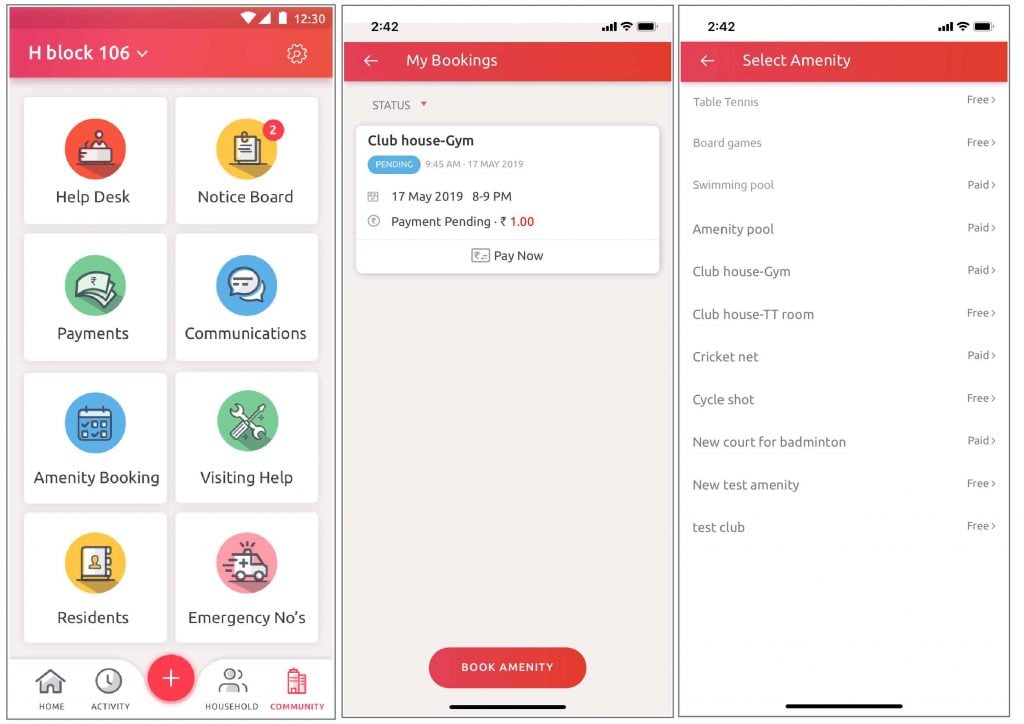
- Go to the Community tab on the Mygate app and click on Amenities. You can view your previous bookings here
- To book a new slot, click on BOOK AMENITY and select the category (paid or free)
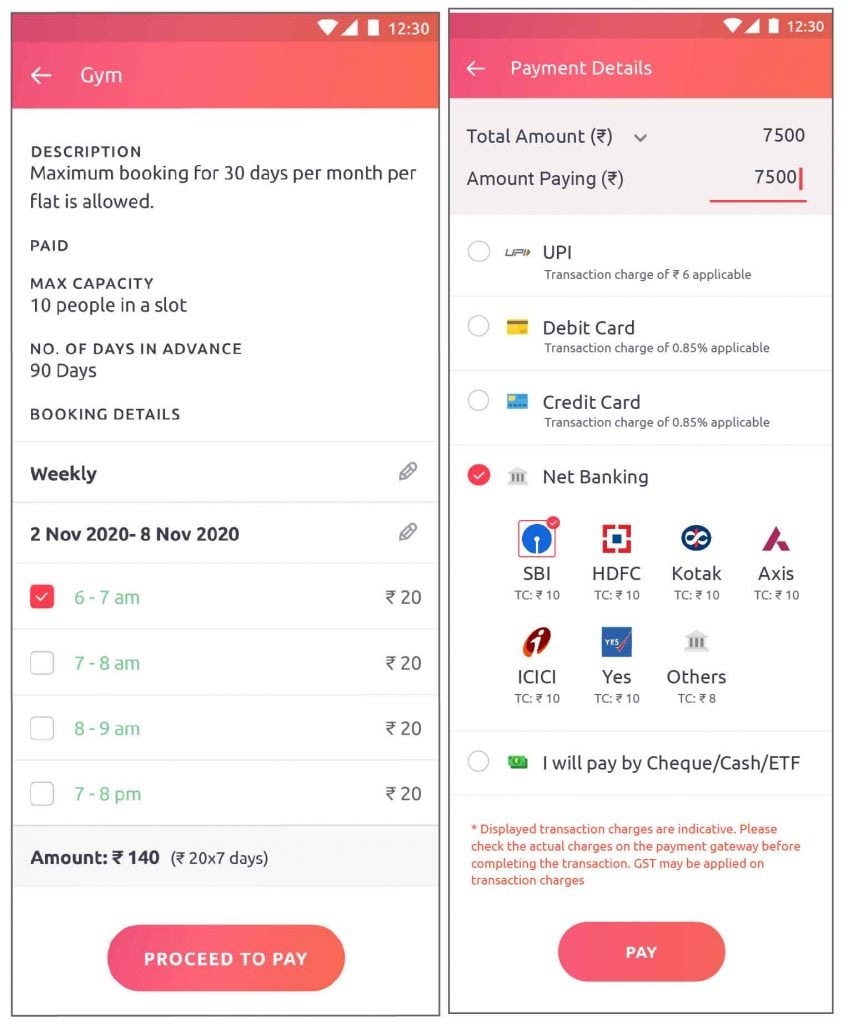
- Select the date and time slot.
- Click on PROCEED TO PAY
- Make payment using our several payment gateway options such as UPI, net banking, credit card, etc.
- Click on PAY, to confirm your slot.
What’s new?
During these unprecedented times, admins have to be even more careful in keeping the societies safe and so Mygate has made an update for residents booking their access to clubhouse amenities on the Mygate app.
- Admins can make the attachments mandatory for amenity booking
- Documents include ‘corona-free’ health certifications for residents
- Residents have to attach documents while booking an amenity
Society management can also ensure that only residents and their guests are allowed to use the clubhouse with Mygate’s Clubhouse Entry feature. It allows them to understand the utilization of the facility and provides details in case of misuse of any equipment or a dispute. The management committee also has the option of restricting any resident’s entry into the clubhouse.
Contact your management committee or Mygate relationship manager to enable Amenities’ Booking for your society today!
Keeping a record of documents, managing and procuring them is time-consuming and a hassle for both society residents and committee members. Mygate has introduced Documents management to solve this issue and make life easier for residents, house owners and management committee members.
Benefits of Documents management
- Residents can store a variety of documents such as rent agreements, identity proofs, house rent receipts, ownership records and more
- Admins can store a variety of documents such as vendor agreements, RWA minutes of meeting, society entry records and more
- Store many number of documents of any file size
- Upload documents in bulk like multiple rent receipts for multiple tenants
- Upload all standard file types such as PDFs, Xls, PNG, JPEG, CSV
- Create multiple folders for different files and update them when necessary
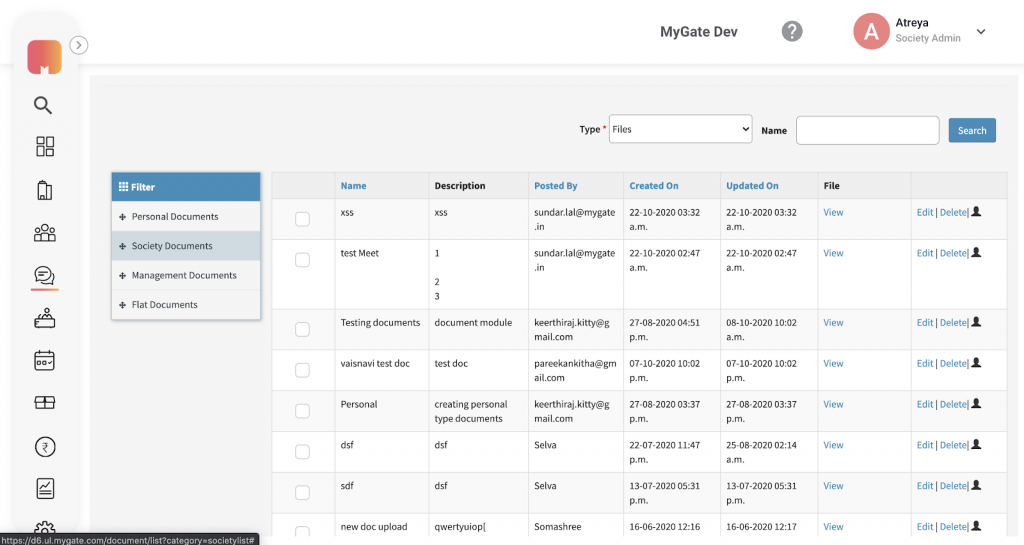
There are 4 categories of storage for different members of the community:
| Category | Document type | Who can upload/edit | Who can view |
| Society | Documents created for society wide use, such as rules, society wide documents, information to all residents, RWA minutes of meetings (can be uploaded from meetings module), etc | Management committee members /society admins & roles with communication admin permissions only | Can be configured- Tenants and owners only. Staff members cannot view these documents |
| Management | Documents created specifically for management committee use – could be vendor agreements, management committee MoMs etc | Management committee members /society admins & roles with communication admin permissions only | Only the society admins |
| Flat | Documents created specifically for tenancy agreements & management , upcoming – ownership and other flat doc uplaods | Only the members of the flat & the society admins & member with tenant management permissions | Only the residents of the flat & the society admins |
| Personal | Any personal documents that you want to keep handy | Only the particular user | Only the particular user who has uploaded the document |
You can access the document storage ‘Society Dashboard’ under Communications
Contact your management committee or Mygate relationship manager to enable Documents for your society today.
After the Yes Bank disaster in 2018, towards the last quarter of 2019, the banking sector sent tremors across the housing society landscape with the Punjab & Maharashtra Co-operative Bank Limited (PMC Bank) fiasco when senior officials committed a masked loan fraud (involving loans to HDIL) to the tune of over Rs 6000 crore. One of the many unsuspecting casualties was Mumbai’s Eden Garden Co-operative Society that saw Rs 24 lakh stuck as RBI restricted withdrawals from PMC Bank.
PMC Bank may or may not be a one rotten apple scenario but the focus is back now on the way urban/district cooperative banks are run and societies are interested in choosing a nationalized bank for heightened security of their funds.
A society, as opposed to panicking and fretting, has to be extra vigilant when choosing a bank. Again, that’s no deterrent for housing societies because where there’s caution, there’s less trouble.
What does the law mandate for housing societies?
The very inception of a housing society mandates the opening of a bank account in a district co-operative bank as per Co-operative Societies’ Acts. However, the government allows societies to open an account with a nationalized bank upon receiving approval from the Registrar of Co-operative Societies. If the society has a solid reason to open an account in a private bank, they can obtain internal consent from the committee members and residents and send an exemption application to the Registrar. A current or institutional savings account can be opened in a private bank however membership and fund deposit in a district co-operative/nationalized bank is compulsory.
According to Maharashtra state bye-laws, “A Banking Account shall be opened by the Society in the nearest State or District Central Co-op Bank / a Scheduled Bank having awarded “ A “ Audit Class in last three consecutive years, nationalized Bank, and in any other mode permitted by general or special order of the State Government, as provided under section 70 of the Act and the account shall be operated upon and all acquaintances and discharges shall be signed by the Secretary jointly with the Chairman or Treasurer.”
What should society consider while choosing the right bank?
Whether a co-operative bank or a nationalized bank, society must consider the below factors before opening a society account in a bank:
1. Security and stability
It’s imperative that you check the financial stability of a bank. To gain a macro perspective on the domestic finance landscape and the health of the banking sector, you can familiarise yourself with the RBI Financial Stability Report published annually. Key elements to research otherwise are – the lower percentage of Non-Performing Assets (unpaid loans), a higher CASA, CAR, and PCR ratio. (The Gross National Performing Assets ratio of all SCBs is projected to increase to 12.5% by March 2021). Another reliable way is to check the CRISIL ratings of a bank and whether it’s rated stable or not. CRISIL A+ is a good indicator.
2. Fees
It’s best practice for a society to shortlist 8-10 banks and compare the following bank charges:
- ATM Fees: Depending on the balance, banks allow 3-5 transactions at other banks however generally the amount charged is from Rs 5 and capped at Rs 20 per transaction (+GST). Rs 1 lakh and above deposit usually allows unlimited transactions.
- Account Maintenance Fees: Minimum balance varies per bank and type of account. There are no non-maintenance fees in co-ops for basic savings accounts.
- Online payment charges: As per RBI, NEFT and RTGS transactions are not chargeable, however, IMPS transactions can be charged from Rs 1 to Rs 25 and the maximum limit is Rs 2 lakh. NEFT transfers limits per day vary generally from Rs 50,000 (for the new beneficiary) up to Rs 5-10 lakh for the regular beneficiaries.
- Debit Card Charges: Co-op and nationalized banks charge anywhere between Rs 60 to Rs 150 to issue a debit card but reissuing may be charged at a higher rate.
Other fees to look up before choosing the right bank are overdraft fees, annual fees, and transfer fees.
3. Interest Rates
A society deposits long-term funds like Sinking Fund, Corpus Fund, Membership Funds, etc in the bank. If your fixed deposits are parked in a co-op bank for 18 months and above, the interest rate will begin anywhere from 7% to 10%. Nationalized banks may offer between 3% and 6% interest (p.a.) but are generally less risky and better managed. To avail higher interest and to ensure returns, it’s advisable to split Rs 1 lakh in two-three different co-op banks each as that’s a maximum insured amount by banks. Remember exit penalty for FDs can be between 0.5% and 1%.
4. Services
A society should also be aware of nearby branches and ATMs of the banks as location plays a critical role in the convenience of banking. Additionally, your bank should have the expertise of wealth management and sound investment options as society enters into a long-term relationship with its financial partner. Other important services to seek are 24/7 customer service, a reliable mobile application, safe deposit box service, loans, and merchant service accounts.
While uniform policies and fair banking practices are crucial qualities of an ideal bank, another great reason to trust a bank is their investment and application of modern-day technology and customer management such as online chatbots, easily navigable IVR, and helpful relationship managers.
A society must conduct thorough research through online investigation as well as seeking the word of mouth counsel before choosing the right bank.
The first cashless wave post electronic card payments first swept India post demonetization in 2016. Currently, due to the Covid pandemic, a massive transformation to a cashless economy has emerged in India. By 2020, digital payments are projected to reach $500 billion. At the end of 2019, there was a 383% growth in digital payments in India.
Cash payments are still the primary method of transaction in India in all manners and forms. However, under the Digital India initiative’s sub-program Cashless India, the government aims to make India a ‘faceless, paperless, cashless’ society by 2021. RBI’s Vision Document which hopes to create a ‘cash-lite’ society predicts that UPI/IMPS will grow by 100% by 2021 while NEFT will grow over 40%.
It makes sense for a housing society to get on board the cashless train as the ecosystem is poised to grow with possible new incentives. Already co-operative societies in villages going cashless are being rewarded Rs 25,000 by the government.
Statistics aside, the biggest advantage that a cashless economy offers is the saving of time and ultimate ease of transaction. More so during the crisis of Covid-19 as it averts virus infections, but as cashless becomes the new norm, a post-pandemic era will witness a society more at ease with technology, especially if the government makes e-payment more accessible and secure.
Why is going cashless good for a housing society?
Members of residential societies are already accustomed to writing cheques when paying huge deposit amounts or other common funds towards society’s upkeep, repair, and upgrade. This is quite a tedious task for MC members to visit the bank physically to deposit/withdraw money.
Another common but redundant practice in housing societies is to collect maintenance fees in cash month on month (especially when the amount is under Rs 2000 to Rs 3000). Not only is it time-consuming but impractical and susceptible to theft or loss. A better option of course is online banking and mobile wallet payments which medium and large residential complexes have already adopted. However, that would entail another lengthy procedure for the Secretary or the Treasurer – maintaining accounting ledgers and reconciliation (physical or Excel spreadsheet) along with constant back and forth between pending dues and reminders to pay.
In the midst of half measures like mobile wallets, the complete and wise solution would be to have a community management software with a stellar integrated feature that enables online app payments and digital record keeping. Not only would your society be truly cashless but also advanced entirely with respect to any and all financial transactions. These apps enable payment through UPI, net banking, credit card, debit card, RuPay, Diners Card, Amex, etc., and are also integrated with major payment gateways as well as international cards. They’re equipped to allow auto bank reconciliation and quick settlements to society account.
Regular service staff and domestic help can also be added as beneficiary and be paid cashlessly by the residents. Tracking advance payment, overdue payments along with auto-reminders make it convenient for MC to manage all wings and buildings effortlessly.
Pros and cons of digital payments for a housing society
Pros:
-
- No danger of loss of money
-
- No chance of robbery/theft
-
- Convenience and speed of execution for residents
-
- No frequent trips to the ATM
-
- Less possibility of financial fraud and embezzlement
-
- No chance of contracting Covid-19, other contagious bacteria and viruses
-
- No waste of time writing cheques or visiting banks
-
- Easy and reliable tracking of incoming and outgoing payments
-
- Digital trail for audit, traceability, and reviews
-
- Ease of executing small, medium, or complex transactions
-
- MC can focus on high-value tasks instead of unnecessary paper-based accounting
Cons:
-
- Lower prevalence of cashless ecosystem in certain neighborhoods
-
- Lack of knowledge and technical education
-
- Prone to hacking and online fraud
-
- Depends on WiFi networks and mobile devices, thus unavailable in case of no internet and battery
-
- Resistance from within the traditional mindsets and lack of faith in technology
With the RBI predicting a 50% increase in mobile payments by 2021, the future for a cashless society in India is already set in high gear. The real change happens from the inside. If the Managing Committee and proactive residents can promote the awareness of ongoing cashless as a best practice, slowly and surely enough traction can be generated towards going 100% digital. The MC can hold training and demonstration camps within the society to educate the residents of the multiple benefits of going cashless, which by the way is much easier now that lockdown has made it pretty much inevitable to transact digitally.
What society must invest in is a reliable and first-class society management app that’s a boon for the community and a true asset for the managing committee.
Monsoon floods displace millions in India each year and have been mounting pressure on the currently vulnerable urban infrastructure. Sure, everyone remembers the 2013 Uttarakhand Floods and 2015 Chennai floods because of the devastation they caused but urban flooding is not a rare occurrence. Just last year, rainwater entered 80% of residential homes in Patna in what was called Bihar Urban Floods. Sustainable drainage systems are inadequate in India and all we have are old and silted sewers that have not been upgraded efficiently. Most cities in India do not have enough storm drains to redirect excess rainwater. Another major reason for flooding is the population density in urban cities. The more, the merrier, the dirtier. Living in a housing society with poor sustainable drainage is a hellish experience come monsoon. People, homes, cars, common utilities, everything is threatened with one big downpour. Societies need to pay utmost attention to stormwater management since it’s the first step that can alleviate urban flooding at macro levels. Let’s explore the subject in depth.
What is stormwater
Stormwater is the water that is the result of rain, hail, snow or ice melt. Stormwater discharge originates from rooftops, streets, pavements, lawns (all impervious surfaces) and gets soaked into the soil/ground or gathers in the form of ponds, puddles, while the excess water that runs off into rivers is called stormwater run-off.
In the pre-urbanized natural landscape, stormwater run-off or discharge was not a matter of concern. But with the rise in population and pollution, uncontrolled and degraded stormwater run-off is considered nonpoint source pollution (resulting from many diffuse sources as opposed to one main source).
When stormwater seeps into the ground, it replenishes the soil, but when it runs off impervious surfaces and passes through the drain and sewers, it becomes polluted and causes more harm than benefits.
Issues with ill-stormwater management
- Urban flooding
- Damage to people, accidents, fatalities
- Destruction of residential property, assets and vehicles
- Streambank erosion
- Destruction of natural habitats
- Damage to public and private infrastructure
- Sinkhole collapse
- Pollution entrance in nearby water bodies due to bacteria, petroleum, plastic, metals and sediment
- Clogging of waterways
- Loss of fish and aquatic species
Stormwater management involves operational and technically engineered actions to control the quality and quantity of stormwater so that the above-mentioned ill effects do not occur.
Residential societies can incorporate stormwater best management practices (BMPs) which can be divided into structural (construction of devices/natural mechanisms) and non-structural (preventive measures).
Structural best practices for stormwater management
1. Infiltration techniques
Residential Infiltration methods include creating temporary catchments in the premises to capture stormwater and processing it through layers so that pollutants may be reduced, peak flow volume can be reduced and groundwater may be recharged.
2. Vegetative swale (Bioswale)
These are V-shaped narrow trenches along the road emptying into the storm drain. They have gentle slopes on both sides and can be planted with native species of plants. Stormwater flows in a more controlled way through a swale and reduces pollutants.
3. Rain garden (Bioretention)
A depressed area on the ground planted with native vegetation and perennials that collects stormwater from streets, lawns, driveway, and rooftops is called a rain garden. –
4. Porous (permeable) pavements
Stormwater can pass through porous asphalt pavements with an underlying stone aggregate layer that provides detention of stormwater run-off.
5. Reduction methods
Societies can deploy different measures so that stormwater doesn’t turn into run-off, to begin with, thus preventing any damages.
6. Green roofs
To reduce the peak run-off rate, societies can construct extensive roofs (3-6 inches of soil depth for shallow vegetation) or intensive green roofs (6-24 inches of soil depth for large vegetation. Rain gets captured and evotranspired back into the atmosphere without overloading the storm sewers.
7. Rainwater harvesting/ rain barrels
Rainwater collected through rooftops and paved pathways can be stored underground in large storage devices and later directed back to the rain garden, infiltration trenches, directly into the soil or can be reused by residents after filtration. Societies can also use cisterns and barrels for reducing stormwater run-off.
8. Sand and organic filters
These are two-chambered self-contained beds filled with sand, peat, tree branches and other organic materials (with underlying inlets and outlets) that provide filtration basins that reduce stormwater impact.
Non-structural (preventive) practices for stormwater management
Green infrastructure inspired better site design follows low impact development approaches while land planning and design. It takes into account conservation of water quality, uses natural and engineered Infiltration and Storage strategy, preventing stormwater run-off by using effectively on-site natural features. More and more builders/developers are realising the market worth of green buildings as the Indian green building market is slated to double by 2022.
Here’s what residential societies can do to contribute towards better stormwater management and reduce pollutants being released into the natural ecosystem.
- Don’t dump any kind of garbage down the storm drains and sewers.
- Make sure no oil, fluids, petrol leaks from your vehicles and spills onto the driveway or on the pavement.
- Use fewer chemicals, pesticides while gardening and use organic fertilizer instead.
- Maintain, inspect and clean your septic tanks/ sewage treatment plants at prescribed times and before the monsoon.
- Make sure your sewers, dry wells and storm drain/culverts are not obstructed by garbage, snags and tree branches.
- Replace your garden lawns with rainwater ponds, native shrubs and plant basins.
- Pick up after your pets.
- Ensure that you compost safely so that the manure doesn’t run off into the waterways.
- Grow more trees within and outside your housing societies.
- Dump your toxic garbage responsibly.
How many of these best practices are you implementing in your community? Every sustainable step taken by accountable communities can cumulatively help solve stormwater mismanagement and strengthen our cities as they grow larger each year.