

A year ago, when the pandemic hit and the world was living by the ideology of ‘stay home, stay safe’, MyGate worked tirelessly towards making societies safer. We developed Comprehensive Covid Management features to enhance the safety of gated communities during the pandemic.
Today, exactly a year later with the onset of the second wave of COVID, it’s important we do not slack. Management Committees across the country continue to use these features to keep their societies safe.
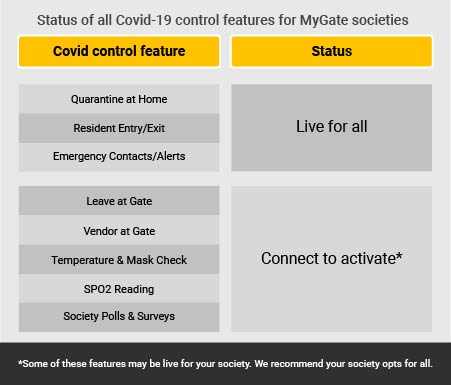
Let’s learn about these features in detail:
Temperature & Mask Checks
Security guards can conduct and capture mask and body temperature checks, using a thermal gun on the app. If either of the conditions aren’t met, the visitor is denied entry.
Quarantine at Home: Using this feature, society admins can identify and mark the flats where people are in quarantine for a specific time period. Admins can also relay the same information to the stakeholders associated with the management of these flats and limit exposure.
Leave at Gate: Leave at Gate enables societies to facilitate completely contactless, secure, and hassle-free delivery management. Residents will be able to choose to leave their delivery at the gate. All they need to do to collect their parcel is share a code with the guard.
Resident Entry/Exit Log: Using this feature, societies can restrict/record entry of visitors to aid contact tracing efforts. Admins can record logs, trace back if needed, and take proactive steps in case of an emergency.
Security Alert: If there is an emergency at home or in the society, residents can raise an alarm to their family and friends, including the ones who are not MyGate users, and the main gate security. The residents will be notified if someone is coming for help.
Society Polls & Surveys: Admins can now encourage digital decision-making. They can conduct society elections & surveys online on the app to make it easier for the residents to cast their votes and get instant feedback.
Vendor at Gate: Using this feature, societies can set up notifications for the arrival of vendors on the app. This helps society residents stay informed each time a local vendor with daily essentials arrives at the gate.
SPO2 Readings: Security guards can now capture the oxygen levels of residents, visitors, and service providers entering the society (using a pulse oximeter) on the app. The entry-exit reports can be checked and monitored by the admin for future discretion.
If your society’s basement turns into a swimming pool every monsoon, you’re not alone. Urban flooding is no longer an occasional inconvenience, it’s a recurring problem across major Indian cities. According to the National Disaster Management Authority (NDMA), while natural causes like extreme rainfall and storms play a role, most urban floods are driven by human factors such as poor drainage systems, encroachments, and lack of maintenance.
For societies, the basement is often the first space to flood. Water creeps in, damages vehicles, affects electrical systems, and weakens the structural integrity of buildings. So while the city works on large-scale flood prevention, here’s what you can do as a resident or RWA member to protect your basement from flooding.
1. Installing and maintaining a sump pump
A sump pump is your most reliable ally when it comes to basement flooding. It works by collecting water in a pit (or sump) and pumping it out through a pipe to a storm drain or soak pit. In India, especially in flood-prone zones like Mumbai, Chennai, or Gurugram, sump pumps are common in newer buildings.
Choose an automatic sump pump with a battery backup, so it keeps running even during power cuts. Regular maintenance is a must—clean the pit, remove debris, and ensure the valve and float switch aren’t jammed. You can also add a water level sensor or alarm to alert security in case water starts accumulating.
2. Choosing the right waterproofing method
If your society hasn’t waterproofed its basement, it’s time to act. One of the most widely used techniques is box-type waterproofing. This involves laying limestone slabs (often Shahabad stone), grouting, and sealing joints with integral plasticizers. It typically costs ₹25 to ₹40 per square foot and takes 7 to 15 days for proper curing.
Other options include crystalline waterproofing, which grows water-resistant crystals within the concrete, and liquid membrane waterproofing, which is applied with a brush or roller. Some societies also waterproof exterior walls to stop moisture before it enters the structure.
3. Adding a backwater valve to prevent sewage backup
One of the most dangerous forms of basement flooding happens when rainwater overwhelms city drains and causes sewage to flow backward into homes. To prevent this, a backwater valve can be installed on the basement drainage line. It automatically closes when water tries to flow the wrong way, keeping your basement free from contaminated water.
This is especially useful for older societies where the sewer system isn’t separated from stormwater lines.
4. Keeping your drainage system clean and functional
Flooding often starts with something as simple as a blocked drain. Make it a routine to clean roof gutters, stormwater outlets, and basement floor drains at least twice a year—ideally before and after the monsoon. Ensure downspouts and drainpipes are not clogged with dry leaves or waste.
Also, check where your basement drains lead. Some are connected to the sewer system, while others might link to a sump pit. Either way, regular maintenance is the best preventive step.
5. Redirecting rainwater through harvesting and landscaping
Rainwater harvesting not just recharges groundwater but also helps prevent flooding. By redirecting rooftop runoff to soak pits or recharge wells, you reduce water pressure around the building foundation.
In your society premises, you can also design swales or rain gardens. These shallow, landscaped depressions help absorb rainwater and reduce surface runoff. You can connect the roof or terrace downspouts directly to them, or extend the piping away from the basement to these collection zones.
6. Creating gentle slopes and adding flood barriers
Many societies retrofit their parking areas and basement entries with flood prevention features. This can include small ramps or flood humps that create a barrier at the entry point. These can deflect rainwater or reduce the volume that enters.
Additionally, check that the surrounding landscape gently slopes away from the building so water naturally drains outward.
7. Taking preventive steps to protect your car
Cars parked in flooded basements often suffer long-term damage. One basic way to reduce this is by disconnecting the battery and elevating the car on a jack if water starts seeping in. Cover the vehicle with a tarpaulin sheet to prevent water from reaching the engine and interiors.
If your society regularly faces this issue, consider adding parking platforms or raised concrete pads. Some societies have also installed wheel ramps with a central flood hump to protect multiple vehicles.
8. Inspecting and repairing weak spots before the rains
Don’t wait for water to enter your basement to look for cracks and leaks. Before the monsoon, get a structural inspection done. Look out for cracks, mold, damp spots, peeling paint, rusted steel, and signs of water seepage on walls and floors.
It’s best to have a professional conduct this inspection so you don’t miss weak points like the rooftop, building corners, or pipe junctions. Catching and repairing these early reduces the chance of structural damage later.
9. Understanding your insurance coverage
Most homeowners and RWAs in India are not aware that standard property insurance often doesn’t cover flood damage unless specifically added. Make sure your personal home insurance includes flood or water damage clauses.
RWAs can also purchase society-level building insurance that includes basement areas, electrical panels, and common amenities. This can make a big difference in post-flood recovery costs.
10.Knowing when to call the professionals
If your basement does get flooded, especially with water mixed with sewage, don’t attempt to clean it yourself. Such water may contain pathogens, bacteria, and chemical residue. Instead, alert your municipal water department or call a licensed flood restoration contractor.
Also, ensure that the electricity to the flooded area is switched off before anyone enters.
Your quick checklist to stay flood-ready
-
Install and test sump pumps with battery backup
-
Clean drains, spouts, and floor traps before every monsoon
-
Waterproof basement floors and walls
-
Add a backwater valve to prevent sewage backup
-
Build gentle slopes and flood humps at basement entry points
-
Create rain gardens or recharge pits for excess rainwater
-
Check and repair structural damage early
-
Raise parked vehicles or install flood barriers
-
Confirm insurance covers flood-related damage
-
Avoid entering flooded areas and always call professionals
In these chaotic times, it has become vital to adopt all the necessary steps to combat the threat of COVID-19 early on. MyGate recognises the need to keep the virus at bay, which is why we have introduced comprehensive COVID management features including temperature and mask checks at gate, containment zone identification, security alert and much more.
In an effort to make your society safer during this pandemic, one of our key initiatives has been to integrate the Aarogya Setu App with the guard device.
How does the integration work?
We have integrated the Aarogya Setu app on the guard device so that security personnel can assess the risk of letting in a visitor. Any visitor or service provider can share their status with a simple QR code scan of the Aarogya Setu app using the guard device – low, moderate, high or COVID-19 positive.
How does this help?
This integration is aimed at helping societies reopen their society gates to visitors cautiously, as the pandemic rages on across the country. Societies with a large number of residents can better monitor the movement at the gate, identify asymptomatic carriers entering the society and attend to any security breaches.
Aarogya Setu integration is now live in all MyGate societies.
*MyGate cannot capture the location or travel history of the visitor with this scan.
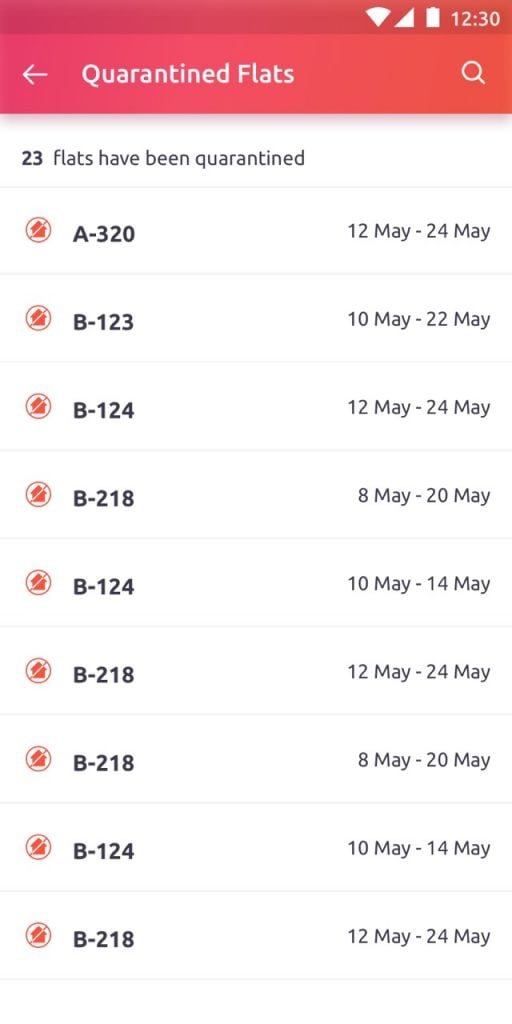
The number of people who are quarantined in their homes is increasing. In the case of housing societies, the guards have no clear mechanism to access this information and act accordingly. This is why Mygate has built the Quarantine at Home feature under Comprehensive Covid Management for Communities.
Here’s how societies will benefit from this feature:
- Committee members can easily identify, mark, and manage the flats where residents are in quarantine for a specific time period.
- Committee members can relay this information to guards and concerned residents via guard app and resident app respectively.
- Residents in quarantine are notified when a flat is marked on the admin dashboard.
- Guards can see this information on the guard app (flats are marked in yellow) when they are creating an entry.
Let’s understand the changes we have introduced across our systems. Since every society has its own set of regulations around quarantine implementation, we have not altered the visitor and service provider access flow.
Admin dashboard
Here’s how Admins can mark a flat in quarantine for a specific time period.
Manage Society > Manage Flats > Select Flat > Mark Flat as Quarantine
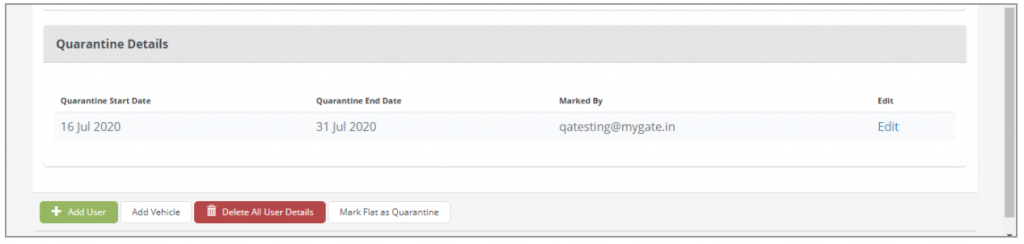
Fill in the flat details, add the reason/emergency contact, and quarantine start and end dates. Admins can choose the start and end dates as per their SOP.

Next, admins can filter flats based on “Quarantine Status”
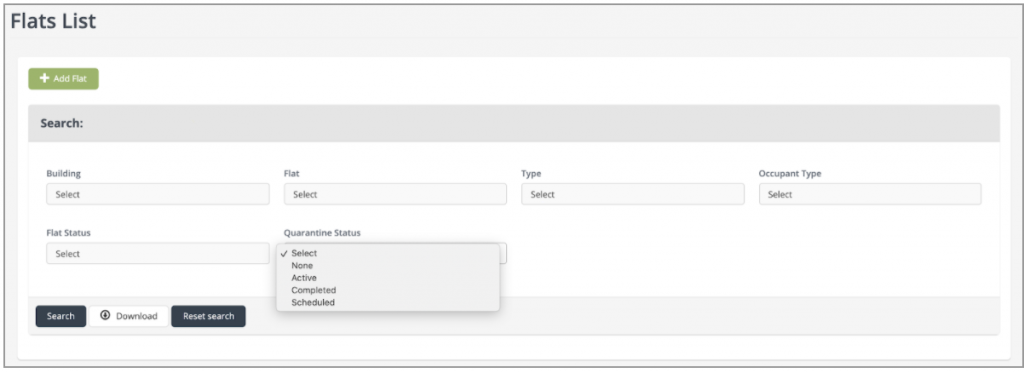
Residents who are in quarantine can also reach out to the nearest hospital, ambulance services, pharmacy, main gate security, or any committee member, using the Emergency Numbers provided on the Mygate app.
Resident app
- Residents will receive a notification and an activity card will be created as per the following changes:
- A flat is marked as a quarantined flat:
Notification: “Your flat has been quarantined” - The quarantine period of a flat is modified:
Notification: “Your Quarantine period has been changed” - The quarantine period of flat ends:
Notification: “Your Quarantine period has ended”
- A flat is marked as a quarantined flat:
- Residents can know if their house-help is working or has worked in a quarantined flat.
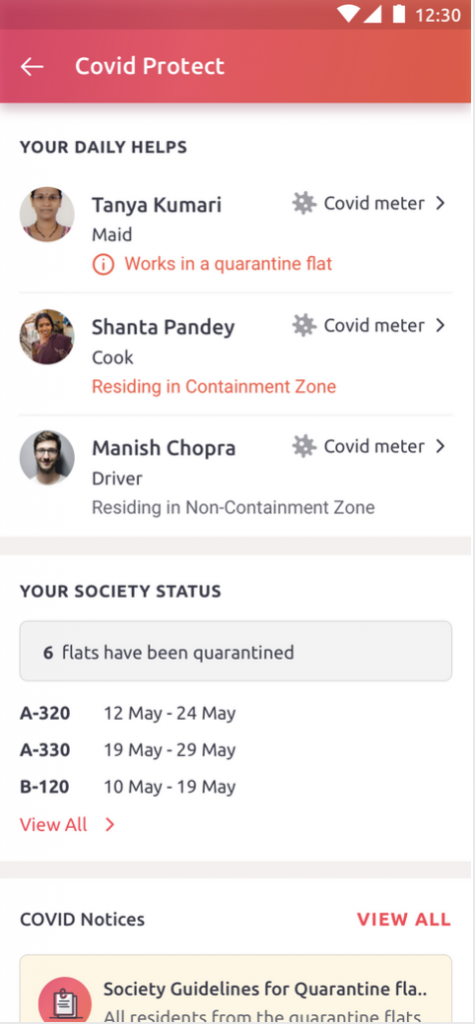
- Residents will have a list of quarantined flats handy on the app.
Guard app
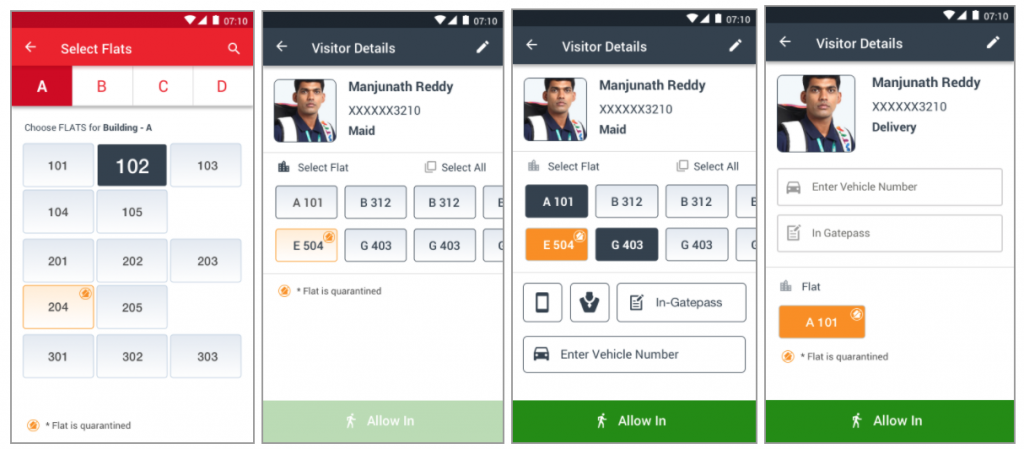
This feature is Live across all Mygate societies. For any concerns, the Management Committee can reach out to their respective Mygate representatives and if you are a resident, please contact your Management Committee.
National Updates
Quarantine relaxations for international travellers
- Travellers to India with a COVID negative report no older than 96 hours may skip institutional quarantine, and instead quarantine at home for 14 days
- Exemption may also be granted in special cases, for compelling reasons, such as the death in the family, serious illness, pregnancy or if parents are travelling with children under the age of 10.
- Source: Ministry of Health & Family Welfare
Unlock 3.0
- Yoga institutes and gymnasiums are permitted, starting August 5, 2020
- Independence Day functions permitted, with social distancing in place and wearing of masks
- Removal of night curfew
- Lockdown to remain in force in containment zones until August 31, 2020
- Social gatherings remain prohibited, with marriage related gatherings capped at 50 persons and funerals at 20 persons
- Source: Ministry of Home Affairs
Important numbers in your city
| National Helplines | |
| WhatApp | 9013151515 |
| Emergencies | 112 |
| Ministry of Health & Family Welfare | 1075 or 011-23978046 |
| City Helplines | |
| Andhra Pradesh | 0866-2410978 |
| Delhi | 011-22307145 |
| Gujarat | 104 |
| Haryana | 8558893911 |
| Karnataka | 104 |
| Kerala | 0471-2552056 |
| Maharashtra | 020-26127394 |
| Punjab | 104 |
| Rajasthan | 0141-2225624 |
| Tamil Nadu | 044-29510500 |
| Telangana | 104 |
| Uttar Pradesh | 18001805145 |
| West Bengal | 033-23412600 |
Got a leaky faucet and don’t know a good plumber? Looking for a carpenter for some urgent woodwork? If your community is on Mygate then there’s no reason to worry about.
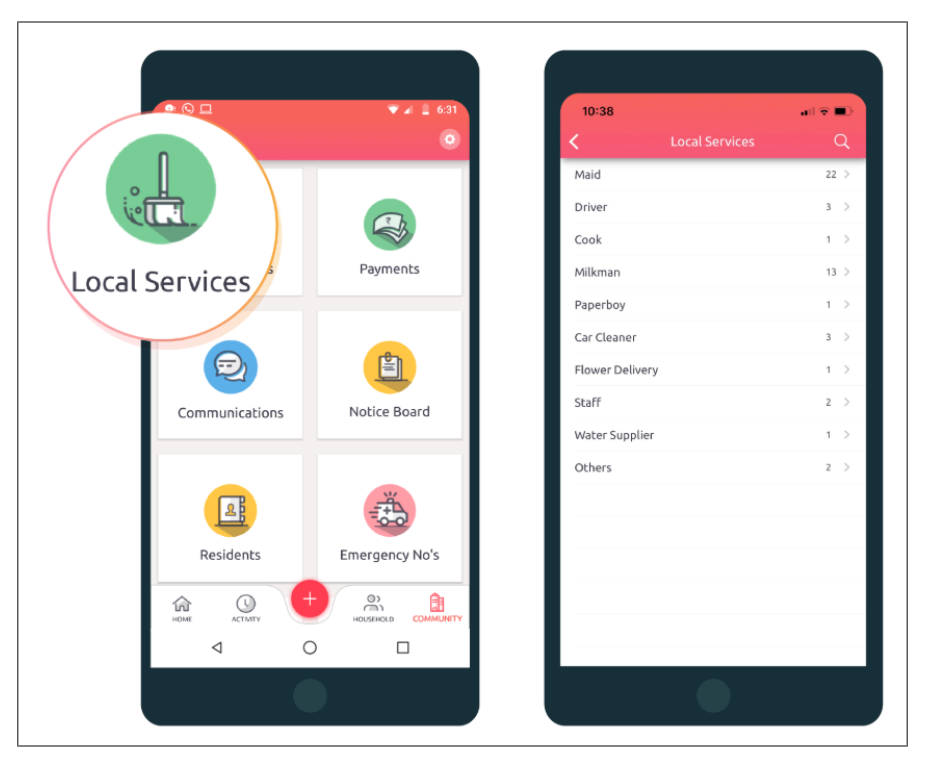
The Local Services feature on the Mygate app helps you find the right service provider nearby such as maid, cook, plumber, carpenter, driver, milkman and more, without any hassle. You can also get a separate list of who among them are inside the community at any given time using the ‘Inside’ filter.
Here’s how the feature helps you
- View a list of the best local services in your area
- Check individual reviews and ratings
- Choose to call them directly via the app
- Apply the ‘Inside’ filter to know who among them are inside the premises
How it works
- Open the Mygate app
- Go to the Community tab
- Click on the Local Services card
- Pick the type of service you are looking for
- Service providers who work in your community are listed
- To view who is inside the community, check the ‘INSIDE’ filter on the top right corner
- Click on the cards to view individual contact details, ratings & reviews
- You can also view if they work in other houses in your community and their available time slots
With Mygate, you never have to hustle to find the assistance you need. Not only that, it also helps you make informed decisions.
Contact your management committee or Mygate relationship manager to enable Local Services for your society today!